
The Car Accident Settlement Process: What Happens Before You Get Paid
Free Case Evals · October 5, 2026

After a crash, you may be dealing with appointments, missed shifts, a damaged vehicle, and calls from an insurance adjuster who seems ready to move faster than you can think. The car accident settlement process generally moves from medical treatment and evidence gathering to a written demand, negotiations, a release, and payment. Before you receive your share, applicable attorney fees, case expenses, medical liens, and other repayment obligations may need to be resolved.
How long does that take? A relatively straightforward claim may resolve within months, while ongoing treatment, disputed responsibility, coverage problems, or litigation can extend the process substantially. The safest way to understand your timeline is to identify what your claim still needs—not rely on a promised payment date. This guide explains those steps and the questions worth asking at each one. It provides general educational information, not legal advice; laws vary by state, and a licensed attorney can explain the rules that apply to your situation.
In This Guide
- In This Guide
- How Does the Car Accident Settlement Process Work?
- What Should You Do in the First Days After a Crash?
- Which Insurance Policies or Parties May Pay Your Claim?
- Why Do Medical Treatment and Maximum Medical Improvement Matter?
- What Evidence Do You Need for a Car Accident Settlement?
- How Do You Document Every Recoverable Loss?
- What Goes Into a Car Accident Demand Letter?
- How Do Insurance Companies Value Accident Claims?
- Which Insurance Adjuster Tactics Should You Recognize?
- How Do Settlement Offers and Counteroffers Work?
- What Happens When Settlement Talks Stall?
- What Does Signing a Settlement Release Mean?
- How Are Medical Bills and Liens Paid From a Settlement?
- What Happens Between Accepting an Offer and Receiving Your Check?
- How Long Does Each Settlement Stage Typically Take?
- Request a Free Case Evaluation Before Your Next Settlement Decision
How Does the Car Accident Settlement Process Work?
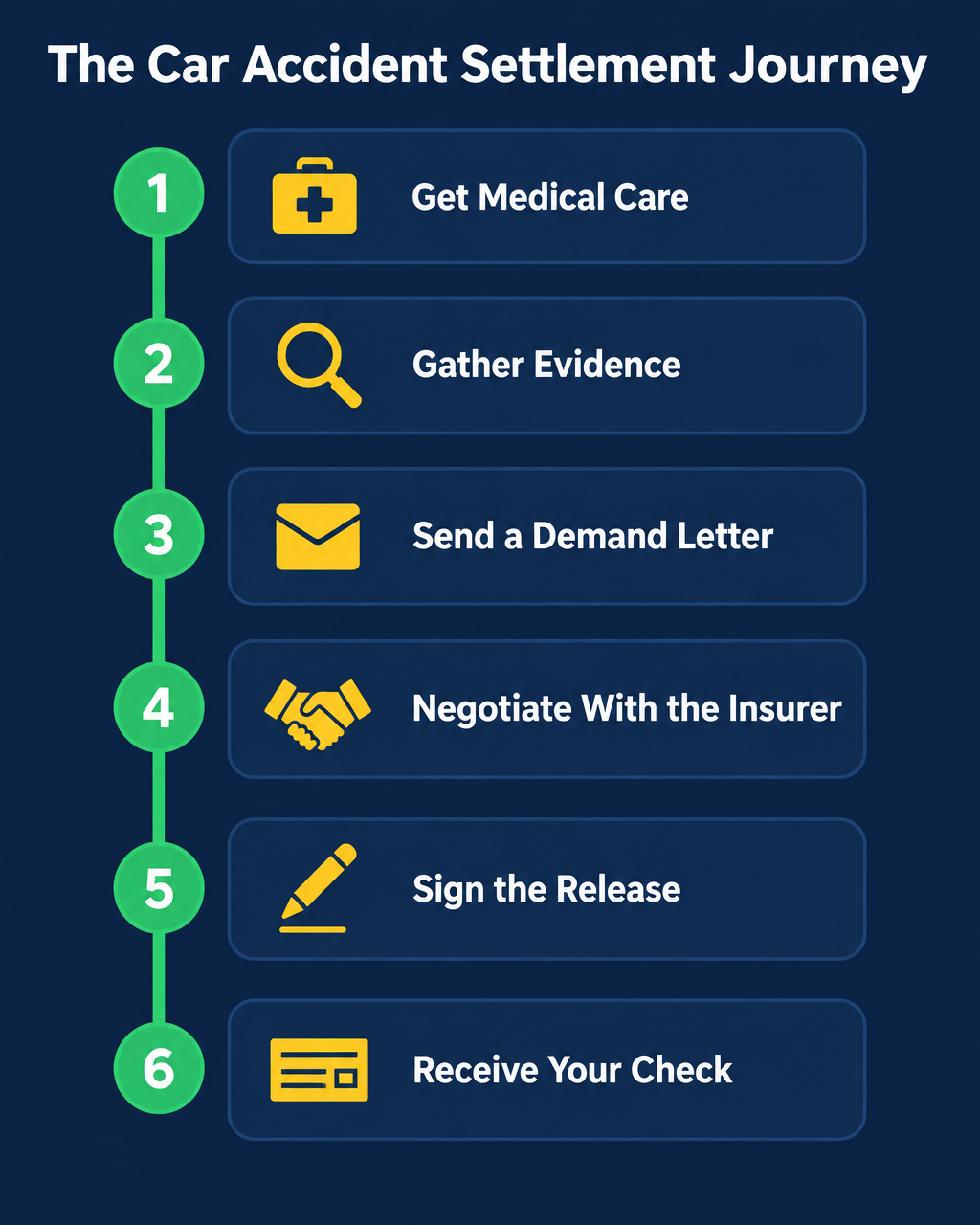
A settlement is an agreement to resolve a claim without asking a judge or jury to decide its value. Usually, an insurer pays an agreed amount in exchange for a release of specified claims against its insured and potentially other named parties. The paperwork defines the bargain, so the details matter as much as the offer.
The process is not always a straight line. You can gather evidence while receiving treatment, and your vehicle damage may be resolved before your injury claim. Negotiations can begin before a lawsuit, continue during litigation, or resume after mediation.
The basic sequence from crash to payment
Most injury claims involve these stages:
- Report the crash and open the relevant claims. Identify the insurers, claim numbers, and people handling each part.
- Obtain appropriate medical care. Follow qualified providers' recommendations and document your recovery.
- Investigate responsibility and coverage. Preserve evidence and determine who may owe compensation.
- Measure your losses. Collect bills, wage records, and support for ongoing limitations or future needs.
- Send a supported settlement demand. Explain why compensation is owed and what losses the claim includes.
- Negotiate or use formal dispute procedures. Resolve disagreements through additional documentation, mediation, arbitration where applicable, or litigation.
- Review the agreement and distribute payment. Address releases, fees, expenses, liens, and remaining balances.
You do not have to complete every step before speaking with an attorney. Early help can be useful when evidence may disappear, coverage is unclear, or an adjuster is asking you to sign something immediately.
Know which claim is being discussed
An adjuster may say your “claim” is ready to settle while referring only to your vehicle repairs. Ask whether the conversation concerns property damage, bodily injury, a first-party benefit, or all claims together.
Keep separate notes for each. Otherwise, you might mistake payment for a totaled vehicle as progress toward an injury settlement—or sign language that reaches further than intended. If you want help identifying where your claim stands, you can request a free case evaluation through Free Case Evals, which connects injured people with participating attorneys and is not a law firm.
What Should You Do in the First Days After a Crash?
Your first priorities are safety and appropriate medical attention. See a qualified medical provider for injury concerns, and follow emergency guidance when symptoms require urgent care. A settlement strategy should never determine whether you seek needed treatment.
Once immediate needs are addressed, create one place for claim information. A folder on your phone, an email label, and a simple notebook can prevent important details from becoming scattered across messages and receipts.
Start a claim contact sheet
Record the following for every insurer involved:
- The company name and claim number.
- The adjuster's name and contact information.
- The type of coverage being discussed.
- When you reported the collision.
- What documents the insurer requested and when you sent them.
- Any stated response dates or upcoming deadlines.
Report the collision to your own insurer as required by your policy, even if you believe another driver was entirely responsible. Notice requirements and cooperation duties can affect benefits under your coverage. Keep proof of submission rather than relying on a phone conversation alone.
Be accurate without guessing
When describing the collision, separate what you observed from what you assume. You can explain that you were stopped at a light and felt an impact without estimating another vehicle's speed if you did not see it approaching.
Similarly, do not declare yourself completely uninjured simply because you have not yet been evaluated. Describe what you know at the time, and update the insurer when accurate information becomes available. Avoid exaggeration, speculation, or adopting an adjuster's wording when it does not match your memory.
If your vehicle is in a tow yard, ask promptly about storage charges, inspection, and relocation. Reasonable efforts to prevent avoidable losses can matter, but moving or disposing of the vehicle may affect evidence. If fault or a vehicle defect is disputed, ask an attorney about preservation before authorizing destruction or major alterations.
Finally, do not let routine claim handling obscure legal deadlines. An insurer opening a file does not mean your right to sue is protected. A calendar reminder for an adjuster's next call is not a substitute for identifying applicable filing and notice requirements.
Which Insurance Policies or Parties May Pay Your Claim?
The driver who caused the crash is often the starting point, but not necessarily the only source of compensation. Coverage depends on the vehicles, drivers, policies, work relationships, and state rules involved. Identifying those sources early can prevent settlement discussions from focusing on an incomplete picture.
Liability coverage and potentially responsible parties
Bodily injury liability insurance generally addresses covered injuries for which the insured is legally responsible, subject to policy terms and limits. Depending on the facts and applicable law, potential responsibility may also involve a vehicle owner, an employer, another driver, or a party responsible for a dangerous vehicle condition.
Say a driver hits you while making deliveries for work. The personal auto policy may not be the entire coverage story. Employment status, the purpose of the trip, and commercial insurance could require investigation. None of those facts automatically creates coverage, but they are worth asking about.
Multiple injured people can complicate matters because they may be seeking payment from the same available limits. A policy's available coverage is also different from what your losses may be worth.
Benefits under your own policy
Depending on your state and policy, you may have access to:
- Personal injury protection, or PIP: Often pays certain accident-related expenses without first establishing another driver's fault, subject to the governing rules.
- Medical payments coverage: May help with covered medical expenses regardless of fault, within policy limits.
- Uninsured motorist coverage: May apply when a legally responsible driver lacks applicable insurance or in certain hit-and-run situations.
- Underinsured motorist coverage: May provide an additional potential source when the responsible driver's coverage is insufficient, depending on policy and state requirements.
- Collision coverage: May help resolve vehicle damage while responsibility remains disputed.
In no-fault systems, injury claims against another driver may also be subject to a threshold. First-party benefits can have their own deadlines and documentation requirements.
Before settling with another driver's insurer, ask whether doing so could affect a claim under your own policy. Some uninsured or underinsured motorist claims involve consent, notice, or preservation requirements. For additional context, see When the Driver Who Hit You Has No Insurance.
Why Do Medical Treatment and Maximum Medical Improvement Matter?
It is difficult to evaluate an injury settlement when nobody yet knows how your recovery will unfold. Early records may describe immediate complaints, while later records explain whether you returned to regular activities, need additional care, or have lasting limitations.
That is why treatment progress often controls the pace of negotiations. Waiting for a clearer medical picture is different from doing nothing. During that time, you can preserve evidence, organize expenses, and investigate coverage.
What maximum medical improvement means
Maximum medical improvement, often called MMI, generally describes a point at which your condition has stabilized and substantial additional improvement is not expected with further treatment. The terminology and its significance can vary by context. A qualified medical provider—not an adjuster—should address your medical status and prognosis.
MMI does not necessarily mean you are symptom-free or will never need care again. You may still need maintenance treatment, follow-up visits, or assistance with lasting restrictions. Those future needs can be relevant to settlement when supported by appropriate medical evidence and recoverable under state law.
Reaching MMI is not a universal legal requirement for settling a car accident claim. However, settling before your prognosis is reasonably understood can leave you responsible for later expenses that the release prevents you from pursuing.
Make the medical record useful by being specific
Tell your provider how the injury affects ordinary tasks. “My back hurts” gives less functional information than explaining that sitting through your normal commute has become difficult. Be honest about improvements, setbacks, previous symptoms, and activities you can still perform.
If you miss an appointment, document why and discuss next steps with the provider. Transportation problems, unavailable appointments, or insurance authorization delays can explain gaps that might otherwise look like a lack of need for treatment.
Do not continue unnecessary care to increase a claim, and do not stop recommended care merely because an adjuster wants to close the file. Ask your provider about your health needs and an attorney about the claim implications.
Legal deadlines continue while you recover. If treatment will extend near a filing deadline, an attorney may need to preserve your claim before the medical picture is complete. Waiting for MMI does not automatically extend the time to bring a lawsuit.
What Evidence Do You Need for a Car Accident Settlement?
A persuasive claim needs more than proof that a crash happened. It should connect the collision to another party's responsibility, connect the collision to your injuries, and support the losses you are asking to recover.
Think of evidence as answering specific questions. Where were the vehicles? Who had the right of way? What changed physically afterward? Which expenses and missed work resulted from those changes?
Preserve evidence that may disappear
Useful collision evidence can include:
- Photos of vehicle positions, impact points, road markings, and visible damage.
- Dashcam footage or nearby business and residential video.
- Witness names and reliable contact information.
- The crash report and any available supplements.
- Messages or other relevant communications about the collision.
- Vehicle inspection records or electronic data, when relevant and obtainable.
Some video systems overwrite footage quickly. A business may not voluntarily release a recording to you, and a preservation request is not the same as obtaining it. An attorney can evaluate whether formal steps are needed to seek evidence before it is lost.
Save original files when possible. A cropped screenshot may omit timing information or context that matters later. Do not edit images to make damage appear more severe.
Understand what a police report can and cannot prove
A crash report is often a useful investigative starting point, not a final decision on civil liability. Officers may not witness the collision, and reports can contain incomplete statements or factual mistakes. Their admissibility and weight also vary.
If you see an error, ask the reporting agency about its correction or supplemental statement procedure. Preserve supporting documentation. An insurer can still investigate responsibility even when a citation was issued.
Create a medical and employment timeline
List the crash date, first evaluation, subsequent appointments, work absences, restrictions, and major changes in symptoms or function. This helps reveal missing records before a demand is sent.
For example, a wage statement may show unpaid time, but a provider's restriction may explain why that time was missed. Together, they are stronger than either document alone. Keep sensitive records secure, and share them only through appropriate channels with the people who need them for the claim.
How Do You Document Every Recoverable Loss?
A settlement demand should reflect supported losses, not just the bills that happen to be in your mailbox. The categories available depend on state law, fault rules, insurance coverage, and the facts of your injury.
A useful approach is to maintain a loss ledger. Give each expense or loss its own entry, with the date, purpose, amount actually documented, payment status, and supporting record. This reduces omissions and helps prevent accidental double counting.
Medical expenses and related costs
Collect itemized bills and relevant treatment records separately. A bill shows a charge; a record helps explain why the service was provided. Insurance explanations of benefits can show adjustments and payments, but they do not always establish the current balance owed.
Other potentially recoverable expenses may include prescribed equipment, medications, and reasonable travel costs for treatment. Keep receipts and explain their connection to the injury. Whether a particular expense is recoverable is a legal question, not something a receipt alone resolves.
For future care, obtain appropriate professional support rather than estimating from internet prices. The expected service, medical basis, likely duration, and cost foundation may all matter.
Lost income and reduced ability to earn
Employees can preserve pay stubs, attendance records, employer verification, and medical restrictions. If you used paid leave, keep records of that too; whether it supports a recoverable loss depends on applicable rules.
Self-employed people may need tax records, invoices, business calendars, canceled jobs, and records distinguishing lost revenue from lost profit. A missed project does not necessarily mean its entire contract price is a recoverable personal loss.
Future earning-capacity claims can require more detailed analysis of job duties, restrictions, and realistic work options. Do not assume a return to any job means your earning ability is unchanged.
Pain, limitations, and changes to daily life
Non-economic losses may include physical discomfort and loss of enjoyment of normal activities, where allowed. A brief, factual journal can help you remember specific changes: needing help carrying groceries, missing a usual family activity, or struggling through a shift you previously handled comfortably.
Record improvement as well as difficulty. Credibility comes from an accurate account, not dramatic language. Avoid putting a monetary value on every difficult day; focus on documenting the experience that supports the claim.
What Goes Into a Car Accident Demand Letter?
A demand letter presents the claim in a form an insurer can evaluate. It is more than a request for payment: it explains responsibility, describes the injury and recovery, identifies recoverable losses, and attaches supporting evidence.
A demand is often prepared when the medical outlook and financial losses are sufficiently clear. There can be reasons to proceed earlier, such as coverage limitations or strategic considerations, but that decision requires care when future treatment remains uncertain.
The core parts of a demand package
A well-organized package commonly includes:
- The claim identification: Parties, collision date, insurer, and claim number.
- A factual account: How the collision happened and why the insured is considered responsible.
- Liability support: Relevant photos, witness information, reports, or other evidence.
- The medical narrative: Treatment course, restrictions, recovery status, and supported future needs.
- A damages explanation: Medical costs, income loss, other expenses, and non-economic harm.
- A settlement request: The proposed terms and instructions for responding.
- Organized attachments: Records that substantiate the statements in the letter.
More pages do not automatically make a stronger demand. Clear organization helps the reviewer find the evidence behind each loss instead of searching through unrelated documents.
Check for gaps before sending
Make sure the records cover all relevant providers and dates. Hospital billing may be separate from physician, imaging, or other professional charges. Missing one source can understate costs or lead to an avoidable request for more information.
Also distinguish billed charges, payments, adjustments, and balances. States differ on how medical expenses are measured and what evidence may be used. Simply adding every number appearing on every document can produce a misleading total.
A demand response date does not necessarily create a legal duty to accept or pay by that date. Special rules may apply to certain policy-limit demands or settlement opportunities, making attorney review particularly valuable.
Keep delivery confirmation and a complete copy of everything submitted. If the insurer later says it lacked a record, you should be able to identify exactly what it received. A clean submission history also helps separate genuine missing-information requests from repeated requests for material already provided.
How Do Insurance Companies Value Accident Claims?
There is no universal calculator that determines a fair car accident settlement. Insurers generally evaluate legal responsibility, the connection between the crash and the claimed harm, the evidence supporting damages, available coverage, and the risks of further dispute.
The adjuster may use internal evaluation tools, but those tools do not replace state law or the individual facts. An offer is a negotiation position, not an official ruling on what your experience was worth.
Liability and shared responsibility
Under comparative negligence rules, an injured person's own share of responsibility can reduce recovery. Some states also bar recovery when that share reaches a particular threshold. A smaller number use contributory negligence rules that can bar recovery based on qualifying fault by the injured person, subject to applicable exceptions.
Because the rules differ, the same factual disagreement can have very different consequences across states. If an insurer assigns you fault, ask what evidence supports that conclusion rather than treating the allocation as settled.
Medical causation and the extent of injury
Insurers often examine how soon you sought care, whether complaints remained consistent, and whether records support the restrictions claimed. They may also consider prior injuries or symptoms.
A preexisting condition does not automatically eliminate a claim for crash-related aggravation. However, distinguishing your earlier baseline from new or worsened limitations can require careful medical documentation. Be truthful with your providers and attorney about prior treatment; surprises usually make evaluation harder.
Vehicle damage can be relevant, but it does not independently decide whether someone was injured. Likewise, an expensive repair bill does not establish the amount of bodily injury damages.
Coverage and litigation risk
An insurer may assess the strength of witnesses, unresolved factual disputes, likely expert testimony, and the cost and uncertainty of litigation. Those considerations can influence negotiation without changing what actually happened to you.
Policy limits may restrict what a particular insurer can pay under a policy, while other coverage or legally responsible parties may warrant investigation. Available insurance, total damages, and your likely net recovery are three different questions.
Be cautious about online formulas that multiply medical bills to produce a settlement estimate. They cannot reliably account for fault rules, evidence quality, future losses, liens, or limited coverage. A useful evaluation should explain its assumptions rather than present a precise answer unsupported by the record.
Which Insurance Adjuster Tactics Should You Recognize?
An adjuster's job includes investigating the claim and protecting the insurer's financial interests. Many requests are routine, and not every disagreement signals misconduct. Still, recognizing common pressure points helps you respond thoughtfully rather than react out of fear or frustration.
A quick offer before your recovery is clear
An early offer may provide welcome relief when bills are arriving. The concern is not speed by itself; it is whether you understand the losses and rights included in the bargain.
Before accepting, ask whether the payment requires a full injury release, what future expenses remain uncertain, and whether repayment claims will reduce what you keep. Financial pressure is real, but a closed injury claim generally cannot be reopened simply because recovery becomes more expensive than expected.
Recorded statements and broad authorizations
The other driver's insurer may request a recorded statement. Your obligations to that insurer can differ from duties owed to your own insurer under your policy. Ask who is requesting the statement, why it is needed, and whether it is required before proceeding; an attorney can clarify your obligations.
Similarly, a broad medical authorization may permit collection of records far beyond the crash-related treatment. Relevant prior records can legitimately matter, but the scope should be understood. Ask what providers, dates, and categories the authorization covers, and whether responsive records can be provided another way.
Repeated requests or unexplained reductions
If an adjuster says treatment was excessive or an absence from work was unsupported, ask for the specific services or dates being challenged. A written explanation gives you a concrete issue to address with records or provider clarification.
When documents are requested again, respond with the original submission date and resend securely if appropriate. Keep the exchange factual. Unsupported accusations rarely move a file forward.
Pressure framed as a final deadline
An offer may have an expiration date, but that date is different from your statute of limitations or a policy deadline. Ask what happens if the offer is not accepted and whether the deadline can be extended for review.
Do not delete relevant social media posts or other evidence. Assume public statements and activity may be examined, and avoid misleading descriptions of either your injuries or recovery. If preservation obligations are unclear, discuss them with an attorney before changing existing material.
How Do Settlement Offers and Counteroffers Work?
Negotiation usually consists of an offer, a reasoned response, and further discussion about the disputed issues. The strongest counteroffer addresses the insurer's analysis rather than merely insisting that the number feels too low.
Request a breakdown where possible. Does the insurer dispute responsibility, exclude part of the treatment, question lost wages, or disagree about lasting limitations? Different objections need different evidence.
Build a counteroffer around the actual disagreement
Suppose you missed work because a provider restricted lifting, but the insurer's review treats the absence as your personal choice. An updated employer statement describing your job duties, paired with the restriction, may address that gap.
If the issue is a missing medical record, supply it. If it is a disputed account of the collision, another copy of the same bill will not help. Organize your response around each contested point so the adjuster can reassess the file.
Keep a negotiation log with:
- Each offer and counteroffer.
- The date and person making it.
- Any conditions attached.
- The reasons given for accepting or rejecting particular losses.
- Documents still requested.
- The agreed next step and expected follow-up.
Confirm material terms in writing. A conversation about a possible resolution can create confusion if one side believes there was a final agreement and the other does not. State law can affect when an agreement becomes binding, including in some circumstances before a formal release is signed.
Compare the proposed settlement with your likely net recovery
The headline amount is not the only number that matters. Ask about fees, case expenses, medical balances, reimbursement claims, and any costs that may increase if litigation continues.
An attorney can explain the strengths, weaknesses, and alternatives, but the settlement decision ordinarily belongs to the client. You should understand both the recommendation and the uncertainty behind it.
If you are unsure whether legal help would add value at this stage, Do You Need a Lawyer After a Car Accident? discusses situations where representation may be particularly useful. You can also connect with a participating attorney for a free evaluation to discuss an offer before making a final commitment.
What Happens When Settlement Talks Stall?
A stalled claim needs a diagnosis. Waiting longer may help if the insurer is reviewing newly submitted records. It is less useful when the real obstacle is denied liability, an unresolved coverage question, or a disagreement neither side can solve through another phone call.
Ask for a written list of outstanding issues. That turns “we are still reviewing” into something you can assess and, where appropriate, escalate.
Options short of a lawsuit
Depending on the dispute, next steps may include:
- Providing targeted evidence that answers a specific objection.
- Asking for a supervisor's review.
- Seeking a written explanation of a coverage decision.
- Proposing mediation with a neutral third party.
- Using an applicable policy dispute procedure.
- Contacting the state insurance regulator about claim-handling concerns.
Mediation generally helps parties explore a voluntary agreement; a mediator does not impose a result. Arbitration differs and may result in a binding decision depending on the agreement and governing rules.
A regulator may review insurer conduct, but a complaint ordinarily does not replace a lawsuit, decide every valuation dispute, or pause filing deadlines. Claims against your own insurer can also involve legal duties and remedies different from those involving another driver's insurer.
When litigation becomes part of the process
Filing a lawsuit does not necessarily mean your case will go to trial. It may preserve the claim and allow formal discovery, including document requests, depositions, and expert analysis. Settlement discussions can continue as that evidence develops.
Litigation also introduces costs, scheduling demands, and uncertainty. Ask what filing would accomplish, which questions discovery could answer, and what expenses may be incurred. A recommendation to sue should connect to the actual obstacle in your case.
The statute of limitations sets a deadline for starting certain legal claims, while government-related claims and other situations may involve separate notice requirements. An open insurance file or ongoing negotiations generally should not be assumed to stop those clocks.
Review Car Accident Filing Deadlines: Protect Your Right to Seek Compensation for a fuller explanation. If a deadline may be approaching, speak promptly with a licensed attorney rather than waiting for the adjuster's next offer.
What Does Signing a Settlement Release Mean?
A release is the document that describes what you give up in exchange for settlement payment. In an injury claim, it commonly ends your ability to seek additional compensation for the released claims, even if you later discover that recovery is harder or more expensive than expected.
That makes release review a separate task from deciding whether the offer sounds acceptable. A number can be agreeable while the accompanying language creates problems.
Read the scope, not just the payment amount
Before signing, identify:
- Who is being released: The driver, owner, insurer, employer, or other parties.
- Which claims are included: Injury, property damage, other losses, or broadly described claims arising from the collision.
- Whether unknown injuries or future losses are covered.
- Any lien or indemnity obligations: Language requiring you to address reimbursement claims or protect another party against them.
- Confidentiality or other restrictions.
- Payment conditions and timing provisions.
Do not assume wording is harmless because the adjuster calls it standard. Ask an attorney to explain terms you do not understand, especially language extending to unnamed parties or obligations beyond resolving your injury claim.
Check other claims before closing this one
A release involving one driver can potentially affect claims against others, depending on its terms and state law. Settlement may also affect uninsured or underinsured motorist benefits if required notices or consent procedures were not followed.
Separate property damage settlements need attention too. Confirm that a vehicle-related release does not unexpectedly resolve bodily injury claims you intend to keep open.
Settlements involving minors or certain legally protected individuals may require court approval or specific arrangements for holding funds. Wrongful death or estate-related claims can involve additional authority and allocation questions. Those circumstances often add steps beyond an ordinary adult injury settlement.
Never sign blank documents or rely on an oral assurance that contradicts the written release. Keep the final signed version and all related correspondence. If a term is changed during review, verify that the executed document actually contains the agreed change rather than an earlier draft.
How Are Medical Bills and Liens Paid From a Settlement?
The settlement amount is not necessarily the amount available for your household expenses. Some providers, insurers, or benefit programs may have a right to payment or reimbursement from the recovery. These obligations should be investigated before settlement funds are distributed.
An unpaid bill and a lien are not identical. A provider can have an outstanding balance without holding an enforceable lien against the settlement. Conversely, a benefit program may assert reimbursement rights even though you never personally received a bill for the paid care.
Common payment and reimbursement issues
Depending on your situation, the settlement may involve:
- Unpaid hospital, physician, therapy, or other treatment balances.
- Provider liens or agreements to receive payment from a recovery.
- Health insurer subrogation or reimbursement claims.
- Medicare conditional payments and applicable recovery procedures.
- Medicaid recovery rights administered under applicable rules.
- Workers' compensation reimbursement interests when the crash also involved work.
Subrogation generally concerns a payer's right to pursue recovery associated with payments it made. Reimbursement generally concerns getting repaid from money you recover. The legal basis, notice requirements, and potential defenses vary by payer, plan, and state or federal law.
Verify before paying
Request itemized balances and the basis for any asserted reimbursement right. Check whether every listed service relates to the collision, whether prior payments were credited, and whether the same charge appears twice.
A health plan's explanation of benefits may not show its final reimbursement demand. Some plans are governed by federal rules that can limit the effect of state-law protections. Government benefit claims can also require formal processes to determine the amount owed.
Some balances or reimbursement claims may be negotiable or subject to legal reductions. Others offer less flexibility. No one should promise a reduction before examining the applicable rules and documents.
Ask what remains your responsibility
Before distribution, request a clear explanation of which bills will be paid from the settlement, which are disputed, and which could remain yours afterward. If money will be held back while a lien is resolved, ask how the reserve was determined and when you will receive an update.
Do not assume a release with the auto insurer resolves your medical accounts. The insurer paying the settlement and the providers or plans seeking reimbursement are often separate participants with separate rights.
What Happens Between Accepting an Offer and Receiving Your Check?
Once terms are agreed, there is still administrative and financial work to complete. That interval can feel especially frustrating because the difficult negotiation appears to be over, yet the money is not available.
Ask for a closing checklist and identify who controls each remaining step. A delay in issuing payment is different from a delay caused by an unresolved lien or required court approval.
From signed documents to cleared funds
Depending on the case, the sequence may include:
- Final review and execution of the release.
- Delivery of tax or payment information when legitimately required.
- Insurer processing and issuance of payment.
- Receipt and endorsement of a check with the proper payees.
- Deposit into an attorney trust account, if represented.
- Confirmation that funds are collected and available for distribution.
- Payment or reservation of fees, expenses, and applicable obligations.
- Distribution of your remaining share with an accounting.
Payment may arrive within weeks in a straightforward closing, but there is no nationwide rule guaranteeing that schedule. Settlement terms, state payment requirements, missing paperwork, incorrect payee information, and approval requirements can all affect timing.
Do not make irreversible financial commitments based only on an estimated mailing date. A check being issued does not necessarily mean cleared funds are available to you that day.
Review the settlement statement
If you have an attorney, the closing statement should explain the gross recovery, attorney fees under your agreement, case expenses, payments to others, any reserves, and your net distribution. Ask whether expenses are deducted before or after the fee calculation and how the agreement addresses them.
Request clarification of unfamiliar charges before approving the accounting. Save the statement, release, payment records, and proof of resolved balances. These records can help if a provider later sends a bill that should already have been paid.
Tax treatment can depend on what a payment compensates for and other circumstances. Do not assume every component is treated identically; a qualified tax professional can address your situation.
Finally, verify unexpected payment instructions through a known contact number. Settlement-related messages can contain sensitive financial information, and a last-minute request to change bank details deserves independent confirmation rather than a quick reply.
How Long Does Each Settlement Stage Typically Take?
There is no reliable single average for the car accident settlement process that can predict your case. The useful question is how long each unfinished task may take and what would cause it to move faster or slower.
The ranges below are practical planning descriptions, not legal deadlines or promises. Several stages often overlap.
| Stage | General planning window | What commonly affects timing |
|---|---|---|
| Reporting and initial claim setup | First days to weeks | Notice, adjuster assignment, and identifying policies |
| Liability and coverage investigation | Weeks to months | Conflicting accounts, unavailable evidence, or multiple parties |
| Treatment and prognosis | Weeks to many months, sometimes longer | Medical needs, appointment access, and recovery progress |
| Collecting final records and preparing a demand | Often weeks after key information is available | Missing records, separate billing offices, and future-loss documentation |
| Demand review and negotiations | Weeks to months | Review requests, coverage questions, and disagreements about damages |
| Litigation, if needed | Many months or longer | Court schedules, discovery, experts, and motions |
| Release, lien resolution, and distribution | Often weeks, but potentially longer | Payment processing, unresolved reimbursement claims, and approvals |
Separate productive waiting from unexplained inactivity
Waiting for a provider's prognosis can serve a clear purpose. Waiting indefinitely for someone to acknowledge an email does not. At each stage, ask three questions: What are we waiting for? Who is responsible for obtaining it? When should we follow up?
You can help by signing appropriate record requests promptly, keeping contact information current, preserving receipts, and telling your attorney about new bills or insurer communications. You generally cannot speed up biological recovery or force a court to provide an earlier date.
Watch for bottlenecks near the finish line
Lien verification can begin before negotiations end, even if final figures will come later. Likewise, confirming the correct legal names and payment recipients before a check is issued can avoid reissuance delays.
If the insurer misses an agreed or legally required payment deadline, ask an attorney about the appropriate response. If the delay is an unresolved medical balance, request a status update on that specific account.
A realistic timeline includes both the negotiation and the closing. Knowing the distinction helps you plan rent, transportation, and other obligations without treating an accepted offer as money already in your bank account.
Request a Free Case Evaluation Before Your Next Settlement Decision
You do not need a perfectly organized file to ask for help. Start with the collision date and location, any claim numbers, a basic description of your treatment, and copies of offers or documents you have been asked to sign. Mention approaching deadlines, disputed responsibility, coverage denials, and outstanding medical bills early in the conversation.
A participating attorney can evaluate the information you provide, discuss state-specific issues, and explain whether additional investigation or representation may be appropriate. Useful questions include what evidence is still missing, whether other coverage should be explored, and what obligations could reduce your share of a settlement.
Free Case Evals is not a law firm. It is a free service that connects people injured in motor vehicle accidents with participating attorneys for a free case evaluation. An evaluation does not guarantee representation, compensation, or a particular result. If you choose to hire an attorney, ask about the separate representation agreement, fees, and expenses.
Before accepting an offer or signing a release you do not fully understand, request your free case evaluation. You can bring the questions you have now—even if your treatment is ongoing and the insurer has not made an offer yet.
Frequently Asked Questions
Can I change lawyers while my car accident claim is pending?
You can generally change attorneys, but your existing agreement, outstanding expenses, and potential fee claims need attention. Ask the new attorney how the file transfer and any competing fee interests would be handled before making the change.
Can a passenger pursue an injury settlement?
A passenger may have claims involving one or more responsible drivers and potentially applicable insurance benefits. If several injured people seek payment under the same policy, coverage limits and allocation issues can complicate settlement.
Does receiving a traffic ticket automatically prevent a settlement?
A ticket does not automatically decide civil responsibility or eliminate every injury claim. Its effect depends on the evidence, the outcome of any related proceedings, and the state's fault rules.
Do I have to repair my car before settling my injury claim?
Vehicle repairs and bodily injury claims are often handled separately, so completing repairs is not necessarily a prerequisite. Preserve damage evidence and check with an attorney before repairs if inspection of the vehicle may matter to a disputed claim.
What if I move to another state during my claim?
Moving does not ordinarily make the pending claim disappear, but it can complicate treatment records, communications, and participation in litigation. Update your contact information promptly and ask your attorney about any required appearances or jurisdiction-specific issues.
Can I settle a claim without hiring an attorney?
You can generally handle your own claim, but you remain responsible for understanding deadlines, evidence requirements, and release terms. Legal review can be especially useful when injuries are ongoing, responsibility is disputed, or reimbursement claims are substantial.
Will bankruptcy affect my car accident settlement?
A pending or potential injury claim may be an asset that must be disclosed in bankruptcy, even before settlement. Tell both your bankruptcy attorney and injury attorney so they can address disclosure, exemptions, authority to settle, and distribution under applicable law.
Is a settlement advance the same as receiving my settlement early?
No. Pre-settlement funding is a separate financial arrangement that can carry significant charges and reduce the money available after resolution. Have an attorney review the contract and consider other options before agreeing.
What if the insurance company handling my claim changes adjusters?
Ask for the new adjuster's contact information and written confirmation of outstanding requests, offers, and next steps. Send a concise status summary with references to previously submitted documents so a personnel change does not unnecessarily restart the review.
This article is for general informational purposes only and is not legal or medical advice. Laws vary by state. Speak with a licensed attorney about your specific situation.
Hurt in a car accident?
Answer a few quick questions to see if you may qualify for a free case evaluation. No cost, no obligation.
Start My Free Case Evaluation