
Your Truck Accident Claim Is Not Just a Bigger Car Accident Claim
Free Case Evals · October 5, 2026
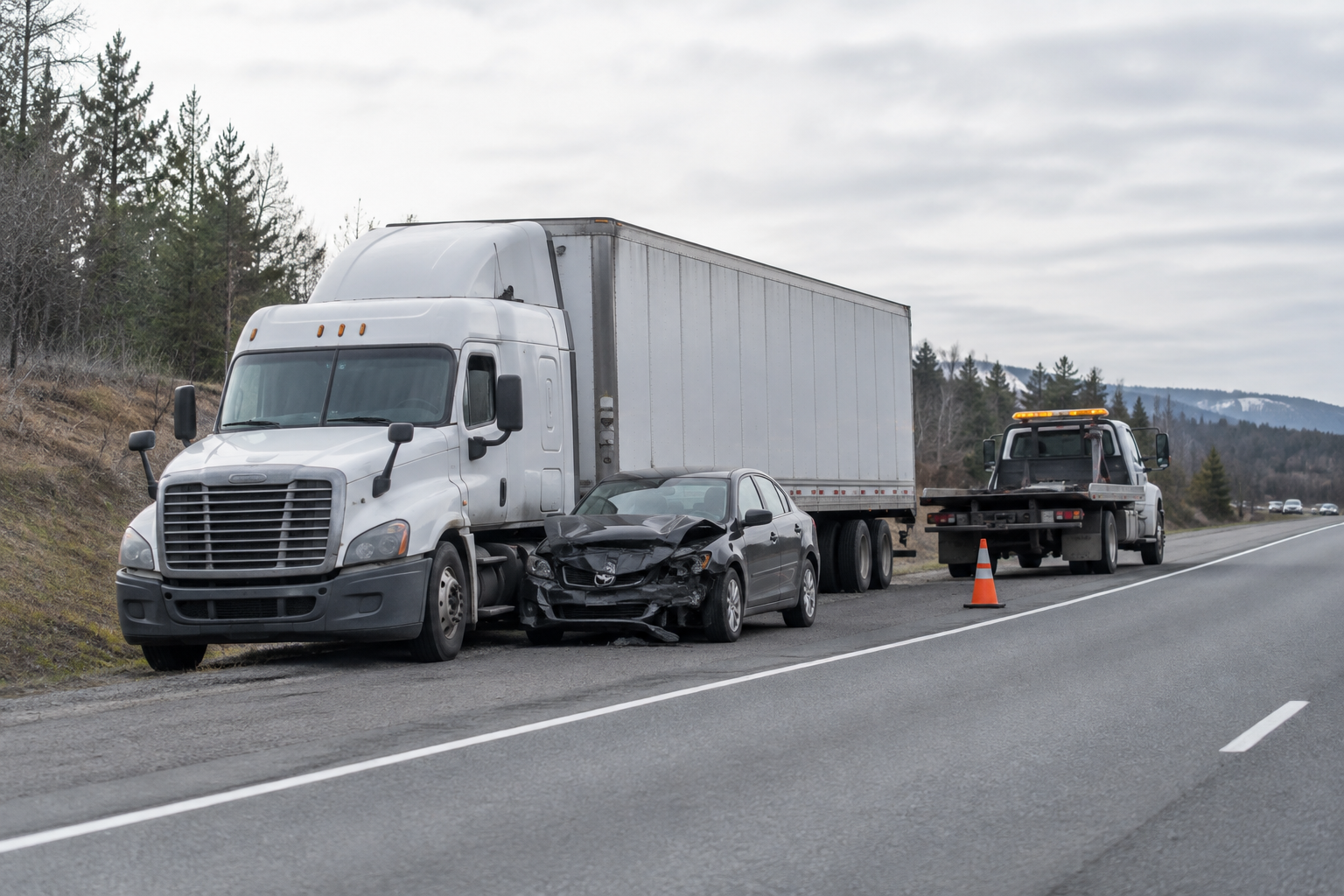
A truck accident claim differs from a typical car accident claim because several people or companies may share responsibility, commercial safety rules may apply, and valuable evidence often sits in the trucking company's systems. Commercial insurance may provide more coverage, but proving who should pay and how much you lost usually requires a broader investigation. A larger policy does not automatically mean a larger payment.
If you were hurt when a tractor-trailer changed lanes, a delivery truck struck your car, or a commercial vehicle failed to stop, you may already be hearing from more than one insurer. Meanwhile, you still have appointments to schedule, work to miss, and transportation to arrange. You do not need to understand the entire trucking industry to begin protecting your options.
This guide explains what makes these cases different and which records, questions, and decisions deserve attention. It provides general educational information, not legal advice. Laws and insurance rules vary by state, so speak with a licensed attorney about your circumstances.
In This Guide
- In This Guide
- How Does a Truck Accident Claim Differ From a Car Accident Claim?
- What Should You Do After a Commercial Truck Crash?
- Who Can Be Liable for a Truck Accident?
- When Can the Trucking Company Be Responsible?
- How Do Cargo Loaders and Manufacturers Affect Your Claim?
- Which Federal Trucking Regulations Matter?
- What Can Truck Black Box Data Prove?
- How Do You Preserve Truck Accident Evidence?
- How Does Commercial Truck Insurance Work?
- What If the Insurer Says You Caused the Crash?
- Why Can Truck Accident Claims Have Higher Value?
- How Do You Document Your Losses and Future Needs?
- How Do Trucking Insurers Evaluate and Dispute Claims?
- What Deadlines and Lawsuit Steps Should You Expect?
- How Can You Choose an Attorney for a Truck Accident Claim?
- Request a Free Truck Accident Case Evaluation
How Does a Truck Accident Claim Differ From a Car Accident Claim?
Imagine you are stopped at a light on your way to work. If another commuter rear-ends you, the investigation might focus on that driver's attention, speed, and personal auto coverage. If a commercial truck rear-ends you, those questions still matter, but they may only be the starting point.
An investigator may also need to determine who employed the driver, who controlled the delivery schedule, who maintained the brakes, and whether the load affected stopping ability. The tractor and trailer may belong to different businesses. The company name on the door may not identify every business involved in operating the truck.
More systems can mean more evidence
A typical passenger vehicle can contain useful electronic crash information. Commercial trucks may generate additional records through dispatch platforms, electronic driving logs, inspection systems, and fleet cameras. These records can help show what happened before impact, including events that a roadside photograph cannot capture.
They can also complicate the claim. Different vendors may hold different records, each with its own retention schedule. Obtaining a police report is helpful, but it rarely replaces an investigation into those sources.
Serious harm and available coverage are separate questions
The force of a collision involving a large truck can cause substantial losses. That does not mean every truck crash produces severe injuries or every claim exceeds the value of a car accident case. Compensation depends on proven harm, legal responsibility, applicable law, and collectible coverage or assets.
Likewise, a commercial logo does not establish that federal trucking rules govern the vehicle. Vehicle weight, cargo, operating area, and other facts affect which requirements apply.
Your practical starting point is to identify the vehicle, driver, carrier, and insurers without making assumptions about their relationships. Save the crash report number, photographs of identifying markings, insurance correspondence, and any business names you receive. Those details help an attorney decide where to investigate next rather than treating the case as an ordinary driver-versus-driver dispute.
What Should You Do After a Commercial Truck Crash?
Your immediate priorities are safety and appropriate medical attention. Call emergency services when needed, follow responders' instructions, and avoid standing near moving traffic or unstable cargo. Do not climb onto a trailer, approach leaking material, or attempt to retrieve evidence from a truck.
See a qualified medical provider for symptoms or concerns after the collision. Describe what happened and answer questions accurately. If symptoms appear later, seek appropriate care and explain when they began; a claim should never dictate whether you obtain treatment.
Capture identifying details when it is safe
Commercial vehicles often display information that becomes useful later. If you can safely take photographs, try to include:
- The truck's position relative to lanes, signals, and nearby vehicles.
- The tractor and trailer license plates.
- Business names and visible carrier identification numbers.
- Vehicle damage, debris, skid marks, and surrounding road conditions.
- Any detached cargo or damaged securement equipment, from a safe distance.
The tractor and trailer may separate soon after the crash. Photographing both can prevent confusion about which equipment was involved. If you cannot take pictures, ask whether a passenger or witness already did; do not put anyone at risk to obtain them.
Keep your account factual
Give responding officers accurate information, but avoid guessing about speed, distance, or the driver's work schedule. Saying you did not see something is more reliable than filling in a gap. Request witness contact details if circumstances allow, and write down your own recollection while it is fresh.
Once you are home, create a folder for the report number, insurer contacts, tow paperwork, and medical discharge instructions. Check where your vehicle was taken and whether storage charges are accumulating. Before authorizing destruction or salvage, ask whether the vehicle needs inspection as evidence.
You may have notice and cooperation duties under your own insurance policy. Review them promptly rather than assuming another insurer will handle everything. For a broader discussion of when representation can help, read Do You Need a Lawyer After a Car Accident?. A commercial truck's involvement is one reason the answer may require more than a simple property-damage assessment.
Who Can Be Liable for a Truck Accident?
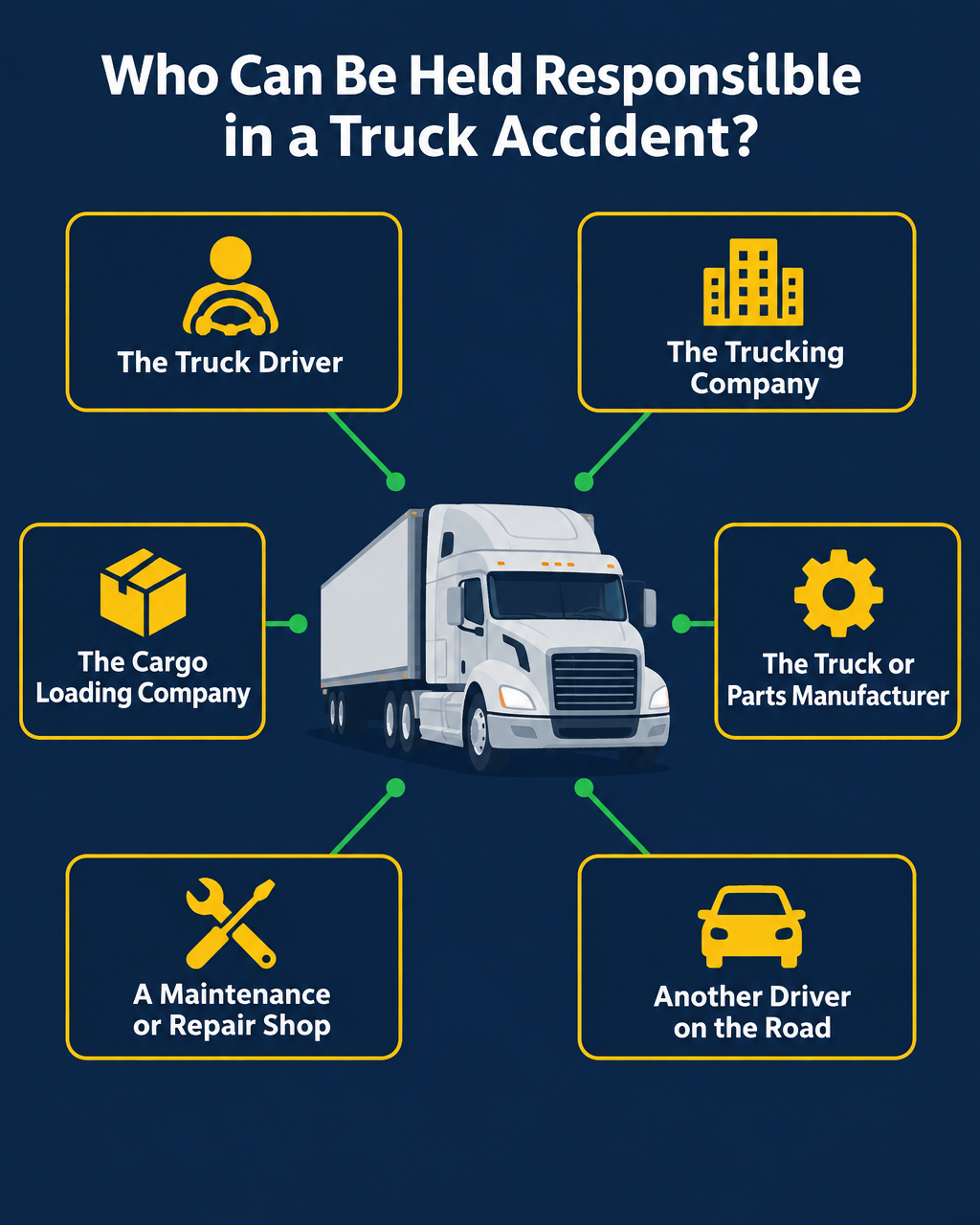
Liability means legal responsibility, not merely involvement in the shipment. A company does not owe compensation simply because its name appears somewhere in the paperwork. The investigation must connect each potential defendant to a legal duty, a wrongful act or omission, and the harm that followed.
The truck driver may be responsible for conduct such as an unsafe lane change, distracted driving, or following too closely. But a driver's mistake can exist alongside failures by other parties. Identifying those overlapping causes can be especially important when the injuries exceed one source of available coverage.
Look beyond the person behind the wheel
Depending on the facts, potentially responsible parties may include:
- The motor carrier: The business operating the truck or arranging its operation under its authority.
- An employer: A business potentially responsible for work-related driving or its own unsafe practices.
- A vehicle or trailer owner: Where ownership-related duties, maintenance decisions, or other legally relevant conduct contributed.
- A loading or shipping business: If negligent loading, packaging, or securement helped cause the crash.
- A maintenance contractor: If deficient inspection or repair contributed to a mechanical failure.
- A manufacturer or seller: When a legally actionable product defect caused or worsened the harm.
Brokers, freight forwarders, and other intermediaries may also require investigation. Claims against them involve distinct duties and sometimes federal preemption issues; arranging a shipment alone does not automatically make an intermediary liable.
Contracts do not tell the entire story
Suppose the trailer belongs to one business, the tractor is leased from another, and the driver takes assignments through a third. The contracts matter, but so do actual control, operating authority, employment facts, and applicable law.
Ask who dispatched the load, paid the driver, approved repairs, and carried insurance for the operation. Shipping documents and lease agreements can help answer those questions.
This is not about adding as many defendants as possible. Unsupported claims can consume time without improving recovery. The goal is to identify every party whose legally relevant conduct contributed, then determine which insurance or assets may respond. A focused investigation can also keep you from accepting one insurer's statement that another company is solely responsible without supporting records.
When Can the Trucking Company Be Responsible?
A trucking company's potential responsibility commonly falls into two categories: responsibility for the driver's work-related conduct and responsibility for the company's own conduct. The distinction matters because each category may require different proof.
Under a legal concept often called vicarious liability, an employer may be responsible for an employee's negligence within the scope of employment. How that applies depends on state law and the working relationship. Independent-contractor labels do not necessarily resolve every liability question, and federal motor-carrier leasing requirements may also be relevant.
Company decisions can create a separate basis for liability
An investigation may examine whether the company used reasonable hiring, supervision, training, inspection, and maintenance practices. For example, a driver might report recurring brake trouble before a truck is sent back on the road. If the problem contributed to the crash, the company's response to those reports could matter separately from the driver's conduct.
Useful records may include:
- Driver qualification and employment materials.
- Training records tied to the vehicle or assignment.
- Prior relevant complaints or safety notices.
- Dispatch communications about delivery timing.
- Maintenance requests and decisions about taking equipment out of service.
- Policies addressing distraction, fatigue, and inspections.
Not every item is automatically available or admissible. Privacy protections, discovery rules, and the specific allegations affect what can be obtained and used.
Ask what happened before the final driving error
Say a truck drifts into your lane. The insurer may describe the event as a momentary steering mistake. Dispatch messages or work records might reveal a more complete explanation, such as scheduling pressure combined with insufficient rest. That possibility must be investigated, not assumed.
The same caution applies to a driver's prior record. An earlier incident does not prove fault in your crash. It may become relevant if it shows the company had notice of a specific risk and failed to respond reasonably.
For you, the useful takeaway is to preserve information suggesting a company-level issue. If the driver mentioned a mechanical problem or a dispatcher contacted you, record what occurred accurately, including the date and contact information. Do not embellish it or approach company employees to pressure them for admissions.
How Do Cargo Loaders and Manufacturers Affect Your Claim?
Sometimes the cause of a truck crash is not visible in the driver's actions. A shifting load, failed tire, defective steering component, or incorrectly repaired brake assembly may change how the truck behaves. These possibilities introduce different parties and different kinds of proof.
Cargo-related cases often require identifying who packed, loaded, secured, inspected, and accepted the shipment. Those tasks may have been divided among several businesses. A sealed trailer can raise different questions from a load the driver could readily inspect, and the governing duties depend on the circumstances.
Loading claims depend on how the cargo contributed
Imagine a trailer becomes unstable during an ordinary turn. Investigators may consider weight distribution, cargo movement, securement devices, and whether the load matched the shipping documents. The fact that cargo spilled does not, by itself, establish who was negligent; the spill could be a result of the collision rather than its cause.
Potentially useful evidence includes loading photographs, warehouse video, scale tickets, bills of lading, packaging instructions, and records identifying the workers or companies involved. Damaged straps, chains, or other securement equipment may also need preservation.
Product and repair claims require different analysis
A manufacturer claim generally requires more than proof that a part broke. Depending on state law, the issue may involve a design defect, manufacturing defect, or inadequate warning, along with proof connecting that defect to the harm.
A maintenance claim may instead focus on whether a repair shop installed a component incorrectly or failed to address a problem it should reasonably have detected. Service history can help separate wear, misuse, defective manufacturing, and poor repair work.
Ask whether the suspected component remains available and who controls it. Destructive testing, where examination changes or consumes the item, may require advance notice and an agreed or court-ordered process so interested parties can participate.
You do not need to diagnose the mechanical failure yourself. Your role is to flag concrete information, such as a witness describing a tire failure before impact, while letting qualified investigators determine what it means. Guessing publicly about a defect can distract from stronger evidence and create an inaccurate account that later needs correction.
Which Federal Trucking Regulations Matter?
Federal Motor Carrier Safety Administration rules govern many commercial motor vehicle operations, particularly those involving interstate commerce. States also regulate commercial vehicles and may adopt similar standards for intrastate operations. Which rules apply depends on the vehicle, business operation, cargo, and any relevant exceptions.
These requirements can give investigators a framework for evaluating conduct that would not arise in an ordinary commuter crash. But a regulatory violation is not an automatic personal injury recovery. You still generally need to connect legally significant conduct to the collision and your losses.
Driver hours and duty records
Hours-of-service requirements limit driving and on-duty activity for covered drivers and require qualifying rest periods. Exceptions and different categories of operations make a one-size-fits-all calculation unreliable.
An attorney may compare electronic logs with dispatch messages, fuel purchases, location records, and delivery timestamps. The purpose is to determine whether the recorded schedule matches the actual work. A compliant log also does not conclusively establish that a driver was alert at the moment of the crash.
Qualifications, inspections, and maintenance
Other requirements address driver qualifications, inspection practices, vehicle condition, and recordkeeping. A valid license alone does not answer whether the driver was qualified for the particular assignment or whether the equipment was reasonably maintained.
A reported mechanical problem may become especially significant if records show it was left unresolved. Conversely, a missing administrative entry may have little connection to a crash caused by an unrelated event.
Cargo securement and other operating rules
Securement standards may address how particular loads must be restrained. Rules can also concern distracted driving, controlled substances and alcohol, and required testing in qualifying circumstances. Testing requirements depend on specific conditions; testing is not automatically required after every commercial vehicle collision.
Ask an attorney three practical questions: Which rules applied to this truck? What evidence suggests a violation? How did that violation contribute to the harm? Those questions keep the focus on causation rather than a list of technical shortcomings.
State law determines how a regulatory violation may be used in a civil claim, including whether a negligence-per-se theory is available. Speak with a licensed attorney rather than assuming a federal safety rule creates a separate right to compensation in every situation.
What Can Truck Black Box Data Prove?
The phrase “black box” is a convenient shorthand, not the name of one universal device. A truck may have an engine control module, an electronic control module, an event recorder, a fleet telematics system, or other electronic equipment. Each can capture different information, and some trucks retain much less than people expect.
Depending on the system and event, available data may concern vehicle speed, braking, throttle use, engine activity, or a triggered recording around a sudden change in motion. Camera systems may provide a forward-facing or other view. No single device necessarily records all those details.
Driving logs are not the same as crash data
An electronic logging device primarily helps record hours-of-service information for covered operations. It is not automatically a second-by-second crash recorder. Its records may still help establish when the driver was operating, where certain status changes occurred, and whether other documents fit the timeline.
Telematics data may reside with an outside vendor rather than inside the truck. Camera clips may be uploaded only after certain triggers, while other footage may overwrite on a rolling cycle. An investigator needs to identify the actual system before assuming what exists.
Data needs context and careful handling
Suppose a download shows braking before impact. That does not, by itself, establish that the driver reacted reasonably. Investigators may need roadway measurements, camera footage, load information, and timing analysis to understand when the danger should have been apparent.
Clock differences also matter. A dispatch server, dashboard camera, and roadside business camera may not display identical times. Experts may need to reconcile those differences before building a reliable sequence of events.
Obtaining electronic evidence often requires specialized tools, technical knowledge, and documentation of how the data was collected. Unauthorized access or an improvised download can alter evidence or create disputes over reliability.
Ask whether the attorney plans to preserve onboard data, cloud records, camera footage, and the vehicle itself. The request should fit the truck's actual equipment, not just refer vaguely to a black box. Electronic data can strengthen or challenge either side's version, which is why prompt preservation matters even before anyone knows what it will show.
How Do You Preserve Truck Accident Evidence?
Evidence preservation is separate from proving your case. First, relevant material must remain available. Only then can investigators evaluate what it establishes. Waiting for an insurer to finish its review can be risky when video overwrites, vehicles move into repair, or routine business systems delete older records.
An attorney may send preservation notices to the carrier, vehicle owners, insurers, maintenance businesses, and technology providers as appropriate. These notices identify categories of evidence that should be retained because a claim is anticipated. A notice is not a court order and does not guarantee cooperation, but it can be an important step.
Be specific about what may disappear
Depending on the collision, preservation efforts may address:
- The tractor, trailer, and relevant components before repair or disposal.
- Onboard electronic data and instructions needed to access it.
- Dashcam footage, fleet video, and associated metadata.
- Dispatch messages, driver logs, and location histories.
- Inspection reports, work orders, and maintenance communications.
- Cargo documents, loading video, and securement equipment.
Nearby businesses, traffic agencies, and other drivers may hold independent footage. Their retention practices can differ from the trucking company's, so identifying a camera early can matter even if you cannot obtain the recording yourself.
Preserve your evidence, too
Keep original photographs and videos rather than only screenshots or social media copies. Save texts, emails, receipts, and insurance letters in a backed-up folder. Record witness contact details and where each witness was positioned.
Do not delete relevant posts, messages, or other material because it seems unhelpful. Your own preservation duties may apply once litigation is reasonably anticipated. Ask an attorney about managing existing social media content rather than trying to clean up your account.
There is also a practical tension between preserving a damaged vehicle and avoiding unnecessary storage costs. An attorney can discuss an inspection plan and communicate with the relevant insurers or storage facility. Simply leaving the car indefinitely in a tow yard is not always necessary or financially sensible.
If you are unsure whether evidence is at risk, you can see if you may have a case through Free Case Evals. The service connects injured people with participating attorneys for a free evaluation; it does not itself send legal notices or investigate crashes.
How Does Commercial Truck Insurance Work?
Commercial trucking insurance often differs from personal auto insurance in both limits and structure. Certain motor carriers must meet financial responsibility requirements that depend on their operations and cargo. Available coverage may be higher than a typical personal policy, but no single limit applies to every truck on the road.
More coverage creates a possible source of payment, not an entitlement to it. The injured person still must establish covered liability and compensable losses. Coverage disputes can arise even when the facts strongly suggest someone caused the crash.
Several policies may need review
Potential sources can include a motor carrier's commercial auto policy, an owner's policy, coverage associated with a trailer, and excess or umbrella insurance. A loader, repair contractor, or manufacturer may have a separate liability policy relevant to its conduct.
These policies do not necessarily add together automatically. Policy language, insured status, exclusions, and the relationship between primary and excess coverage affect which insurer responds and in what order. Cargo insurance generally concerns damage to freight, not compensation for every person injured in a truck crash.
Ask whether all potentially applicable policies have been identified and whether any insurer is disputing coverage. Also ask whether other people injured in the same event may be making claims against a shared per-occurrence limit.
Your own coverage may help with immediate needs
Depending on your state and policy, personal injury protection, medical payments coverage, collision coverage, or uninsured/underinsured motorist coverage may be relevant. No-fault benefits can address certain losses without first resolving the truck driver's fault, while rules governing injury lawsuits vary.
Health insurance may help pay for care, subject to its terms and possible reimbursement rights. Using available benefits does not necessarily end a claim against a responsible party, but coordination matters.
Before signing a liability release, ask whether your own insurer requires notice or consent to protect an underinsured motorist claim. Related concerns are discussed in When the Driver Who Hit You Has No Insurance.
Keep declarations pages, benefit explanations, denial letters, and claim numbers. A statement that a business has insurance is less useful than knowing the actual policy, applicable period, available limits, and coverage position for your collision.
What If the Insurer Says You Caused the Crash?
Fault disputes are common in commercial truck cases because several vehicles may be involved and the collision may unfold over a large area. The insurer might argue that you cut in too closely, remained beside the trailer, stopped unexpectedly, or drove too fast for conditions.
Do not assume that argument is correct, but do not dismiss it without examining the evidence. Your lane position, signal use, speed, and opportunity to avoid the collision can affect the claim. So can the truck driver's speed, following distance, visibility, and response.
State fault rules can change the stakes
In comparative negligence systems, an injured person's share of fault can reduce compensation. Some states allow recovery despite substantial shared fault; others bar recovery when fault reaches a particular threshold. A smaller group of jurisdictions uses contributory negligence rules that can bar recovery for contributing negligence, subject to applicable exceptions.
Because these rules differ, the same disputed lane change may have different legal consequences depending on where the crash happened. Do not rely on a general online explanation to decide whether you qualify.
Objective details are better than assumptions
Photographs of impact points, lane markings, debris, sight lines, and vehicle resting positions may help test competing accounts. Electronic records and witness statements can add context. An accident reconstruction professional may be useful when speed, movement, or collision sequence is genuinely disputed.
A police report is relevant, but it is not always the final word on civil liability. The reporting officer may not have witnessed the crash, and some conclusions may rely on incomplete information. If a report contains a factual error, ask about the agency's correction process and preserve supporting documents.
Be especially careful with broad statements such as “I never saw the truck” when what you mean is that you did not see it move into your lane. Accuracy matters more than sounding certain.
Rear-end collisions can also involve disputed issues such as chain reactions or sudden lane changes. Rear-End Crash Claims: What Injured Drivers Should Know explains why impact location alone may not settle responsibility. Your truck claim should be evaluated on its particular evidence, not a rule of thumb about which vehicle struck which.
Why Can Truck Accident Claims Have Higher Value?
Truck accident claims can involve greater losses because a large vehicle's size and weight can produce severe damage and lasting disruption. A person may need extended treatment, miss substantial work, or require help with activities they previously handled alone. Those consequences, when documented and legally recoverable, can increase the amount at issue.
Higher insurance limits can make more compensation potentially collectible, but they do not create damages. A claim with limited losses does not become a high-value claim merely because a substantial commercial policy exists. Conversely, severe losses may exceed available insurance.
Compensation starts with what the crash changed
Depending on state law and the evidence, recoverable damages may include:
- Reasonable medical expenses associated with the collision.
- Supported future treatment and care costs.
- Lost earnings and reduced future earning capacity.
- Property damage and related transportation losses.
- Pain, suffering, and loss of enjoyment of life.
- Certain household-service or family-related losses where recognized.
Each category requires its own analysis. For instance, future earning capacity is not simply all wages someone hoped to earn. It may require evidence of work history, functional restrictions, realistic employment options, and the expected duration of limitations.
Serious cases can require more planning
When lasting limitations are reasonably anticipated, medical professionals and other qualified experts may assess future needs. The point is not to assemble the largest imaginable number. It is to identify needs supported by the evidence and explain how the crash caused them.
If someone died, wrongful death and estate-related claims may be available, but eligible claimants and recoverable losses vary by state. Families should seek individualized guidance rather than assume ordinary injury-claim rules apply unchanged.
Punitive damages are different from compensation for losses. They are available only in limited circumstances under applicable law, often require proof beyond ordinary negligence, and may be restricted or excluded from insurance coverage. They should not be treated as a routine part of a trucking claim.
Be wary of settlement calculators that assign a value based on vehicle type or multiply medical bills by a fixed figure. The strength of liability evidence, causation disputes, future uncertainty, coverage, and state law all influence a claim. A careful evaluation explains those factors rather than promising a result.
How Do You Document Your Losses and Future Needs?
A strong damages presentation connects each requested loss to an understandable record. You should not have to remember months of appointments, missed shifts, and out-of-pocket purchases when an insurer finally asks for documentation. Start a simple system that you can maintain even on difficult days.
Keep separate folders for medical care, work, vehicle expenses, and insurance communications. A basic spreadsheet can list the date, expense or loss, supporting document, and whether someone has already paid it. That last detail helps avoid confusion about outstanding bills and reimbursement obligations.
Medical and daily-life records
Retain bills, visit summaries, referrals, prescriptions, and explanations of benefits. A provider's charge and an insurer's payment are different records, and both may matter under applicable law. Tell your providers accurately about prior symptoms and relevant history rather than assuming older problems destroy your claim.
A preexisting condition does not necessarily prevent recovery for harm the collision caused or aggravated. It can, however, make the before-and-after evidence especially important.
Keep a brief, factual journal about daily limitations. Instead of writing only “bad day,” note that you needed help carrying groceries, missed a family activity, or could not complete your usual shift. Do not exaggerate, and assume relevant entries may later be requested in litigation.
Earnings and practical expenses
For missed income, collect pay statements, attendance records, tax documents where appropriate, and an employer's confirmation of missed work. If you are self-employed, invoices, canceled appointments, business records, and evidence of historical earnings may help distinguish gross revenue from actual income loss.
Also keep receipts for reasonable collision-related transportation and assistance. Whether a particular expense is recoverable depends on state law, necessity, and proof; saving a receipt does not guarantee reimbursement.
Explain gaps instead of hiding them
If you miss treatment because transportation fell through or you could not afford a visit, tell the provider and your attorney. Insurers may interpret unexplained gaps as evidence that the injury resolved. Honest documentation helps show what actually happened without asking anyone to rewrite medical records.
Ask treating professionals about expected recovery, restrictions, and follow-up needs. Do not request a particular prognosis to increase the claim. Reliable medical guidance protects your health and helps determine whether a settlement would account for reasonably supported future losses.
How Do Trucking Insurers Evaluate and Dispute Claims?
A trucking insurer may begin investigating quickly because commercial crashes can involve substantial exposure. It may obtain driver statements, inspect equipment, review camera footage, and retain investigators or experts. Early investigation is not proof of wrongdoing by the insurer; it means you should recognize that evidence is already being evaluated from another party's perspective.
Common disputes involve liability, whether the crash caused particular symptoms, the necessity or cost of treatment, lost income, and the support for future needs. Insurers may also disagree among themselves about which policy should respond.
Be deliberate about statements and authorizations
An opposing insurer may request a recorded statement or a broad medical authorization. Before agreeing, ask what is requested, why it is needed, and whether a narrower way of providing relevant information is available. A licensed attorney can explain the consequences in your situation.
Your obligations to your own insurer may be different because your policy can require notice and cooperation. Do not assume that declining a request from the other driver's insurer means you can ignore requests from your own.
Keep a communication log with dates, names, contact details, and the subject discussed. Confirm significant administrative information in writing when practical. If you do not know an answer, do not estimate simply to fill silence.
Evaluate offers by what they resolve
An early offer may arrive before your recovery path is clear. Ask whether the payment settles property damage only or also releases bodily injury claims. A release may cover additional parties or claims beyond what you expected, depending on its language.
A settlement normally ends the claims it releases, even if later needs prove greater than anticipated. Before signing, discuss unresolved treatment, future losses, benefit reimbursement claims, legal fees, and case expenses. The headline settlement figure is not necessarily what you will receive after deductions.
Health plans, government programs, or medical providers may assert reimbursement or lien rights. Those issues require review rather than assuming all bills disappear when the insurer pays.
Avoid treating a low first offer as either the final answer or evidence of a guaranteed larger result. A useful response identifies what the offer overlooks and supplies supporting evidence. Negotiation becomes more concrete when the disagreement is tied to records, not just competing demands.
What Deadlines and Lawsuit Steps Should You Expect?
Every truck accident claim has time-sensitive issues, but they do not all share the same deadline. The statute of limitations generally limits when a lawsuit may be filed. Separate notice requirements, insurance conditions, and procedural deadlines can arise much earlier.
The relevant period may depend on the state, claim type, injured person's circumstances, defendant, and other facts. Claims involving government vehicles or public entities may have special notice requirements. Wrongful death and product-related claims can also require separate analysis.
An open insurance claim does not necessarily protect the deadline
Do not assume that ongoing negotiations, a claim number, or an adjuster's request for more records stops the limitations period. Whether a deadline is extended or paused is a legal question. Ask an attorney to identify the actual filing and notice dates that apply to you.
Evidence can disappear well before the lawsuit deadline arrives. That is why preservation and deadline review should occur alongside medical recovery, not only after treatment concludes.
Litigation can uncover records that informal requests do not
If a lawsuit is filed, the parties may exchange documents, submit written questions, take depositions, and obtain information from third parties through authorized procedures. Corporate witnesses may be questioned about matters such as maintenance practices, dispatch systems, and record retention.
Experts may evaluate reconstruction, mechanical issues, future care, or earnings losses where needed. Courts can resolve disputes about evidence and legal issues before trial. Settlement discussions or mediation may occur at different stages, but neither guarantees resolution.
Several defendants can make scheduling and discovery more involved. Coverage disagreements and disputes over access to equipment may also affect progress. Still, complexity alone does not tell you how long your claim should take.
Ask what is delaying the next step: missing medical information, a pending inspection, incomplete coverage disclosure, or a court deadline. That question is more useful than relying on a generic timeline.
If your claim could involve workers' compensation because you were working when injured, raise that immediately. A third-party claim and workplace benefits may coexist, but coordination, reimbursement, and notice rules can affect both. You should understand those relationships before resolving either matter.
How Can You Choose an Attorney for a Truck Accident Claim?
You deserve a clear explanation of what an attorney would investigate and how the relationship would work. A consultation should help you understand your options, not pressure you into believing that every truck crash leads to a major settlement.
Ask about experience with the issues your case actually presents. A collision involving disputed electronic data may require different resources from a loading-related rollover or a straightforward delivery-vehicle crash. General personal injury experience can be relevant, but the investigation plan should match the facts.
Questions that reveal the proposed approach
Consider asking:
- Which businesses and insurance policies should be investigated first?
- Does any vehicle, component, video, or electronic record need immediate preservation?
- What facts would support or weaken liability?
- Would outside experts likely be needed, and for what purpose?
- Which deadlines or special notice rules may apply?
- Who will handle routine communication and major decisions?
- What records should I gather before the next meeting?
You can also ask how the attorney would evaluate conflicting accounts rather than assuming your version will go unchallenged. A thoughtful answer should acknowledge uncertainty and explain how evidence may resolve it.
Understand fees and expenses before hiring
Some personal injury attorneys use contingency fee arrangements, but terms vary. Ask for the written agreement and understand how fees are calculated, how litigation expenses are handled, and what obligations may exist if there is no recovery. Do not assume that every firm uses the same terms.
Discuss settlement authority and communication expectations. You should know who will explain an offer, potential deductions, and the consequences of accepting it. If a referral to another firm becomes necessary, ask how that affects your representation and fees.
Bring what you have, even if your file is incomplete: the crash date and location, report number, photographs, medical provider information, insurer letters, and any release or authorization you have been asked to sign. Make a short list of immediate problems, such as a pending vehicle disposal or an approaching benefits deadline.
You can connect with a participating attorney for a free evaluation through Free Case Evals. Free Case Evals is not a law firm and does not provide legal advice. Any decision to hire an attorney is separate from requesting the evaluation, and representation terms should be discussed directly with that attorney.
Request a Free Truck Accident Case Evaluation
If you are facing calls from several insurers or are unsure who operated the truck, an evaluation can help identify the questions that need attention first. You do not need a finished medical record, a complete list of companies, or your own theory of fault before asking for help.
Start with the information you can reliably provide: when and where the collision occurred, what vehicles were involved, whether you received treatment, and which insurers have contacted you. Mention anything time-sensitive, including a vehicle scheduled for salvage, an offer awaiting your signature, or a notice you do not understand.
A useful conversation should leave you with a clearer understanding of possible responsible parties, evidence-preservation needs, available coverage, and applicable deadlines. It should also distinguish what is already known from what requires investigation. No responsible evaluation can guarantee compensation or predict a result from the truck's size alone.
Free Case Evals is a free service that connects people injured in motor vehicle accidents with participating attorneys for a free case evaluation. It is not a law firm, does not represent you, and does not provide legal advice. Laws vary by state; a licensed attorney can assess how they apply to your situation.
When you are ready, request your free truck accident case evaluation. Bring your questions as well as your paperwork, especially the practical ones about bills, missed work, and what an insurer wants you to sign.
Frequently Asked Questions
Can I pursue a truck accident claim if I was a passenger?
A passenger may have a claim against one or more drivers or other responsible parties, depending on what caused the collision. Coverage associated with the vehicle you occupied may also matter. A licensed attorney can review the available claims and any state-specific restrictions.
Does it matter if the truck was empty when it hit me?
An empty trailer does not automatically make the claim an ordinary car accident case. The vehicle's classification, operation, ownership, and applicable insurance still require review. Whether the empty condition affected handling or braking is a factual question for the investigation.
Can I have a claim if the truck never physically touched my car?
Physical contact is not always necessary to establish negligence if a truck driver's conduct caused you to crash. Proving that sequence may require witnesses, video, or other independent evidence. Certain insurance claims involving unidentified vehicles can have additional requirements that vary by state and policy.
What if the truck driver received no traffic ticket?
The absence of a citation does not by itself defeat a civil claim. Traffic enforcement and civil liability involve different questions and procedures. Evidence obtained after the roadside investigation may still establish negligence.
Can I pursue compensation if I live in a different state from the trucking company?
Living in another state does not automatically prevent a claim. Where a lawsuit can be filed and which state's law applies depend on the collision, the parties, and jurisdictional rules. An attorney should evaluate those issues rather than assuming your home state's rules control.
What happens if the trucking company closes after the crash?
A business closure does not necessarily eliminate insurance that covered the operation at the time of the collision. However, insolvency or bankruptcy can affect procedures, available recovery, and whether litigation may proceed. Prompt legal review can help identify coverage and any special claim requirements.
Should I speak with a trucking company investigator who visits my home?
You can ask for the person's identity, employer, and purpose before deciding whether to discuss the collision. Avoid guessing, signing unfamiliar documents, or allowing access to your property without understanding the request. An attorney can advise you about communications with investigators and any separate obligations to your own insurer.
Can an injured pedestrian or cyclist bring a truck accident claim?
Yes, a person does not need to occupy a motor vehicle to potentially pursue a negligence claim against responsible parties. The investigation may focus on turning movements, visibility, crossings, and the conduct of everyone involved. Available insurance benefits and fault rules depend on state law and the circumstances.
Is a free case evaluation the same as hiring an attorney?
No. Requesting an evaluation through Free Case Evals is a way to connect with a participating attorney to discuss your circumstances. Any representation arrangement must be established separately with the attorney, including its scope, fees, and expenses.
This article is for general informational purposes only and is not legal or medical advice. Laws vary by state. Speak with a licensed attorney about your specific situation.
Hurt in a car accident?
Answer a few quick questions to see if you may qualify for a free case evaluation. No cost, no obligation.
Start My Free Case Evaluation