
Car Accident Statute of Limitations: How to Protect Your Claim Before Time Runs Out
Free Case Evals · October 5, 2026

After a crash, you may be juggling repair estimates, missed work, medical appointments, and calls from an insurance adjuster. The car accident statute of limitations is the legal deadline for filing a lawsuit, and it varies by state and by the type of claim you have. To protect your options, confirm your state's rule with a licensed attorney rather than assuming that reporting the accident or negotiating with insurance stops the clock.
Say you're stopped at a light and get rear-ended on the way to work. Your car goes to a repair shop, you see a medical provider, and the other driver's insurer opens a file. It feels as though your claim is moving forward. But that insurance file and your right to file a lawsuit run on separate tracks, and a deadline can expire while an adjuster is still requesting paperwork.
This guide provides general educational information, not legal advice. Laws vary by state, and the correct deadline depends on details that may not be obvious from the crash report. A licensed attorney can help identify the rules that apply to your situation.
In This Guide
- What Is the Car Accident Statute of Limitations?
- Why Do Car Accident Filing Deadlines Vary by State?
- When Does the Deadline Start for an Injury Claim?
- Does Vehicle Property Damage Have a Different Deadline?
- How Do Wrongful Death Filing Deadlines Work?
- Can a Government Vehicle Accident Have a Shorter Deadline?
- Do Minors or People With Legal Incapacity Get More Time?
- Can the Discovery Rule Extend a Car Accident Deadline?
- How Are Insurance Deadlines Different From Lawsuit Deadlines?
- Do Settlement Negotiations Stop the Statute of Limitations?
- What Must Happen to File a Car Accident Lawsuit on Time?
- What Happens if You Miss the Car Accident Filing Deadline?
- What Evidence Should You Preserve Before It Disappears?
- How Do You Document Losses While the Filing Clock Runs?
- What Should You Do Now to Protect Your Car Accident Claim?
- Request a Free Case Evaluation Before Time Becomes a Problem
What Is the Car Accident Statute of Limitations?
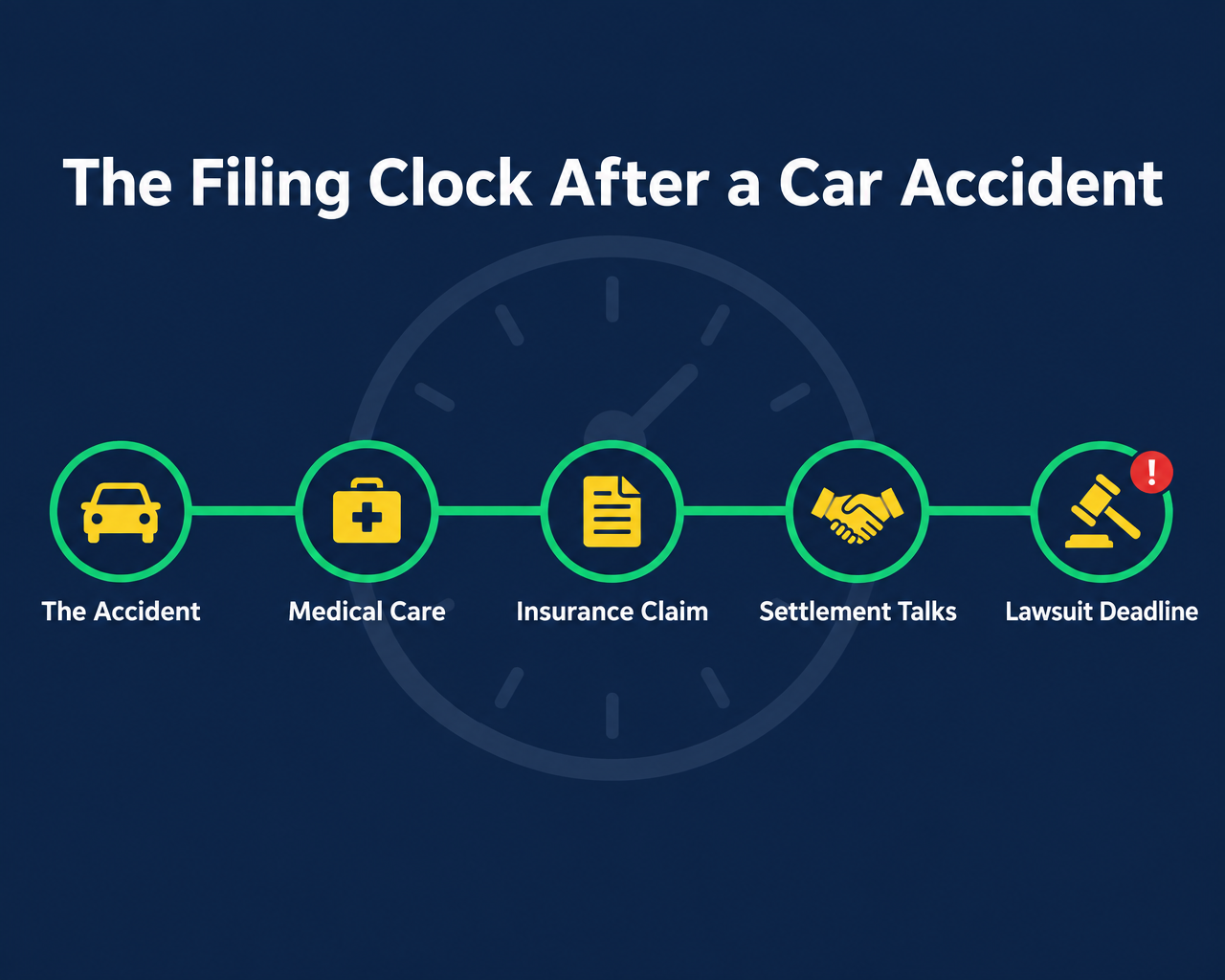
A statute of limitations sets the period during which a legal claim generally must be brought in court. In a car accident case, it limits how long you have to begin a lawsuit seeking compensation from a person or entity you believe is legally responsible. It does not tell you how long your injuries should last or how quickly an insurer must offer a settlement.
The distinction matters because everyday language blurs different actions. You might say you “filed a claim” when you called an insurance company. In that setting, filing usually means asking an insurer to investigate and pay under a policy. Filing a lawsuit means beginning a court case through the required legal procedure. One does not ordinarily substitute for the other.
Think in terms of separate clocks
After a collision, several deadlines may run at the same time:
- A deadline to bring a personal injury lawsuit.
- A different deadline for vehicle or other property damage.
- Policy requirements for notifying your own insurer or submitting benefit forms.
- Special notice requirements if a public entity may be responsible.
- Procedural deadlines that arise after a lawsuit begins.
Meeting one does not necessarily satisfy the others. A police report documents an event; it generally does not preserve every civil claim arising from it. Similarly, an insurer acknowledging your request for compensation does not mean a court deadline has been extended.
Your first practical task is to separate these categories. Start a simple document listing each potential claim, the relevant insurer or other party, and the deadline that needs confirmation. Mark uncertain dates as unconfirmed rather than treating a guess as a safe cutoff.
If you do not know which categories apply, you can request a free review of your situation. Free Case Evals is not a law firm; it connects people injured in motor vehicle accidents with participating attorneys for a free case evaluation. A licensed attorney can assess the applicable deadlines rather than relying on a general online timeline.
Why Do Car Accident Filing Deadlines Vary by State?
Each state establishes its own rules for civil claims. Those rules can distinguish personal injury from property damage, wrongful death, claims involving public agencies, and certain insurance disputes. Even when two claims come from the same crash, the applicable legal periods may be different.
The place where you live is not always the only location that matters. Suppose you live near a state border, commute across it, and collide with a delivery vehicle registered somewhere else. Determining which state's law governs may require looking at where the crash happened, where the parties are based, and where a lawsuit could properly be filed.
Why an online deadline chart may not answer your question
A general chart may describe an ordinary negligence claim against a private driver. It may not explain whether another state's limitations period can apply through a borrowing statute, whether a government notice rule is involved, or whether a claim arises under an insurance contract rather than ordinary negligence law.
Choice-of-law rules decide which jurisdiction's laws govern particular issues. Those rules can be technical, and filing in a different location does not automatically give you more time. Moving after the crash also does not simply reset the deadline.
Give an attorney the geographic facts early:
- Where the collision occurred, including the roadway and municipality.
- Where you and the other driver lived at the time.
- Whether either vehicle was used for business or government work.
- Where relevant insurance policies were issued, if known.
- Whether any potentially responsible party is located elsewhere.
Keep the crash report and policy declarations pages available, but do not delay a consultation because you lack one document. These records help identify the right questions; they do not necessarily settle them by themselves.
Ask for the deadline applicable to your particular claim, not just the usual car accident deadline in a state. Also ask whether another notice or contractual requirement arrives first. Confirming the earliest relevant date is more useful than knowing only the longest possible lawsuit period.
When Does the Deadline Start for an Injury Claim?
For an ordinary injury claim after a car crash, the accident date is often the starting point. The legal term for the point when a claim becomes enforceable is “accrual.” Accrual rules vary by state and claim type, so the starting date needs confirmation along with the length of the filing period.
Do not assume the clock waits until your treatment ends. You may still be attending appointments, missing shifts, or learning whether you can return to your usual job while the deadline continues to run. A final medical bill is not ordinarily what starts an accident-related injury claim.
What if you initially thought you were fine?
Some people leave a crash focused on getting home or arranging a tow, then notice discomfort later. See a qualified medical provider when you have concerns, and give an accurate account of when symptoms began. Medical records can help document the sequence of events, but the date of your first appointment does not automatically become the legal start date.
For general information about getting evaluated after a collision, see Whiplash After a Crash: Why Getting Checked Matters. Medical care should address your needs, not be postponed while you wait for an insurer to accept responsibility.
Create a short chronology with:
- The date and approximate time of the collision.
- When you first noticed any injury-related concerns.
- Your first medical appointment and subsequent visits.
- Work absences or changed duties connected to the crash.
- Dates you reported the injury to an insurer.
This timeline helps distinguish medical developments from legal deadlines. It also gives an attorney a clearer picture if the insurer argues that a delay in seeking care makes causation uncertain.
When treatment is ongoing, ask how a claim can be preserved without pretending your recovery is complete. Filing a lawsuit and settling a case are different decisions. Depending on the circumstances, an attorney may be able to protect the filing deadline while continuing to gather evidence about your losses. You should not feel forced to choose between ignoring the clock and signing an early release you do not understand.
Does Vehicle Property Damage Have a Different Deadline?
Damage to your vehicle may fall under a different limitations period than physical injuries. The same can be true for personal belongings damaged in the collision, such as a phone, child safety seat, or work equipment. Never assume the injury deadline also controls every property loss; confirm your state's rule for each claim.
The process can also involve different insurers. Your collision coverage may pay for covered vehicle damage subject to policy terms and a deductible. The other driver's property damage liability coverage may be another source of payment if responsibility and coverage are established. Neither route automatically resolves your injury claim.
Keep the repair file separate from the injury file
Create a property damage folder containing:
- Photographs showing the vehicle before repairs or disposal.
- Repair estimates, supplemental estimates, and final invoices.
- Tow-yard and storage notices, bills, and payment receipts.
- Rental car documents and records of other transportation expenses.
- Ownership, financing, or lease paperwork.
- Any total-loss valuation report and your supporting vehicle records.
Save written explanations when the insurer excludes an item or disputes the vehicle's condition. If you disagree with a total-loss valuation, records of trim level, mileage, options, and pre-crash condition may help you explain the disagreement. Recoverable items and valuation standards vary by state and policy.
Watch the scope of any release
A property payment may arrive well before an injury claim is ready for evaluation. Before signing, find out whether the document settles only specified property damage or releases other claims too. Labels and casual assurances are less useful than the actual language you are asked to accept.
There can also be related issues if your insurer pays first and seeks reimbursement from the responsible party through subrogation. Tell your attorney about those payments, your deductible, and any recovery notices.
A repair shop's storage charges create another practical time pressure even when the lawsuit deadline is not close. Ask promptly about inspection and storage arrangements, while preserving documentation before the vehicle changes hands. An attorney can help assess whether the vehicle itself needs to remain available as evidence, particularly when crash mechanics or a suspected defect are disputed.
How Do Wrongful Death Filing Deadlines Work?
When someone dies because of crash-related injuries, the applicable claims may be different from an ordinary personal injury case. A wrongful death claim generally concerns legally recognized losses resulting from the death. A survival claim, where available, may preserve certain claims the person had before death. State law determines who can bring each claim and what compensation may be available.
The filing periods and starting dates can differ. Depending on the state and claim, the relevant date may involve the death, the injury, or another legally defined event. Do not assume that every claim gets a fresh filing period when a person dies.
The person handling insurance may not be authorized to sue
A spouse, adult child, or other relative may communicate with an adjuster without being the person legally entitled to bring the case. Some claims require action by a personal representative of an estate. Others are brought by specified survivors. Resolving that authority can take preparation, making early review useful even while the family is grieving.
Useful records may include:
- The crash report and available insurance correspondence.
- The death certificate and relevant medical records.
- Any estate appointment documents already obtained.
- Employment, earnings, and household support records.
- Funeral and burial invoices and proof of payment.
- Information about surviving family members and dependents.
You do not need to assemble every record before asking for help. Start with what you have and identify who is currently communicating with insurers. Having a central contact can reduce confusion without deciding who has legal authority.
Government involvement, an injured minor's death, or a death occurring after an extended period of treatment can add further deadline questions. Those issues should be evaluated together rather than through separate assumptions about each exception.
Ask an attorney to identify every potentially available claim, who must bring it, and the deadline for each. Also ask how estate administration affects the necessary steps. A pending estate matter or ongoing insurance conversation should not be treated as assurance that the accident-related filing periods are protected.
Can a Government Vehicle Accident Have a Shorter Deadline?
Potentially, yes. A crash involving a public bus, municipal work truck, or another government vehicle may trigger special rules. A claim involving alleged unsafe road design or maintenance can raise similar issues even if the other driver was a private individual.
Governments may have immunity from certain claims, and permission to sue can depend on complying with specific procedures. A formal notice of claim may be required before a lawsuit. That notice can be due substantially sooner than the ordinary filing deadline for a claim against a private driver. Requirements vary by jurisdiction and by the government entity involved.
An ordinary report may not count as legal notice
Calling the agency, telling the vehicle's driver, or having police investigate does not necessarily satisfy a formal claim requirement. The notice may need particular information, delivery to a designated recipient, and a specified method of service. Federal, state, and local entities can use different processes.
As soon as government involvement seems possible, preserve:
- Photographs of vehicle markings, license plates, and unit numbers.
- The driver's stated employer and any supervisor's contact details.
- The agency name shown on incident paperwork.
- The exact road location and nearby landmarks.
- Letters or emails from a government claims office.
- Any forms provided by an agency or its claims administrator.
A government-looking vehicle is not always owned or operated by a public entity. It could belong to a contractor, and responsibility might involve one or both. Conversely, an unmarked vehicle could be used for government work. An attorney can investigate identity and employment rather than relying on appearance.
Ask specifically: “Is there a pre-suit notice requirement, who must receive it, and is there also an administrative process or waiting period?” Those questions are more precise than asking only when you have to sue.
If you have already sent something, keep a complete copy with delivery confirmation. Do not assume a partially completed form or a message to the wrong office protects the claim. Prompt legal review can determine whether additional action is needed and whether any legally available cure or exception applies.
Do Minors or People With Legal Incapacity Get More Time?
Some states pause, or “toll,” certain limitations periods when an injured person is a minor. Some also recognize tolling for a legally defined incapacity. These protections vary, may contain limits, and do not necessarily apply to every claim or notice requirement arising from the crash.
Being overwhelmed, hospitalized, or unable to manage daily tasks does not automatically establish legal incapacity for deadline purposes. The relevant standard can be much narrower than the ordinary meaning of being unable to handle paperwork. An attorney needs the circumstances and supporting records to evaluate it.
A child's claim and a parent's claim may be separate
Suppose your child is injured while riding in your car. State law may treat the child's injury claim differently from a parent's claim for certain expenses or related losses. An extension protecting the child's claim may not protect the parent's separate claim.
Government notice requirements can also have their own rules for children. Insurance policy conditions may require attention long before the child reaches adulthood. Waiting without advice can therefore put some rights at risk even where an injury limitations period is tolled.
Ask a licensed attorney:
- Which claims belong to the child and which belong to a parent or another party?
- Does tolling apply to each relevant filing period?
- Are there government, insurance, or other notice requirements that still run?
- Who has authority to bring the claim or approve a settlement?
- Would a court need to review a proposed settlement involving the child?
Preserve the child's records now, not years later. School attendance records, appointment history, activity restrictions documented by appropriate providers, and a parent's lost-work records may become harder to obtain over time.
If legal incapacity may be involved, keep documentation showing when it began, its nature, and any guardianship or representative appointment. Those facts may matter to both timing and authority to act.
Even a valid extension does not stop evidence from disappearing. The practical value of early investigation remains the same: witnesses are easier to locate, records are more accessible, and potential coverage can be identified before administrative confusion grows.
Can the Discovery Rule Extend a Car Accident Deadline?
The discovery rule can delay accrual of some claims until a person discovers, or reasonably should have discovered, legally relevant facts about an injury and its cause. Whether it applies to a car accident claim depends on state law and the specific circumstances. It is not a general promise of extra time whenever a diagnosis arrives later.
In many collisions, the event and the possibility of injury are apparent immediately. Learning later that the injury is more serious than you initially believed may not restart the clock. Similarly, receiving a larger medical bill or discovering that recovery will take longer does not automatically create a new starting date.
What facts should you bring to an attorney?
Rather than deciding for yourself that the discovery rule applies, document:
- What you knew immediately after the collision.
- When you first noticed a possible injury or other loss.
- What medical providers or other professionals told you and when.
- When you learned of a possible connection to the collision.
- What steps you took to investigate the problem.
Keep records contemporaneous where possible. Appointment summaries, dated messages, and earlier insurance statements can help establish what was known at particular times. Avoid rewriting your history to fit what you later learned; an accurate sequence is more useful.
Other exceptions need individual review
Depending on the state, issues such as fraudulent concealment, a defendant's absence, or another recognized legal circumstance may affect timing. These doctrines often have narrow requirements and may interact with other rules. A defendant moving away, for example, does not universally stop the limitations clock.
Some claims can also face a statute of repose, an outside limit measured from a specified event rather than discovery. That issue may arise when a collision involves an allegedly defective vehicle component or another claim beyond ordinary driver negligence. Repose rules, where applicable, may restrict otherwise available extensions.
The safest approach is to work from the earliest plausible deadline until an attorney confirms otherwise. An exception is a legal issue to investigate, not a cushion to build into your personal calendar. If time may already be short, tell the attorney that at the beginning of the conversation.
How Are Insurance Deadlines Different From Lawsuit Deadlines?
An insurance policy can require notice, forms, supporting records, or other action separately from the statute of limitations. State insurance laws may impose additional rules. Meeting the lawsuit deadline does not necessarily preserve every insurance benefit, and timely insurance notice does not necessarily preserve a lawsuit.
Several types of coverage may matter after a crash:
- Liability coverage: The responsible driver's policy may pay covered injury or property claims, subject to limits and defenses.
- Personal injury protection, or PIP: In no-fault systems and other settings where available, this may pay specified benefits without requiring you first to prove another driver's fault.
- Medical payments coverage: This may help with covered medical expenses under the policy's terms.
- Uninsured or underinsured motorist coverage: This may apply when a responsible driver has no coverage or insufficient coverage.
- Collision coverage: This may address damage to your own vehicle under your policy.
Which coverage applies, and in what order, depends on state law and policy language. No-fault/PIP rules can also affect when an injury lawsuit is available, but “no-fault” does not mean there are no deadlines.
Ask for the actual policy requirements
Request the policy and applicable endorsements rather than relying only on an insurance card. Ask the insurer to identify required forms and time limits in writing. Save when you sent documents and any confirmation of receipt.
Uninsured and underinsured motorist claims deserve particular attention. There may be requirements involving notice, arbitration, consent to settle with another party, or preservation of the insurer's recovery rights. Settling with a driver without checking these conditions can create problems for a separate coverage claim. For more context, read When the Driver Who Hit You Has No Insurance.
If an insurer says you reported too late, request the explanation and relevant policy language in writing. Whether late notice defeats coverage can depend on the applicable law and facts; it should not be assumed either way.
Bring all coverage letters to an attorney, including reservations of rights and denials. Those documents may reveal a deadline or coverage dispute that would not appear in the crash report.
Do Settlement Negotiations Stop the Statute of Limitations?
Generally, ongoing settlement discussions do not stop the car accident statute of limitations. An adjuster can continue reviewing records, asking questions, or considering a demand while the filing period runs. Neither a friendly conversation nor a statement that the file remains open should be treated as an extension.
Imagine you send your bills and wage records, then the insurer asks for another medical record. You provide it and wait. The adjuster changes, and the new person requests time to review the file. That sequence may be an ordinary part of claims handling, but it does not ordinarily alter your deadline to sue.
A demand letter is not a lawsuit
A demand letter explains the claim and asks for payment. It can be useful in settlement discussions, but sending it generally does not commence a court case. An attorney's involvement alone also does not mean a lawsuit has been filed.
Keep a negotiation log with:
- The date of each substantive conversation.
- The name and contact information of the person involved.
- What records were requested or submitted.
- Any offer and the conditions attached to it.
- Any statement concerning deadlines or extensions.
If someone says you have additional time, preserve the exact written communication and have an attorney evaluate it. A written tolling agreement may pause or modify timing in some circumstances, but it requires careful attention to the parties covered, the claims included, and the duration. Do not assume an informal assurance has that effect.
Avoid a deadline-driven release
An approaching filing date can make a quick offer feel like the only available option. Before accepting, understand which claims are released, whether additional payments remain available, and how outstanding bills or reimbursement claims affect what you receive.
An attorney can assess whether filing is needed to preserve the case while discussions continue. That does not guarantee a settlement or make litigation necessary in every claim. It separates the decision about protecting a court remedy from the decision about accepting a particular payment.
If negotiations have lasted longer than expected, ask directly whether the lawsuit deadline has been calculated and what step will protect it if no agreement is reached.
What Must Happen to File a Car Accident Lawsuit on Time?
Filing a lawsuit usually requires preparing and submitting the appropriate initiating documents to a court with authority to hear the case. Requirements vary by jurisdiction. The documents must identify the claims and parties, and the filing must comply with the court's procedures.
Service of process—the formal delivery of lawsuit papers—can create an additional timing issue. Some jurisdictions connect timely commencement to service requirements, while others impose separate deadlines after filing. Simply uploading a document or mailing something to an insurer is not a reliable substitute for checking the governing rules.
The correct defendant matters
You may know the driver by name without knowing every potentially responsible party. The driver could have been working, using an employer's vehicle, or operating a rented or leased vehicle. Ownership alone does not automatically establish liability, but it may point to questions that need investigation.
If a commercial truck was involved, evidence about the carrier, employment, maintenance, and operations may be relevant. Why Truck Accident Claims Are Different explains why identifying the responsible parties can require more than reading the driver's insurance card.
An attorney may need time to:
- Confirm legal names and service addresses.
- Investigate employment or agency relationships.
- Review where the case can properly be filed.
- Evaluate required notices or other pre-suit steps.
- Prepare allegations supported by the available facts.
- Arrange proper filing and service.
Waiting until the last moment leaves little room to correct mistaken identities, rejected submissions, or missing information. Electronic filing does not eliminate every procedural obstacle.
Adding someone later may not solve the problem
Courts sometimes allow amended claims to “relate back” to an earlier filing, but the requirements vary and can be strict. Filing against one person before the deadline does not automatically preserve a later claim against someone else.
If you hire an attorney, confirm in writing what the representation covers and who is responsible for deadline protection. A consultation or document review does not by itself establish that someone has agreed to file your case. If a firm declines representation, promptly contact another attorney rather than assuming the first firm is still taking action.
What Happens if You Miss the Car Accident Filing Deadline?
If the applicable limitations period expires, the defendant can generally raise it as a defense and seek dismissal. Even strong evidence that the other driver caused the crash may not overcome a valid time bar. The deadline concerns whether the court claim can proceed, not just whether the underlying facts are persuasive.
A missed deadline can also weaken settlement leverage. If the opposing insurer believes you can no longer enforce the claim in court, it may decline payment on that basis. Its earlier investigation or willingness to discuss settlement does not necessarily prevent that result.
Do not decide on your own that every option is gone
If you think you missed a filing date, seek prompt legal review. The deadline you found online may address the wrong claim, starting date, defendant, or state. An exception may apply, or another claim may remain timely. None of those possibilities should be assumed, but they are worth checking quickly.
Prepare a concise timeline that includes:
- The crash date and location.
- Any later injury discovery or death relevant to the claim.
- When each insurer received notice.
- Dates of government notices, if any.
- Any lawsuit filing or service already attempted.
- Written statements about extensions or delayed action.
Tell the attorney immediately that timeliness is the concern. Sending a long stack of documents without flagging the possible deadline problem can make urgent triage harder.
A denied insurance claim is not always a missed lawsuit deadline
An insurer may deny a claim because it disputes fault, coverage, causation, or compliance with policy conditions. Those reasons are different from a court limitations defense. Ask for the reason in writing so an attorney can evaluate the actual issue.
Likewise, do not assume a dismissal automatically allows you to start again. Whether refiling is possible may depend on the reason for dismissal and any applicable saving rule. If a previous case was filed, bring the complaint, dismissal order, and service records.
Avoid abandoning documents even if the situation looks discouraging. An accurate record gives an attorney the best opportunity to assess whether any lawful path remains, without promising that a missed deadline can be repaired.
What Evidence Should You Preserve Before It Disappears?
The legal filing window may be longer than the useful life of key evidence. Nearby businesses may overwrite camera footage. A damaged vehicle may be repaired or salvaged. Witnesses move, change phone numbers, or forget details that once seemed clear.
Starting early protects the quality of your claim, not merely its timeliness. Proof that the other driver was responsible and proof of your losses are separate needs, and both can become harder to establish with delay.
Preserve the material you already control
Keep original photographs and videos, including files stored on your phone or dash camera. Back them up without editing away timestamps or other available metadata. Save text messages with the other driver, relevant emails, and full insurance letters rather than relying on cropped screenshots alone.
Write down witness names and contact details. Record what you personally remember about the traffic signal, lane positions, weather, visibility, and events immediately before impact. Distinguish observation from assumption. “I saw the vehicle enter my lane” is different from guessing why the driver did so.
Identify evidence held by others
Tell an attorney promptly about:
- Businesses or homes with cameras facing the roadway.
- Public transit, traffic, or other possible video sources.
- Dash cameras in nearby vehicles.
- Employer records if the driver was working.
- Vehicle data or a potentially relevant defective component.
- Tow yards, repair shops, or salvage facilities holding a vehicle.
A preservation request may ask a person or company to retain relevant material, but it does not guarantee that evidence exists or that you automatically receive it. Formal legal steps may be needed to obtain records. Access and retention rules vary.
Avoid entering private property or attempting to retrieve restricted data yourself. Document where evidence may be located and let an attorney assess lawful collection methods.
Finally, keep your public statements consistent with the facts. Social media posts can omit context and may be reviewed during a claim. Do not delete potentially relevant material without legal guidance, but think carefully before posting speculation about fault, your activities, or the value of your case. A clear, preserved record is more useful than an online argument about what happened.
How Do You Document Losses While the Filing Clock Runs?
A timely claim still needs evidence of what the crash cost you. Different losses require different records, and the person who may pay can depend on fault, available coverage, policy limits, and state law. No single bill or photograph captures the entire claim.
Medical expenses and care-related records
Keep bills, itemized statements, explanation-of-benefits documents, receipts, and appointment information. A bill shows a charge; an insurance explanation may show adjustments or payments. Retain both so the financial picture can be evaluated accurately.
Follow a qualified medical provider's recommendations and explain access problems honestly. If transportation, scheduling, or cost interferes with care, document the issue and discuss available options with the provider. Do not undergo treatment simply to build a claim.
Work and household impacts
For missed earnings, save pay records, schedules, attendance information, and employer communications. If you are self-employed, relevant proof may include tax records, invoices, canceled work, and business records that distinguish revenue from actual lost income. Estimates without supporting records are easier to dispute.
Keep receipts for replacement household help when relevant and record what tasks you could not perform. State law determines which losses are recoverable. A brief factual journal can document daily effects without exaggeration: an appointment that required time off, a task that required help, or an activity limited by your condition.
Responsibility affects payment too
Insurers may dispute who caused the collision or argue that you share responsibility. Comparative negligence rules can reduce compensation based on assigned fault. Contributory negligence rules in some jurisdictions can bar recovery in circumstances where the claimant shares fault. The applicable approach varies by state.
Also track payments already made by health insurance, auto insurance, or other benefit sources. Certain payers may assert reimbursement rights or liens against a recovery. An offer's face value therefore may not equal the amount ultimately available to you.
Ask an attorney how unresolved bills, future losses supported by appropriate evidence, and reimbursement obligations affect evaluation of the claim. You can continue organizing these records while deadline protection is addressed. A complete record helps support a request for fair compensation without assuming that every expense will be recoverable or that a particular outcome is assured.
What Should You Do Now to Protect Your Car Accident Claim?
You do not need to solve every legal and insurance question at once. A workable plan separates urgent deadline review from the ongoing job of documenting your recovery and expenses. The objective is to avoid a preventable loss of options while keeping the process manageable.
Build a one-page case snapshot
Write down the crash date, location, drivers, vehicle owners if known, insurers, and claim numbers. Add whether a child was injured, a government vehicle was involved, someone died, or the collision occurred away from your home state. Those details can change which rules need review first.
List the documents you have and the ones you are waiting for. Include any settlement offer, release, denial, or notice with a response date. Bring the actual document, not only your recollection of what it said.
Ask focused questions during a consultation
A useful deadline discussion should address:
- Which state's law governs each potential claim?
- What is the earliest plausible filing or notice deadline?
- Does any policy require action before that date?
- Are there additional parties who need investigation?
- What evidence should be preserved immediately?
- What does the attorney need before deciding whether to accept representation?
- If representation begins, what tasks remain your responsibility?
If you are not sure what kind of help you need, you can see whether an attorney can review your crash claim. Free Case Evals connects injured people with participating attorneys for a free case evaluation; it does not provide legal advice or act as your lawyer.
Use a calendar as a backup, not a legal conclusion
Once an attorney has identified relevant dates, record them along with earlier follow-up reminders. Keep a note of who confirmed each deadline and which claim it concerns. Do not calculate a legal cutoff by casually adding time to the crash date; court rules, accrual issues, and special requirements can change the result.
Respond to reasonable requests for information, keep copies, and notify your attorney if your contact information changes. If no attorney has agreed to represent you, keep seeking help promptly. The practical protection comes from completed steps and clear responsibility, not from assuming that an inquiry, an insurance claim, or an appointment request has preserved your case.
Request a Free Case Evaluation Before Time Becomes a Problem
If you are worried about a filing deadline, you can ask for a review even if your treatment is ongoing or your documents are incomplete. Start with the crash date and location, the parties involved, and any letters containing deadlines. Mention possible government involvement or an approaching cutoff at the beginning.
Free Case Evals is not a law firm. It is a free service that connects people injured in motor vehicle accidents with participating attorneys for a free case evaluation. A licensed attorney can review the circumstances, explain which state rules may apply, and discuss potential next steps. Any decision about representation and its terms should be confirmed directly with the attorney.
Request your free case evaluation to discuss your accident and the deadlines that may affect your claim. Submitting a request does not file a lawsuit, establish that an attorney represents you, or pause any deadline. If you believe a filing or notice deadline is close, seek prompt help from a licensed attorney rather than waiting for the insurance process to finish.
Frequently Asked Questions
Does a traffic ticket against the other driver extend my filing deadline?
A traffic citation does not ordinarily extend the civil filing deadline. Traffic proceedings and your compensation claim are separate matters, so confirm the applicable state deadline without waiting for the ticket to be resolved.
Should I wait for a criminal case against the driver to finish?
Do not assume that a pending criminal case pauses your civil deadline. Some states have special rules for particular circumstances, but a licensed attorney should assess them before you rely on additional time.
What if my filing deadline appears to fall on a holiday or weekend?
Court rules may affect how a deadline falling on a nonbusiness day is calculated. Those rules can differ for court filings, government notices, and insurance requirements, so have an attorney confirm the date rather than assuming the next business day is safe.
Does filing an insurance department complaint protect my right to sue?
An insurance department complaint generally does not replace filing a lawsuit or automatically pause its deadline. It may address claims-handling concerns, but you should separately confirm all court and policy deadlines with a licensed attorney.
Can a passenger have a different deadline from the drivers?
A passenger's applicable deadline depends on the claim, state law, and circumstances such as age or government involvement. Passengers should obtain their own deadline review rather than relying on the dates another person in the vehicle was given.
Will hiring a new attorney restart the statute of limitations?
Changing attorneys does not ordinarily restart the filing period. If you change representation, make sure the new attorney receives the file promptly and confirms responsibility for any upcoming deadlines.
Can mediation preserve my claim without filing a lawsuit?
Participating in mediation does not automatically suspend the statute of limitations. Whether a valid agreement or applicable rule changes the deadline requires legal review, so clarify deadline protection before relying on mediation alone.
What if I signed a settlement release before learning about additional losses?
A release can limit further recovery even if the original lawsuit deadline has not expired. Whether it can be challenged depends on its language and applicable state law; have an attorney review the signed document promptly.
Does a free case evaluation mean an attorney will file my lawsuit?
No. An evaluation is an opportunity to discuss the situation, not a guarantee of representation or filing. Confirm directly with the attorney whether they have accepted your case and what work they have agreed to handle.
This article is for general informational purposes only and is not legal or medical advice. Laws vary by state. Speak with a licensed attorney about your specific situation.
Hurt in a car accident?
Answer a few quick questions to see if you may qualify for a free case evaluation. No cost, no obligation.
Start My Free Case Evaluation