
Should I Get a Lawyer for a Car Accident? An Honest Guide to Your Options
Free Case Evals · October 5, 2026

If you’re asking, “should i get a lawyer for a car accident,” the short answer is: consider speaking with one if you were injured, fault is disputed, or the insurance company is resisting a claim you can document. You may be able to handle a straightforward property-damage claim yourself when responsibility is clear and payment covers your documented losses. A consultation can help you distinguish between a manageable claim and one with risks you haven’t yet seen.
Say you’re stopped at a light and get rear-ended on the way to work. At first, your biggest concern is getting the car home. A few days later, you’re juggling appointments, missed shifts, repair estimates, and calls from an adjuster who wants you to settle. Whether you need representation depends less on how dramatic the crash looked than on what you lost, what remains uncertain, and which rules apply.
This guide explains those decisions from your side of the table, including costs and reasons not to hire. It provides general educational information, not legal advice. Laws vary by state, so speak with a licensed attorney about your circumstances. Free Case Evals is not a law firm; it is a free service that connects people injured in motor vehicle accidents with participating attorneys for a free case evaluation.
In This Guide
- In This Guide
- When Should You Get a Lawyer for a Car Accident?
- When Might You Handle a Car Accident Claim Yourself?
- What Should You Do Before Deciding Whether to Hire?
- Which Insurance Policies or Parties May Pay Your Claim?
- How Do Fault Disputes Change the Need for a Lawyer?
- What Losses Can You Document After a Car Accident?
- What Does a Car Accident Lawyer Actually Do?
- How Do Contingency Fees and Case Costs Work?
- How Should You Handle Insurance Calls and Settlement Offers?
- How Long Do You Have to Take Action?
- What Happens If Your Claim Requires a Lawsuit?
- How Do You Choose a Lawyer and Spot Red Flags?
- What Should You Bring to a Free Case Evaluation?
- How Can You Decide Whether Representation Is Worth It?
- Request a Free Case Evaluation Before You Decide
When Should You Get a Lawyer for a Car Accident?
Legal help tends to matter most when a mistake could affect more than a repair bill. If your injuries interrupt work, require continuing care, or leave uncertainty about future expenses, a claim can become difficult to evaluate before your medical situation is clearer. A lawyer cannot remove that uncertainty, but can help you avoid treating an incomplete picture as a final one.
Look for complexity, not just visible vehicle damage
Consider a consultation when any of these circumstances apply:
- You need continuing treatment or have unresolved limitations.
- You missed work, reduced your hours, or cannot perform your usual duties.
- The other driver denies responsibility or changes their account.
- Several vehicles, a commercial vehicle, or a government-owned vehicle were involved.
- Insurance coverage is disputed, missing, or apparently insufficient.
- You are being asked to sign a release before understanding your losses.
- The crash caused a death or involved an injured child.
None of these automatically means you must hire someone. They do mean that a simple exchange of bills and receipts may not resolve the claim fairly or safely.
Watch for decisions you cannot easily undo
An insurer might offer quick payment while you are still waiting for an appointment. The immediate relief can feel significant, especially when rent is due. But a final injury release generally closes the covered claim, even if additional problems or expenses emerge afterward.
Similarly, accepting a settlement from one source can sometimes affect rights under another policy. A lawyer can examine how the proposed agreement interacts with other coverage before you commit. That review is different from merely asking whether the offer sounds generous.
A consultation does not require a commitment
You can ask an attorney to explain the risks before deciding whether full representation makes sense. Describe the actual decision in front of you: an unanswered claim, a disputed bill, a release, or a coverage denial. A focused question usually produces a more useful conversation than asking for an immediate settlement estimate.
If you do not know where to start, you can get a free case evaluation through Free Case Evals. The service connects injured people with participating attorneys; it does not itself evaluate legal rights or represent you.
When Might You Handle a Car Accident Claim Yourself?
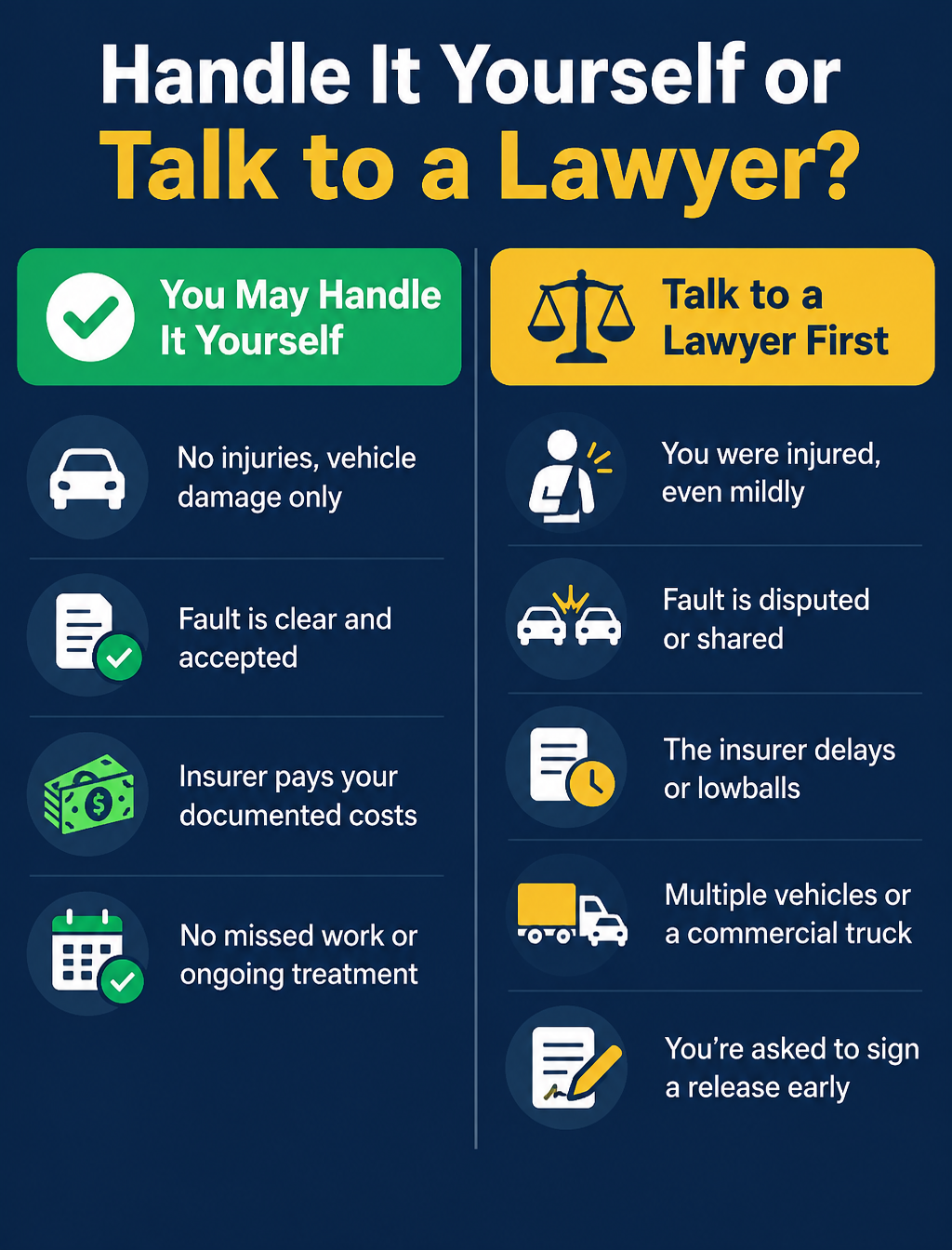
Not every accident requires an attorney. You may reasonably handle a claim yourself when it involves only vehicle damage, responsibility is accepted, the applicable coverage is clear, and the insurer’s proposed payment addresses your documented loss. Even then, read what you are signing and keep copies of every agreement.
A small, well-documented injury claim may also be manageable without representation if treatment is complete, the consequences are understood, liability is undisputed, and there are no unusual reimbursement or coverage issues. The difficulty is knowing whether all those conditions are actually satisfied. Feeling better today does not necessarily resolve questions about outstanding bills or benefit repayment.
Compare the task with your available time
Self-management means doing more than making an initial phone call. You may need to:
- Request records and itemized bills from multiple offices.
- Confirm which insurance payments have already been made.
- Explain missed work with employer documentation.
- Follow up on missing information and unanswered messages.
- Review settlement language and resolve reimbursement claims.
If those tasks fit your situation and schedule, representation may not add enough value to justify its cost. If you are recovering, caring for children, and missing work, the same tasks may be much harder to manage reliably.
Keep property damage separate in your thinking
A vehicle payment and an injury settlement are not necessarily the same transaction. Before accepting a check or signing a document, confirm whether it resolves only property damage or also releases injury claims. Do not assume a form is limited because the conversation was about repairs.
For a totaled vehicle, review the valuation report, vehicle options, condition, and comparison vehicles. For a repair claim, keep estimates, photographs, invoices, and rental records. Ask the insurer to explain any disputed deductions in writing.
Know when a do-it-yourself claim has changed
You can reconsider if the insurer shifts its position, your recovery becomes more complicated, or new coverage questions arise. Keep an organized file from the beginning so an attorney can review the history if needed.
Do not wait until the final deadline simply because negotiations have been cordial. An adjuster’s willingness to keep talking does not necessarily preserve your right to pursue the claim.
What Should You Do Before Deciding Whether to Hire?
You do not need to choose a lawyer before taking practical steps to protect yourself. Start with your safety and seek an evaluation from a qualified medical provider when appropriate. Follow the provider’s instructions, and explain truthfully when symptoms began and how the collision occurred. Medical decisions should serve your health, not a claim strategy.
Preserve information while it is still available
Create a folder for crash-related material. Save originals when possible, and back up digital files. Useful items include:
- Photographs of the vehicles, roadway, signs, debris, and visible damage.
- Driver, owner, insurance, and witness contact information.
- The collision report number and any available report.
- Dashcam footage and information about nearby cameras.
- Tow, storage, transportation, and repair receipts.
- Messages exchanged with insurers or the other driver.
Avoid editing original photographs or replacing full message threads with isolated excerpts. Dates, surrounding context, and original files can matter if an insurer questions what a document shows.
For a broader practical checklist, see After a Car Accident: Your First-Hours Checklist.
Track obligations that continue while you consider counsel
Your own policy may require timely notice and cooperation. Vehicle storage charges may keep growing. A medical office may continue billing while the liability claim remains unresolved. Ask what must happen next rather than assuming everything pauses once a claim number exists.
If you cannot afford a recommended service or cannot arrange transportation, tell the provider and keep a record of the problem. An unexplained treatment gap can prompt questions from an insurer, while a documented access barrier gives context. Do not obtain unnecessary care or continue treatment solely to increase a claim.
Keep a simple communication log
For each call, write down the date, the person’s name, the claim number, what was requested, and any promised response date. Follow significant conversations with a brief written confirmation when appropriate. This reduces confusion if a file changes adjusters.
Be cautious about discussing the accident publicly. A casual post can be misunderstood when separated from context. Preserve existing relevant material, and ask an attorney about preservation duties rather than deleting posts or messages because you are worried about how they look.
Which Insurance Policies or Parties May Pay Your Claim?
A claim is not worth only what your receipts show. It also depends on who may be legally responsible and whether insurance or other resources are available. Identifying payment sources early helps you understand why an insurer may pay certain expenses but refuse others.
Liability insurance follows legal responsibility
The at-fault driver’s bodily injury liability coverage may pay covered injury damages, subject to policy limits and applicable law. Property damage liability coverage generally addresses vehicle and other property losses. These are distinct coverages, and a payment under one does not automatically establish what is owed under the other.
Other potentially responsible parties may include a vehicle owner or an employer when a driver was acting within the scope of employment. Responsibility is fact-specific. A company logo on a vehicle is a reason to investigate, not proof that the company must pay.
Your own coverage may have a role
Depending on your state and policy, possible benefits include:
- Personal injury protection, or PIP: May cover specified medical expenses, wage losses, or other benefits regardless of fault, subject to rules and limits.
- Medical payments coverage: May pay covered medical expenses without first resolving responsibility.
- Collision coverage: May help repair or replace your vehicle, usually subject to a deductible.
- Uninsured or underinsured motorist coverage: May apply when the responsible driver has no applicable insurance or insufficient coverage.
In no-fault systems, injury lawsuits may be limited unless state requirements are met. PIP benefits and a liability claim also may operate on different schedules, so ask about each separately.
Multiple policies can create additional requirements
Uninsured and underinsured motorist claims can involve notice requirements, coverage definitions, offsets, and procedures for preserving rights before settling with another insurer. Whether policies can be combined depends on policy language and state law. For more context, read When the Driver Who Hit You Has No Insurance.
Ask any lawyer reviewing your case: “Which policies have you identified, which ones remain unconfirmed, and what must we do to preserve access to them?” If several people were injured, ask whether they may be competing for a shared limit. Strong evidence of harm does not increase the amount of insurance available, which is one reason an honest coverage review matters.
How Do Fault Disputes Change the Need for a Lawyer?
Fault is not always settled by the location of vehicle damage or by what a driver said at the scene. Insurers may compare accounts, inspect photographs, review reports, and argue that more than one person contributed. When your payment depends on assigning responsibility, evidence becomes especially valuable.
Understand shared fault in plain language
Under comparative negligence rules, your compensation may be reduced based on your share of responsibility. Some states also bar recovery once your fault reaches a particular threshold. Under contributory negligence rules, even a small amount of legally relevant fault may prevent recovery, subject to applicable exceptions.
The specific system and its exceptions vary by state. That is why an adjuster’s statement that you were “partly responsible” deserves examination rather than automatic acceptance. Ask what conduct they are relying on and what evidence supports their position.
Separate observations from assumptions
Suppose the other driver claims you changed lanes abruptly. You remember staying in your lane, but neither account is enough by itself to resolve the dispute. Roadway photographs, impact locations, a witness, dashcam footage, or available vehicle data may help test each version.
Practical steps include:
- Write down your recollection without filling gaps with guesses.
- Identify witnesses who actually saw the collision, not only its aftermath.
- Preserve camera footage before it is overwritten.
- Note lighting, road conditions, signs, and lane markings.
- Review the crash report for factual errors and ask about correction procedures.
A police report can be useful, but it does not necessarily determine civil liability. Whether particular statements are admissible or persuasive depends on the circumstances and local rules.
Ask what investigation would change the assessment
A lawyer should be able to explain which disputed fact matters and what could help establish it. Not every collision requires an expert reconstruction. Sometimes a single independent witness or a complete set of scene photographs is more useful than an expensive investigation.
Avoid arguing with the other driver in messages or trying to persuade a witness to adopt your account. Preserve what people actually said. If an insurer attributes fault to you, request the explanation in writing and have a licensed attorney review how your state’s rules affect the claim.
What Losses Can You Document After a Car Accident?
Pursuing fair compensation starts with an accurate record, not a demand built around a guess. Depending on the law and available coverage, recoverable losses may include medical expenses, lost earnings, diminished earning ability, out-of-pocket costs, and noneconomic harm such as pain and loss of enjoyment of life. Each category needs support appropriate to that loss.
Medical expenses and anticipated care
Keep itemized bills, treatment records, prescription receipts, and insurance explanations of benefits. These documents serve different purposes: a bill shows charges, while an explanation of benefits may show adjustments, payments, and remaining responsibility.
If future care is being considered, an attorney may need a qualified provider’s opinion about its necessity and expected course. Your own concern that you might need treatment is understandable, but it is not a substitute for medical support. Avoid assuming that every billed charge will necessarily be recoverable; state rules differ.
Missed earnings and work limitations
For wage loss, gather pay records, work schedules, employer verification, and documentation of medically supported restrictions. Keep track of missed overtime or used leave, but ask how those losses are treated under applicable law rather than assuming each is payable.
Self-employed people may need additional evidence, such as:
- Tax returns and prior earnings records.
- Canceled contracts or missed appointments.
- Invoices showing established work patterns.
- Records of replacement labor expenses.
- Evidence separating lost revenue from business expenses that were avoided.
Future earning impairment is different from wages already missed. It may require medical and vocational evidence about how lasting limitations affect your ability to work.
Daily-life effects and practical expenses
Keep receipts for necessary transportation, parking, and other accident-related expenses. If someone helps with tasks you previously handled, record what assistance was needed and why. Whether paid or unpaid help is compensable depends on the jurisdiction and evidence.
A brief, factual journal can document disrupted sleep, difficulty driving, missed activities, or trouble completing ordinary tasks. Specific entries are more useful than repeated descriptions such as “bad day.” For example, explain that you could not carry groceries without help rather than assigning yourself a dramatic rating.
Do not inflate losses or hide improvements. A balanced record that acknowledges better days is more credible and gives the lawyer a clearer basis for assessing what the evidence supports.
What Does a Car Accident Lawyer Actually Do?
Much of a lawyer’s work happens outside a courtroom. It often involves organizing facts, identifying missing evidence, checking coverage, and responding to an insurer’s objections. Understanding that work helps you judge whether representation offers something your particular claim needs.
Early work: define the claim and protect evidence
The firm usually begins with intake, conflict checking, a representation agreement, and a review of available records. Once retained, counsel may notify insurers of representation, request policy information where available, obtain the crash report, and identify evidence that could disappear.
For a commercial vehicle collision, that might include investigating ownership, employment relationships, and relevant business records. In a simpler crash, it may mean locating a witness and preserving a nearby camera recording. The scope should follow the facts, not a standard promise to investigate everything.
Ongoing work: build and test the documentation
As your claim develops, the legal team may:
- Request records and follow up on incomplete responses.
- Compare bills with insurance payments and outstanding balances.
- Obtain employment documentation.
- Investigate liability disputes and coverage exclusions.
- Communicate with adjusters about missing proof or inconsistent positions.
- Track legal deadlines and required notices.
- Identify possible medical liens or reimbursement claims.
Paralegals and case managers commonly handle parts of this process under attorney supervision. That is not itself a problem. You should know who handles routine updates and which lawyer is responsible for legal decisions.
Settlement work: explain the offer, not just relay it
When the claim is sufficiently developed, a lawyer may prepare a demand explaining responsibility, injuries, losses, and supporting evidence. Negotiations often involve responding to specific challenges: disputed treatment, alleged shared fault, missing wage documentation, or limited coverage.
Your attorney should explain the strengths, weaknesses, and likely deductions from an offer. You decide whether to accept a settlement; the attorney should not make that decision without your authorization.
Your participation still matters
Representation does not eliminate your role. You will need to provide truthful information, forward bills, report changes in employment or treatment, and respond to requests. Ask how often the firm updates clients and what counts as a development worth reporting immediately.
You should also ask what work the firm will not perform. Some injury firms do not handle vehicle valuation disputes, benefit appeals, or unrelated employment problems. Knowing those limits prevents urgent tasks from falling between you and your lawyer.
How Do Contingency Fees and Case Costs Work?
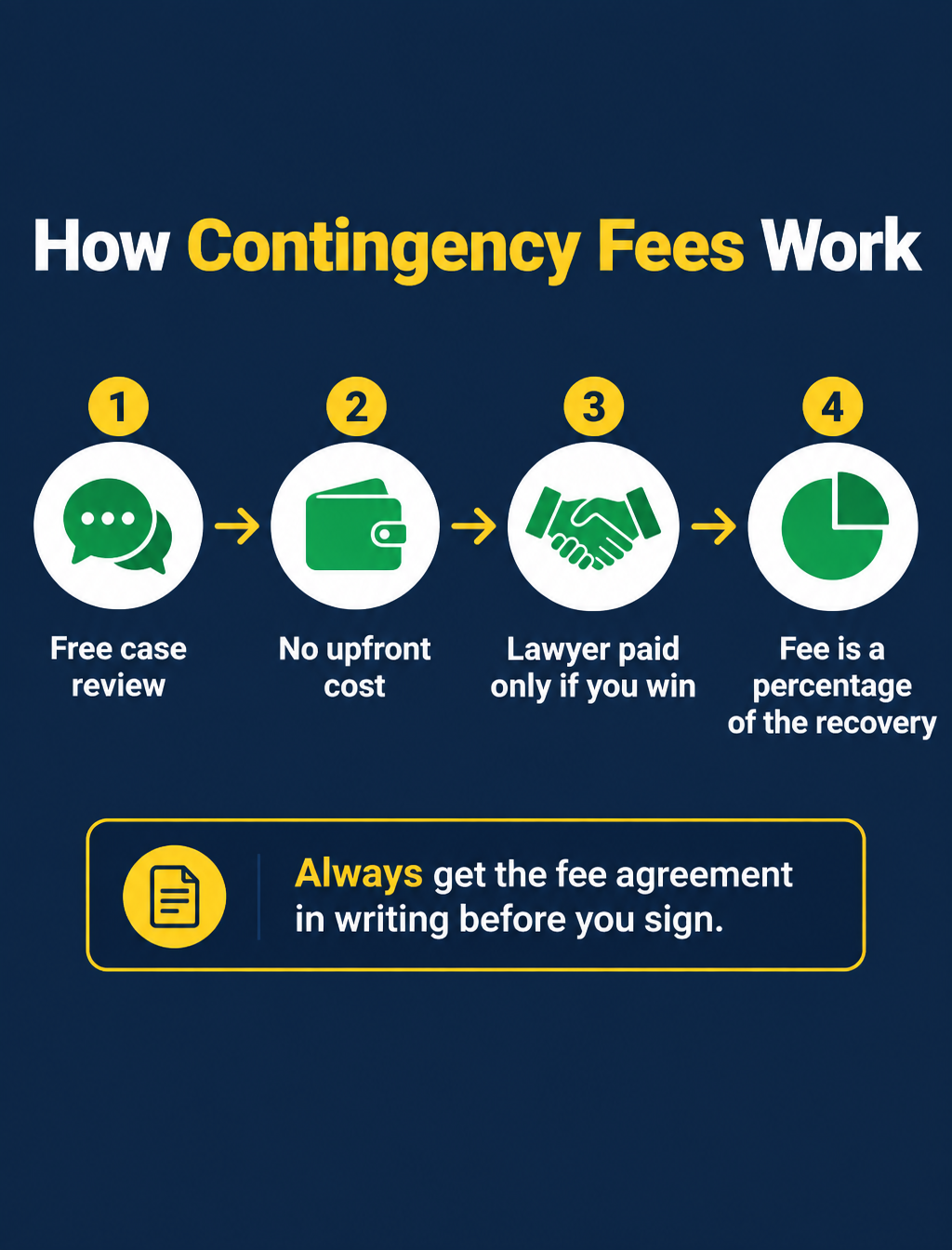
Many car accident attorneys handle injury cases on a contingency fee basis. Generally, the attorney’s fee depends on obtaining a recovery rather than billing you by the hour. The actual percentage, calculation method, covered work, and exceptions belong in a written agreement.
A free consultation and a contingency agreement are separate things. You can speak with an attorney at no charge for an initial evaluation without assuming every later service is free. Read the representation contract before signing, and request plain-language explanations of unfamiliar terms.
Fees are different from case expenses
Attorney fees compensate the firm for legal work. Case expenses may include record retrieval, filing fees, deposition transcripts, expert services, or other costs incurred in pursuing the matter. A firm may advance those expenses and seek reimbursement later.
Ask these questions directly:
- Is the fee calculated before or after case expenses are deducted?
- Does the fee change if a lawsuit is filed or an appeal is needed?
- Which expenses might I owe if there is no recovery?
- Will you seek approval before major expenses are incurred?
- Does the agreement cover property damage or only bodily injury?
- What happens financially if I end the relationship or change lawyers?
There is no substitute for the actual contract. Advertising such as “no fee unless we win” may describe attorney fees without fully explaining the treatment of expenses.
Focus on the net recovery
The settlement amount is not necessarily the amount you receive. A simplified way to understand the distribution is:
Gross recovery − attorney fees − case expenses − valid liens, reimbursement claims, and other agreed deductions = net amount to you.
Health insurers, certain benefit programs, medical providers, or others may have repayment rights depending on the circumstances. Those rights are not all identical, and an attorney cannot promise that every balance will be reduced. Ask who will verify them and whether negotiation or resolution is included in the representation.
Before authorizing a settlement, request an estimated distribution showing what is known, what remains unresolved, and how uncertainty could affect your share. Before funds are disbursed, review the final settlement statement. A responsible discussion of costs helps you compare representation with your alternatives without pretending anyone can guarantee the financial result.
How Should You Handle Insurance Calls and Settlement Offers?
An adjuster’s job is to investigate and resolve claims under the insurer’s policies and obligations. The adjuster is not your personal legal adviser. You can remain courteous and cooperative without guessing, agreeing to unclear statements, or treating every request as routine.
Identify who is asking and why
At the start of a call, confirm the insurer, the person’s role, and which claim they are handling. Your duties toward your own insurer may differ from your obligations when dealing with the other driver’s insurer. Policy cooperation provisions and state law can affect what is required.
If you are asked for a recorded statement, ask about its purpose and whether it is required under your policy. A lawyer can help you understand the request before you respond. Do not simply ignore your own carrier’s communications, since failure to meet applicable obligations can create separate problems.
Stick to facts you know. “I don’t know” or “I don’t remember” is more accurate than an estimate presented as certainty. Do not minimize what you are experiencing just to be polite, and do not speculate about a diagnosis or future medical needs.
Read authorizations before signing
An insurer may request access to medical records relevant to the claim. Review the scope of an authorization, including which providers, dates, and types of information it covers. An overly broad request may expose unrelated information, while refusing every relevant request can interfere with evaluation.
Ask why the requested records are needed and whether a more limited authorization or direct production of relevant records is appropriate. Disclose relevant history truthfully; the goal is an accurate review, not concealment.
Evaluate an offer against the entire claim
Before deciding, obtain the offer and release in writing. Confirm:
- Which claims and parties would be released.
- Whether all current bills have been identified.
- Whether future losses remain uncertain.
- Whether another insurer must consent before settlement.
- Whether reimbursement obligations remain outstanding.
If the offer excludes a loss, ask for the insurer’s reasoning. Missing proof may be fixable; a legal or coverage dispute may require a different response. Do not let an arbitrary-sounding offer expiration replace an informed decision, but also do not assume every deadline can be ignored. Seek prompt review when a release or time-sensitive demand is involved.
How Long Do You Have to Take Action?
There is no single nationwide deadline for a car accident claim. The statute of limitations sets a time limit for filing certain legal actions, and its length depends on the state, type of claim, and circumstances. Different claims arising from the same crash may have different deadlines.
A claim submitted to an insurer is not the same as a lawsuit filed in court. Ongoing negotiations generally do not, by themselves, pause the filing deadline. If you are close to any possible deadline, get a licensed attorney’s assessment promptly rather than waiting for the adjuster’s next response.
Some requirements come earlier
Other time-sensitive duties may include:
- Giving notice under an insurance policy.
- Submitting applications or bills for certain benefits.
- Presenting a claim involving a government entity.
- Providing notice required for uninsured motorist coverage.
- Preserving rights before accepting another settlement.
Special rules can apply to minors, people lacking legal capacity, estates, and crashes connected with more than one state. Those rules are technical. Do not assume a general internet deadline accounts for your situation or that a possible exception will protect you.
Evidence has its own clock
Even when the legal filing period is not close, evidence may be lost much earlier. Surveillance systems can overwrite recordings, vehicles may be repaired or disposed of, and witnesses can become hard to locate. A preservation request may help, but the right recipient and the nature of the evidence matter.
If your vehicle may contain relevant evidence, ask about inspection before authorizing disposal when feasible. At the same time, address storage charges and safety concerns rather than allowing expenses to accumulate without a plan. Counsel can help balance preservation with those practical demands.
Use a deadline worksheet
Write down the crash date, every insurer notice, any stated response deadline, and the names of potentially involved public entities or employers. Bring policy documents and letters to the evaluation, even if you do not understand them.
Ask the attorney to identify which deadlines they can confirm and which require investigation. Until a lawyer actually agrees to represent you, do not assume that requesting an appointment or submitting an intake form means someone is monitoring or protecting your filing deadline.
What Happens If Your Claim Requires a Lawsuit?
A lawsuit may become necessary when settlement discussions cannot resolve a dispute or when filing is needed to preserve a claim. It does not mean a trial is inevitable. Negotiation can continue during litigation, but the process adds formal rules, expenses, and demands on your time.
Filing begins a structured exchange
A complaint generally states the legal claims and requested relief. The opposing party has an opportunity to respond, and the court may establish a schedule. During discovery, both sides can seek relevant documents, written answers, and testimony through procedures governed by court rules.
You may need to help answer questions about the crash, your treatment, work history, prior relevant injuries, and claimed losses. Your lawyer should explain what is being requested and prepare you to respond truthfully and completely. Guessing to fill a memory gap can create avoidable inconsistencies.
Depositions and evaluations require preparation
A deposition is testimony given under oath outside the courtroom. It can feel unfamiliar, but preparation should focus on understanding the process, listening carefully, and answering accurately—not memorizing a script.
Depending on the rules and disputed issues, the defense may also seek a medical examination or expert review. Ask your lawyer what is required, what records are involved, and how to address scheduling or accessibility concerns. Do not ignore a formal request because it seems intrusive; have counsel review it.
Settlement remains your decision
Mediation may provide an opportunity to negotiate with a neutral person’s assistance. If an agreement is reached, the release and payment terms still need review. If it is not, the case may proceed toward additional motions or trial.
Ask about the practical burdens before authorizing litigation:
- What additional expenses are expected?
- What evidence remains missing?
- How much participation will be required from me?
- What could prevent collection even after a favorable decision?
- Does the current fee agreement cover trial and any appeal?
Litigation should be discussed as a tool with risks, not as a threat that automatically forces payment. An attorney should explain why filing may improve your position, what uncertainty remains, and how the potential recovery compares with the added costs and effort.
How Do You Choose a Lawyer and Spot Red Flags?
The right attorney for your claim should be licensed for the relevant work, able to explain the issues clearly, and willing to discuss costs without pressure. A polished advertisement does not tell you who will handle your file or whether the firm is suited to the dispute you actually have.
Ask questions that reveal how the firm works
Consider asking:
- Who is the attorney responsible for my case?
- Have you handled claims with this kind of fault or coverage issue?
- Will your firm handle litigation if settlement fails?
- Would another firm receive or handle any part of the case?
- How will I receive updates, and who answers urgent questions?
- What obstacles do you see based on the information available?
- What services fall outside the proposed agreement?
You can verify licensing and publicly available disciplinary information through the relevant state attorney-regulation authority. Reviews may offer clues about communication, but they do not establish likely results or legal skill in your particular matter.
Treat certainty about outcomes as a warning
Be cautious if someone promises a specific settlement, guarantees success, or assigns a firm value before reviewing records and coverage. An experienced attorney can discuss factors that influence value without pretending to know an outcome that depends on disputed facts and future decisions.
Other warning signs include pressure to sign immediately, refusal to provide the fee agreement, unexplained charges, and evasive answers about who will do the work. You should also be wary of anyone who encourages exaggeration, concealment, or unnecessary treatment.
Look for respectful, practical communication
A useful first conversation should leave you understanding the next step, even if the attorney cannot answer everything yet. You should be able to say that you are confused about a bill or worried about costs without being dismissed.
Ask about language access, communication preferences, and accommodations you need. If you work shifts, find out whether the firm can arrange calls at workable times. These details affect your ability to participate throughout the claim.
If you already have counsel and are considering a change, review the existing agreement and discuss potential fee or expense obligations with prospective new counsel. Changing lawyers may be possible, but it should be planned so deadlines, records, and communications do not fall through a gap.
What Should You Bring to a Free Case Evaluation?
You do not need a perfect file to request an evaluation. A short, accurate account and the documents you already have are enough to start identifying questions. Missing information can be listed for follow-up rather than delaying the conversation indefinitely.
Prepare a one-page overview
Include the date and location of the collision, who was involved, and a brief description of what happened. Add where you received care, whether treatment is continuing, and how work or daily responsibilities have changed. Separate confirmed facts from information someone else told you.
List all known insurers and claim numbers. Mention whether you were working, driving for a platform, using a borrowed vehicle, or riding as a passenger. Those details can affect coverage even when they seem unrelated to how the crash occurred.
Gather the most useful documents
Bring or securely provide available copies of:
- The crash report or report number.
- Photos, videos, and witness contact information.
- Insurance identification and policy declarations pages.
- Medical bills and available treatment information.
- Pay records or employer correspondence about missed work.
- Adjuster letters, coverage denials, offers, and releases.
- Any contract you have already signed with another attorney.
Do not send sensitive documents to an unverified email address or upload them through a channel you do not understand. Ask how the service or attorney will receive and use your information.
Leave with a clear next step
Useful evaluation questions include: “What is the biggest unresolved issue?” “What should I preserve now?” and “Which deadlines need confirmation?” Ask whether representation is being offered and, if so, what written agreement is required before the attorney begins work.
A preliminary discussion may identify possibilities without establishing claim value or confirming all coverage. That is a limitation of the information available, not necessarily a sign that the consultation was unhelpful.
You can connect with a participating attorney for an evaluation through Free Case Evals. The service is free and is not a law firm. Any legal assessment or representation comes from the attorney, and representation depends on a separate agreement. Before ending the conversation, confirm who, if anyone, is responsible for the next action and when you should expect to hear back.
How Can You Decide Whether Representation Is Worth It?
The decision is not simply whether a lawyer might obtain a larger gross settlement. You need to consider costs, claim complexity, the work involved, and your ability to protect your rights without help. No one can reliably promise that hiring counsel will leave you with more money in every case.
Compare realistic paths, not promises
Consider three possible approaches: handling the claim yourself, obtaining advice on a limited issue if a lawyer offers that service, or hiring full representation. Limited assistance is not available from every firm and may not fit a claim requiring continuing investigation or urgent court action.
For each option, ask:
- What tasks would I remain responsible for?
- What legal or coverage questions are still unresolved?
- What fees and expenses could apply?
- What evidence needs to be obtained promptly?
- What happens if the insurer refuses to move from its position?
This comparison is more useful than focusing only on a fee percentage. A lower fee does not help much if necessary work is excluded; full representation may be unnecessary if the remaining issue is narrow and well documented.
Use your circumstances as part of the assessment
Imagine that your treatment is complete, your missed wages are documented, and the insurer accepts responsibility. Your main task may be organizing the claim and reviewing an offer. Now imagine the same crash with conflicting accounts, continuing work restrictions, and a possible coverage exclusion. The need for investigation and legal judgment is different, even though the collision itself has not changed.
Your capacity matters too. If pain, caregiving duties, or unpredictable work hours prevent timely follow-up, assistance may offer practical value beyond negotiating. That does not make a fee irrelevant; it makes your time and limitations part of an honest comparison.
Be prepared for an attorney to decline
A firm may decline because of limited coverage, disputed responsibility, expected expenses, deadlines, workload, or a mismatch with its practice. A rejection does not necessarily prove that you have no claim. Ask whether the reason is legal merit, financial feasibility, or the firm’s own selection criteria.
You may seek another opinion, but keep working on urgent obligations while doing so. The goal is an informed choice, not collecting enough optimistic responses to make uncertainty disappear.
Request a Free Case Evaluation Before You Decide
If you are still unsure whether to hire a lawyer, bring the decision back to the problem you need help solving. Perhaps you have a release you do not understand, an insurer disputing fault, unpaid treatment bills, or uncertainty about returning to work. You do not need to predict the value of the entire case before asking about that problem.
Free Case Evals connects people injured in motor vehicle accidents with participating attorneys for a free case evaluation. It is not a law firm and does not provide legal advice or representation. A participating attorney can review the information you share, discuss applicable state-law issues, and explain whether they may be able to help. No outcome or acceptance of representation is guaranteed.
Before requesting an evaluation, gather your crash date, location, claim numbers, and any time-sensitive correspondence. Include whether an offer has been made or a document is waiting for your signature. If you do not have all your records, say what is missing rather than waiting to assemble a perfect packet.
You can request your free case evaluation here. Use the conversation to ask about your immediate next step, the work an attorney would perform, and the agreement that would govern fees and expenses. You remain free to decide whether the proposed representation fits your needs. Until an attorney confirms that they represent you, continue tracking notices and deadlines, and seek prompt help with anything time-sensitive.
Frequently Asked Questions
Can I get a lawyer if I was a passenger in the accident?
Yes. Depending on responsibility and available coverage, a passenger may have a claim involving one or more drivers or other parties. An attorney can also assess whether representing multiple occupants would create a conflict of interest.
Should I talk to a lawyer if the at-fault driver is a friend or relative?
A consultation can help you understand insurance coverage and the practical implications of pursuing a claim. Do not assume that insurance eliminates every possible personal consequence for the driver. Household relationships and policy exclusions may affect coverage.
Can I hire an attorney after accepting a vehicle repair payment?
Possibly, depending on what the payment and any accompanying release resolved. A payment limited to property damage may not close an injury claim. Have an attorney review the actual documents rather than relying on how the payment was described.
Does receiving a traffic ticket mean I cannot pursue compensation?
Not necessarily. A citation and civil responsibility are related but distinct issues, and the effect of the ticket depends on state law and the evidence. Tell the evaluating attorney about the citation and any related court proceedings.
What if I had a medical condition before the crash?
A preexisting condition does not automatically prevent a claim for harm caused or worsened by a collision. The distinction may require medical evidence comparing your condition before and after the crash. Be accurate with both your qualified medical provider and the attorney reviewing the claim.
Do I need a lawyer in the state where the crash happened?
You need counsel authorized to handle the matter in the relevant jurisdiction. When the crash, drivers, and insurance policies involve different states, applicable law and filing location may require additional analysis. Ask prospective counsel how they would address those issues.
Can I request an evaluation for a family member who is injured?
You can ask about the intake process and explain that you are helping a family member. The attorney may need the injured person’s consent or documentation showing legal authority before discussing confidential information or accepting instructions. Different requirements can apply when the injured person is a minor or cannot act independently.
Will my health insurer handle the car accident claim for me?
Health insurance may pay covered medical expenses, but that does not ordinarily mean it is pursuing all your injury damages on your behalf. It generally does not resolve your lost earnings or noneconomic losses. It may also have reimbursement rights that need review.
What if the other driver asks me to avoid insurance and settle privately?
A private arrangement can leave unresolved questions about injuries, payment, releases, and your own policy’s reporting requirements. Do not assume a verbal promise protects you if additional expenses arise. Consider a licensed attorney’s review before signing an agreement or giving up claims.
This article is for general informational purposes only and is not legal or medical advice. Laws vary by state. Speak with a licensed attorney about your specific situation.
Hurt in a car accident?
Answer a few quick questions to see if you may qualify for a free case evaluation. No cost, no obligation.
Start My Free Case Evaluation