
Partial Fault Car Accident: Can You Still Recover Compensation?
Free Case Evals · October 5, 2026
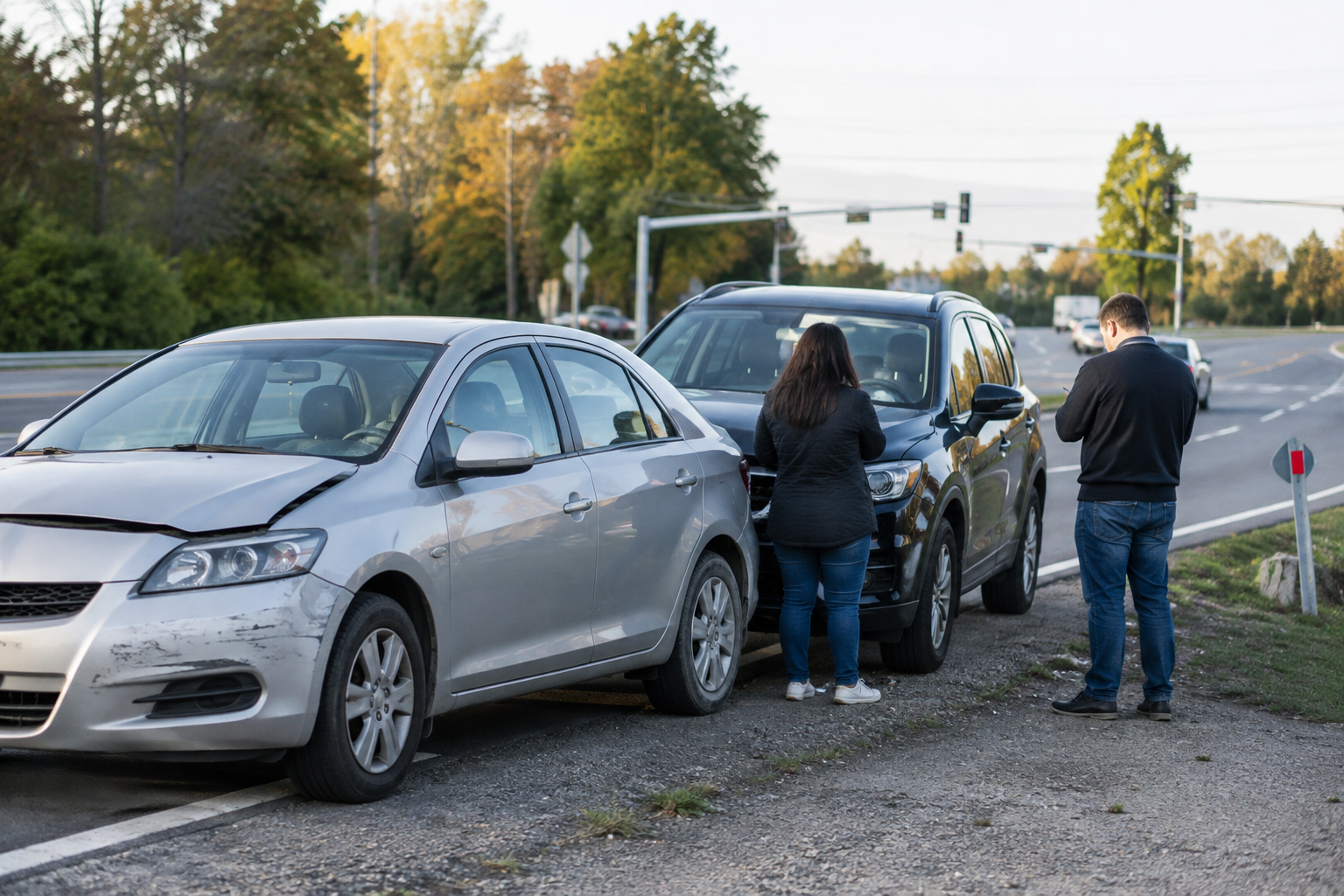
You may still be able to recover compensation after a partial fault car accident. In many states, your share of responsibility reduces what you can recover rather than automatically ending your claim. Other states impose a fault threshold or follow stricter contributory negligence rules, so the law that applies can make a major difference.
That can feel unsettling when an insurance adjuster says you were driving too fast, should have reacted sooner, or somehow caused the crash you are still trying to process. But an adjuster's initial position is not the same as a final legal determination. Responsibility should be evaluated using evidence, the applicable legal rules, and what each person actually did—not simply who called the insurer first.
This guide explains how shared fault works, what can challenge an unsupported blame assessment, and how to document the compensation you are seeking. It provides general educational information, not legal advice. Laws vary by state, and a licensed attorney can explain how they apply to your circumstances.
In This Guide
- Can You Get Compensation After a Partial Fault Car Accident?
- How Does Comparative Negligence Affect Your Recovery?
- What Happens in a Contributory Negligence State?
- Who Decides Fault, and Can You Challenge the Decision?
- How Are Car Accident Fault Percentages Argued?
- What Evidence Can Shift Blame After a Crash?
- How Do Common Crash Scenarios Create Shared Fault Disputes?
- How Do Insurers Use Partial Fault to Reduce Offers?
- What Should You Say When an Adjuster Blames You?
- Which Insurance Coverage May Pay When You Share Fault?
- How Do You Document the Full Value of Your Losses?
- What If Several Drivers or Other Parties Share Responsibility?
- What Deadlines and Early Mistakes Can Affect Your Claim?
- How Can You Evaluate a Settlement Offer That Includes Shared Fault?
- How Can an Attorney Help With a Disputed Fault Claim?
- Request a Free Case Evaluation for a Partial Fault Car Accident
Can You Get Compensation After a Partial Fault Car Accident?
The first question is not simply whether you made a mistake. It is whether another person also acted negligently, whether that conduct contributed to the crash and your losses, and how the governing state's rules treat your own conduct. A driver can make an error without being solely responsible for everything that follows.
Say you are driving through an intersection when another vehicle turns across your lane. The other driver argues that you were traveling too fast. Their turn and your speed may both require investigation, but the allegation about speed does not automatically excuse the turn or establish that you could have avoided the collision.
A shared-fault injury claim generally involves several separate questions:
- Responsibility: What did each person do or fail to do?
- Causation: How did that conduct contribute to the collision or claimed harm?
- Damages: What losses can you prove resulted from the crash?
- Recovery rules: Does your share of responsibility reduce compensation or potentially bar it?
- Available payment: What insurance or other legally responsible sources can cover the claim?
Keeping these questions separate helps you recognize an incomplete insurance explanation. An insurer might acknowledge that its driver caused the collision but dispute your medical expenses. Or it might accept your documented losses while arguing that your own conduct substantially contributed. Those are different disagreements, and they call for different evidence.
Start with facts, not a self-assigned percentage
You do not need to decide your own fault percentage before asking for help. Write down the sequence of events, preserve supporting records, and distinguish what you know from what you suspect. A statement such as “I did not see the other car until it entered my lane” is more useful than a broad conclusion that the crash must have been your fault.
If you are unsure whether shared responsibility leaves you with options, you can see if you may have a case. Free Case Evals connects injured people with participating attorneys for a free case evaluation; it is not a law firm.
How Does Comparative Negligence Affect Your Recovery?
Comparative negligence assigns responsibility among people whose conduct contributed to an injury. Under this approach, your recoverable damages generally decrease according to your share of fault. The key distinction is whether the applicable state uses a pure system or a modified system.
Pure comparative negligence
Under a pure comparative negligence system, sharing most of the blame generally does not, by itself, eliminate an ordinary negligence claim against another responsible party. Your own responsibility still reduces the damages recoverable from others. You must also establish the other party's negligence, causation, and your losses.
This does not mean every claim produces a payment. Evidence may fail to show that another person contributed, insurance may be limited, or other defenses may apply. The rule addresses the effect of your fault; it does not solve every other issue in the claim.
Modified comparative negligence
Modified comparative negligence also reduces recovery for shared responsibility, but it adds a cutoff. Depending on the state, recovery may be barred when your fault reaches half of the total responsibility or only when it exceeds half. That distinction can determine whether an otherwise supported injury claim can proceed.
States may also differ in how they compare your responsibility with multiple defendants. Ask whether your conduct is compared with all defendants together, particular defendants individually, or under another statutory framework. Do not assume that a rule you read about in another state applies to your collision.
Why the threshold changes negotiations
When the evidence places responsibility near the applicable cutoff, a dispute over fault is not merely a dispute over a smaller check. It may determine whether the defendant owes compensatory damages at all under that rule. That gives both sides a reason to examine timing, visibility, traffic controls, and reasonable opportunities to avoid impact closely.
Ask the insurer to identify the negligence rule it is applying and explain its factual basis for the proposed allocation. If the crash occurred outside your home state or involves parties from different states, an attorney may need to analyze which jurisdiction's law governs. Your mailing address alone does not necessarily answer that question.
What Happens in a Contributory Negligence State?
A small group of jurisdictions follows contributory negligence rather than ordinary comparative negligence for many injury claims. Under this stricter doctrine, negligence by an injured person that legally contributes to the injury can bar recovery from another negligent party. That makes a supported allegation of even limited contributing negligence potentially serious.
But the rule is not “any imperfection means you lose.” The defendant generally must establish the elements of the contributory negligence defense under the applicable law. A criticism of your driving still needs a legally meaningful connection to the collision or injury.
For example, an expired vehicle registration does not by itself explain why someone crossed into your lane. A traffic-law issue unrelated to how the crash happened should not automatically become a complete defense. Whether a particular fact matters depends on the conduct involved, causation, and state law.
Exceptions require careful analysis
Some jurisdictions recognize doctrines that may limit a contributory negligence defense in particular circumstances. One example is last clear chance, which can concern whether a defendant had a legally sufficient later opportunity to avoid harm. Its requirements vary, and it should never be assumed to apply just because the other driver might have braked sooner.
The defendant's level or type of misconduct may also affect available defenses. These are technical questions, not shortcuts that guarantee recovery. A licensed attorney can assess whether an exception has factual support and is recognized in the relevant jurisdiction.
What to do with a denial based on your conduct
If an insurer denies your claim on contributory negligence grounds, request its position in writing. Keep the letter, the evidence it identifies, and the policy or claim information attached to it. Note whether the adjuster relies on a specific driving action or merely repeats the other driver's version.
Do not let a strict rule discourage you from preserving evidence. Video, an independent witness, or a more accurate timeline may show that the alleged mistake never occurred or did not contribute. The urgency is to have the evidence and denial reviewed while records and witnesses remain available.
Who Decides Fault, and Can You Challenge the Decision?
Several people may evaluate responsibility after a collision, but their decisions serve different purposes. The officer who investigates, the adjuster who handles the claim, and a court considering a lawsuit do not all have the same authority or use the same process.
Police reports and traffic citations
A crash report may contain observations, witness information, diagrams, statements, and an officer's assessment. It can be valuable, especially when it documents physical evidence at the scene. However, an officer may arrive after the vehicles have moved and may not have witnessed the collision.
A citation is also not automatically a complete civil-fault determination. Its significance can depend on the violation, the disposition of the traffic case, and state evidentiary rules. Likewise, the absence of a citation does not establish that a driver acted reasonably.
Request the report and check concrete details: vehicle positions, direction of travel, passenger names, insurance information, and whether statements were attributed to the correct person. If something is factually wrong, ask the reporting agency about its correction or supplemental-statement procedure. A disagreement with the officer's conclusion may not qualify as a clerical correction.
Insurance assessments
An adjuster assigns a working liability position to decide whether to pay, deny, or negotiate a claim. That position may change as new evidence arrives. Your insurer and the other driver's insurer may even disagree about the same event.
Ask whether an announced fault decision applies to your bodily injury claim, vehicle damage claim, or an insurer-to-insurer reimbursement process. Different claim tracks may have different procedures, and a decision in one does not necessarily settle every other issue.
Courts, arbitration, and negotiated agreements
If a case proceeds to trial, a judge or jury may decide fault under the applicable law. Some disputes go through arbitration under a policy or agreement. Many claims instead settle without any court determining a definitive percentage.
You can dispute an insurer's assessment with evidence and a written explanation. If negotiations fail, available options may include internal review, contractual dispute procedures, or litigation. A state insurance department may review claims-handling concerns, but it generally does not function as a court that resolves every contested negligence question.
How Are Car Accident Fault Percentages Argued?
There is no universal calculator that converts a dent, a citation, and two driver statements into a reliable fault percentage. Responsibility is argued by comparing conduct with the care reasonably expected under the circumstances and connecting each departure to the harm.
The strongest analysis follows the sequence of the crash. What was happening before the conflict? Who created the hazard? When could each driver reasonably perceive it? What safe alternatives were actually available? What happened between the first impact and the vehicles' final positions?
Look at opportunity, not hindsight
After a crash, it is easy to say that someone should have swerved or stopped. The useful question is whether the person had enough time, visibility, distance, and control to do so reasonably. Swerving into occupied lanes may not have been a safe alternative at all.
Facts that can influence the analysis include:
- Traffic signals and signs controlling each driver's movement.
- Lane markings, turn restrictions, and right-of-way duties.
- Following distance and the flow of traffic.
- Weather, lighting, road surface, and sight obstructions.
- Driver distraction or impairment supported by evidence.
- The timing of braking, turning, acceleration, or lane changes.
- Whether another vehicle or road hazard limited an avoidance maneuver.
A driver with the right of way still generally owes reasonable care. At the same time, having a theoretical ability to react does not mean the driver had a practical opportunity to prevent impact.
Demand a connection between conduct and the crash
Suppose an insurer says you were “not paying attention.” Ask what supports that statement. Was there a witness, video, a recorded admission, or merely an assumption because a collision occurred? Then ask how the alleged inattention changed the outcome.
A useful written challenge addresses each asserted mistake separately. Identify the allegation, cite the record that supports or contradicts it, and explain the unresolved factual question. Avoid substituting your own unsupported percentage. Showing why the insurer's reasoning is incomplete is often more productive than arguing that your number feels fairer.
An attorney may recommend reconstruction or other expert analysis when technical questions justify the expense. Not every collision requires an expert, but some cannot be assessed responsibly from photographs alone.
What Evidence Can Shift Blame After a Crash?
Evidence is most useful when it answers a disputed question. A photograph of a broken bumper may establish damage but say little about which vehicle changed lanes. Footage showing the seconds before impact may address that question directly.
Preserve the full scene
When it is safe and lawful, photographs can document vehicle positions, lane markings, traffic controls, sightlines, debris, skid marks, and road conditions. Include wide views as well as close-ups. Never step into traffic or delay needed medical attention to gather evidence.
If you could not take photographs, check whether a passenger, witness, tow operator, or responding agency has records. Nearby businesses or residences may have cameras, but recording systems can overwrite footage quickly. Ask promptly whether relevant video exists and whether it can be preserved; access may require permission or formal legal process.
Keep original files when possible. Editing a video into a short clip may omit the very context that explains the crash. Save the complete recording, associated dates, and any information about the device's clock being inaccurate.
Find witnesses who saw the lead-up
A witness who heard a crash and turned around may confirm final positions but not the movement that caused it. Someone who watched the traffic signal or saw a lane change may provide more direct information about responsibility.
Record contact information and a neutral description of what the witness says they observed. Do not coach them, suggest wording, or ask them to choose a fault percentage. Independent recollection is more useful than agreement with your interpretation.
Consider records beyond the police report
Depending on the circumstances, relevant material may include:
- Dashcam footage and recordings from nearby vehicles.
- Emergency call recordings and dispatch records.
- Vehicle inspection, repair, and towing documentation.
- Event data from vehicles equipped with relevant recording systems.
- Commercial driving logs, route information, or maintenance records.
- Traffic-signal timing records or roadway maintenance documents.
Some evidence requires specialized collection or legal authority. Do not access someone else's account, device, or vehicle without permission. If a vehicle may be salvaged or a business may delete records, tell an attorney promptly. A preservation request can help establish notice, though it does not guarantee that every item exists or will be retained.
How Do Common Crash Scenarios Create Shared Fault Disputes?
Crash labels are useful starting points, not final answers. “Rear-end collision” or “left-turn accident” describes a pattern, but the sequence and surrounding conditions still matter. Recognizing the likely dispute helps you preserve evidence that addresses it.
Rear-end collisions
Say you are stopped at a light on the way to work and another driver hits you from behind. Following distance, speed, and attention may strongly support responsibility against the rear driver. But the insurer may allege that you abruptly merged into the lane, reversed, or had nonfunctioning brake lights.
Identify whether those allegations have support. Video showing you stationary before impact, a witness who followed your vehicle, or an inspection documenting the lights can address specific claims. A rear impact alone does not prove every detail, but a speculative alternative should not replace investigation.
Left turns and intersection crashes
A driver turning across oncoming traffic may have a duty to yield, while the other driver may be accused of speeding or entering against a signal. Signal phase, visibility, turning paths, and the timing of entry can be decisive.
Keep photographs of signs and sight obstructions. Look for witnesses who could see the relevant signal, not just the collision. A witness facing a different direction may have seen a different light.
Lane changes and merging
These disputes often become competing accounts of who moved first. Damage location helps, but it may not establish the full movement by itself. Lane markings, dashcam footage, turn-signal use, speed changes, and whether a lane was ending can provide context.
Avoid assuming that being farther ahead gave either vehicle an unconditional right to merge. The applicable traffic rules and actual movements matter more than a simplified rule of thumb.
Parking lots and backing collisions
Both drivers may claim they were stopped while the other reversed. Store cameras, backup-camera recordings if retained, parking-space orientation, and impact locations can help test those accounts. Property owners may also have incident reports.
In each scenario, build the timeline before arguing fault. A concise diagram labeled as your recollection can help explain directions, but keep it separate from photographs and official diagrams so nobody mistakes your reconstruction for independently verified evidence.
How Do Insurers Use Partial Fault to Reduce Offers?
An insurer may legitimately investigate whether your conduct contributed. The concern is not that fault is being discussed; it is whether the proposed reduction is supported and whether other reductions are being hidden in the same offer.
An adjuster may start with a reduced assessment of your damages, then apply a fault reduction to that lower figure. If you focus only on blame, you may overlook excluded wage losses, disputed treatment expenses, or an incomplete assessment of how the injuries affected your daily activities.
Ask for the calculation behind the offer
Request a written explanation identifying:
- The losses the insurer recognizes and the amounts it disputes.
- Its assessment of total damages before considering shared fault.
- The responsibility it attributes to you and the supporting facts.
- Any coverage limit or policy exclusion affecting payment.
- Whether the offer addresses bodily injury, property damage, or both.
The insurer may not disclose all internal evaluation materials. Even so, asking these questions clarifies what you need to challenge and creates a record of the explanation provided.
Watch for unsupported shortcuts
A shared-fault argument may rely heavily on a single sentence from your statement while overlooking physical evidence. Another approach is to treat uncertainty as a reason to assign you blame automatically. Two drivers disagreeing does not, by itself, prove equal responsibility.
Pressure can also arise when the adjuster says an offer is available only if you settle quickly. Before accepting, determine whether the proposal is a full release and whether your losses are sufficiently understood. An immediate payment may have consequences beyond the bill you need to pay this week.
Keep negotiation issues separate. If the insurer questions both fault and medical expenses, provide the evidence responsive to each rather than sending the same general objection repeatedly. Ask what additional information would change its position and when it expects to review your submission.
A low offer is not automatically bad faith, and a coverage dispute is not automatically improper. If communications reveal unexplained delays, shifting explanations, or misstatements about the claim, preserve them for review by a licensed attorney or the appropriate regulator.
What Should You Say When an Adjuster Blames You?
You can cooperate with a claim investigation without guessing or adopting the adjuster's conclusions. The goal is a clear, accurate account—not a perfect speech or an argument on the phone.
Before a substantive call, review your notes, the crash date and location, photographs, and the information you actually remember. If you are tired, in pain, or unable to concentrate, ask whether the discussion can be scheduled for a better time. Do not ignore policy deadlines or reasonable requests from your own insurer while arranging that conversation.
Separate observation from assumption
Describe what you saw, heard, and did. If you do not know another vehicle's speed, say so rather than supplying a number. If you first noticed the vehicle immediately before impact, explain that limit instead of speculating about its earlier path.
It is reasonable to ask questions such as:
- What specific action are you saying contributed to the collision?
- What evidence supports that conclusion?
- Have you reviewed the available video and witness information?
- Can you send your liability position in writing?
- What documents are still needed to complete your review?
Do not deny a fact you know is true. Credibility can be damaged more by an inaccurate response than by a driving mistake that needs to be evaluated in context.
Understand who is requesting a statement
Your obligations to your own insurer may differ from your obligations to the other driver's carrier. Your policy may require cooperation, recorded information, or other claim procedures. Before giving a recorded statement or attending a formal examination, ask a licensed attorney what duties and risks apply.
Read written statements before signing them. Check whether words such as “suddenly,” “never,” or “could have avoided” accurately reflect what you know. Request corrections to genuine inaccuracies instead of signing simply to move the claim along.
After each call, record the date, participants, documents discussed, and next steps. Confirm significant factual corrections in writing. If you want to record a conversation yourself, first check applicable consent laws; permission requirements vary. Ordinary written call notes can provide a useful record without creating that additional issue.
Which Insurance Coverage May Pay When You Share Fault?
Shared fault does not affect every type of coverage in the same way. A liability claim against another driver, a first-party medical benefit, and a collision claim for your vehicle are distinct. Open the relevant claims and ask each insurer to explain its coverage position rather than assuming one liability dispute controls everything.
The other driver's liability coverage
Bodily injury liability coverage may pay covered injury damages for which the insured driver is legally responsible, subject to policy terms and limits. Your state's negligence rules can reduce or bar that recovery. Property damage liability coverage addresses covered damage to your vehicle or other property, usually under a separate limit.
A determination that your damages exceed available coverage does not automatically make the insurer responsible beyond the applicable limit. Other responsible parties or coverage sources may need investigation.
Your own PIP or medical payments coverage
Personal injury protection, often associated with no-fault systems, may pay certain covered expenses regardless of who caused the crash. Eligibility, benefits, filing requirements, and limits vary. Medical payments coverage may also help with covered medical expenses without resolving the other driver's liability.
“No fault” does not mean responsibility never matters. Some states restrict when an injured person may pursue certain damages outside the no-fault system, while property claims may follow different rules. Ask about both immediate benefits and any separate liability claim.
Collision and uninsured or underinsured motorist coverage
Collision coverage may help repair or replace your vehicle after a covered crash, subject to the deductible and policy terms, even when responsibility is disputed. Your insurer may later seek reimbursement through subrogation. Whether and when your deductible is returned depends on the recovery and applicable rules.
Uninsured or underinsured motorist coverage may apply when a legally responsible driver has no applicable insurance or insufficient coverage. Shared fault can still affect the underlying entitlement to damages. Notice requirements, consent-to-settle provisions, and offsets need careful review before you release the other driver.
Health insurance may also help address treatment bills while an injury claim remains unresolved, with possible reimbursement issues later. For a closer look at payment sources, read Who Pays Your Medical Bills Before a Crash Claim Settles?.
How Do You Document the Full Value of Your Losses?
Fault is only one part of compensation. Even if you successfully challenge an insurer's blame assessment, you still need evidence of the losses you are asking it to cover. Organize those records while the claim is pending rather than trying to recreate everything just before settlement.
Medical care and related expenses
See a qualified medical provider for evaluation and follow individualized medical guidance. Keep visit summaries, referrals, bills, insurance explanations of benefits, and receipts for covered out-of-pocket expenses. Bills and medical records serve different purposes: one documents charges, while the other helps explain the care and its connection to the collision.
If cost, transportation, or scheduling prevents you from attending an appointment, document the problem and discuss it with your provider. Insurers may question unexplained gaps, but financial barriers should not be disguised. Accurate context is better than an incomplete record.
Avoid adding every health expense to the claim without explanation. The recoverability of medical charges and the treatment of billed versus paid amounts vary by state. Future care should be supported by appropriate professional evidence, not your own estimate.
Missed work and reduced earning ability
Keep pay stubs, work schedules, leave records, employer verification, and any provider documentation of work restrictions. Record whether missed time was unpaid, charged against leave, or handled through another benefit. These distinctions can affect how a loss is presented and whether reimbursement issues arise.
If you are self-employed, useful records may include prior tax filings, invoices, contracts, canceled appointments, and ordinary business expenses. Lost revenue is not necessarily the same as lost income. An accountant or other qualified professional may help explain complicated losses.
Property expenses and daily-life effects
Save repair estimates, valuation reports, towing and storage invoices, rental documentation, and receipts for damaged belongings. Discuss storage promptly; avoidable charges can become a separate dispute. Keep photographs before repairs or disposal when reasonably possible.
For pain, limitations, and other non-economic losses, write brief, factual notes about activities you could not do or needed help completing. Focus on actual changes rather than dramatic descriptions. Record paid assistance separately from unpaid help and ask what the governing law allows. A well-supported damages file lets you evaluate a fault-adjusted offer against the full claim rather than the insurer's unexplained starting point.
What If Several Drivers or Other Parties Share Responsibility?
Some crashes involve more than two competing driver accounts. A chain collision may begin with one impact and continue with another. A commercial driver may be working for a business. A roadway defect or vehicle problem may raise a separate question about who contributed.
Start by identifying the vehicles, drivers, owners, employers, and relevant insurance policies. Record the order of impacts as accurately as you can. If you felt several impacts but could not see their sequence, say that; do not fill the gap with a guess.
More parties can change the recovery rules
States differ in how they allocate damages among multiple responsible defendants. Under several liability principles, a defendant may generally owe only its assigned share. Under joint and several liability rules, a defendant may sometimes be responsible for more than that share, subject to state-specific restrictions and exceptions.
Those rules are separate from the question of your own negligence. Together, they can affect both what you may legally recover and which source may actually pay. The presence of multiple insurance policies does not mean you can collect the same loss more than once.
Look beyond the person behind the wheel
An employer may have responsibility for an employee's driving within the scope of employment, depending on the facts and law. Vehicle ownership, maintenance arrangements, or an allegedly defective component may create other avenues for investigation. None of these theories should be assumed merely because a business name appears on a vehicle.
Useful records can include delivery or trip information, vehicle ownership details, maintenance documents, and photographs of the road condition. Claims involving public entities may require early notice under special procedures. Product-related questions may make preservation of the vehicle or component especially important.
Be careful about settling one piece first
A release involving one driver can affect remaining claims, settlement credits, contribution issues, or underinsured motorist benefits. Policy language and state law determine the consequences. Have a licensed attorney review a proposed partial settlement before assuming it leaves every other claim untouched.
When responsibility is spread across parties, a clear coverage map and impact timeline can be as important as the argument about your own driving.
What Deadlines and Early Mistakes Can Affect Your Claim?
A strong liability argument does not preserve a claim indefinitely. The statute of limitations sets a deadline for filing a lawsuit, while other rules may require notices or insurance submissions much earlier. Injury and property damage claims can have different deadlines, and exceptions are specific to the applicable law.
Do not assume that an open claim, continuing treatment, or settlement negotiations stops the legal clock. An adjuster may keep discussing the case even when a filing deadline is approaching. Confirm the deadlines independently with a licensed attorney.
Track more than the lawsuit deadline
Create a calendar for:
- Required notices to your own insurance company.
- Applications and documentation for available first-party benefits.
- Any special notice involving a government vehicle or public entity.
- Requests to preserve video, vehicle data, or business records.
- Policy-based dispute or arbitration requirements.
- The applicable lawsuit filing deadlines.
The details may depend on where the crash occurred, who was involved, your age or legal status, and the type of claim. For more background, see Car Accident Filing Deadlines: Protect Your Right to Seek Compensation.
Avoid preventable evidence and paperwork problems
Do not delete crash-related messages, photographs, or social media posts to make the record look better. Preserve relevant material and ask an attorney about your obligations. New public posts can also be misunderstood, so avoid discussing fault or negotiations online.
Before a totaled vehicle is transferred or destroyed, consider whether it contains disputed evidence. Balance that concern with storage costs by promptly discussing inspection and preservation options. Simply leaving a vehicle in storage indefinitely is not a practical evidence plan.
Read releases, authorizations, and settlement checks carefully. A document described as routine may authorize broad record access or settle more than you intend. Ask what it covers and keep a copy of anything you sign.
Finally, report facts consistently and correct genuine mistakes promptly. Differences in memory can happen after a stressful event, but unexplained changes give an insurer another issue to investigate. Preserve your original notes and explain later clarifications rather than rewriting the history as though you always remembered every detail.
How Can You Evaluate a Settlement Offer That Includes Shared Fault?
A settlement offer needs more than a reaction to the bottom line. You need to understand the damages valuation, the fault reduction, the available coverage, and the obligations that will come out of the payment. Otherwise, an offer that appears to resolve the immediate pressure may leave important losses unaddressed.
Review the offer in separate layers
First, compare the insurer's recognized damages with your documentation. Are medical expenses, missed work, property losses, and other legally recoverable harm addressed? If future losses remain uncertain, ask what evidence is needed to evaluate them responsibly.
Second, review the fault analysis. Does it account for the strongest video, physical evidence, and witness information? Has the insurer identified a causal connection between your alleged mistake and the crash? A disagreement about damages should not quietly become additional blame.
Third, examine coverage and payment restrictions. A policy-limits offer may reflect limited insurance rather than agreement that the proposed amount fully compensates you. Determine whether other coverage or defendants need evaluation before a release is signed.
Focus on what the agreement actually resolves
Ask whether the release covers bodily injury, property damage, unknown claims, other insured parties, or all claims arising from the collision. Confirm whether signing could affect uninsured or underinsured motorist coverage or another insurer's reimbursement rights.
Potential deductions may include valid medical liens, health-plan reimbursement claims, attorney fees if you hired counsel, and case expenses under your agreement. Their validity and amount should be reviewed rather than assumed. Request an explanation of the expected distribution before agreeing to resolve the claim.
Use a focused counterproposal
If you disagree, organize your response around specific corrections: an omitted loss, a factual error, an unsupported fault allegation, or new evidence. Send readable copies and retain proof of submission. Ask for a response addressing the disputed points instead of repeating only the amount you want.
Settlement also involves uncertainty, time, costs, and enforceability. An attorney can help you compare those practical considerations with the legal strength of your claim. For the broader sequence of negotiation, release, and payment, read From Crash to Check: How Car Accident Settlements Work.
How Can an Attorney Help With a Disputed Fault Claim?
An attorney can do more than tell an insurer that you disagree. A useful case review identifies the governing negligence rule, tests the evidence supporting each allegation, checks available coverage, and determines what must happen before deadlines expire. The goal is to replace a vague blame dispute with specific legal and factual questions.
Legal review can be particularly valuable when an insurer invokes contributory negligence, places you near a modified-comparative cutoff, or asks you to settle before the facts are developed. Multiple vehicles, commercial activity, missing video, and conflicting medical or wage documentation can add reasons for a closer look.
Bring a practical evaluation packet
You do not need a perfect file to request a consultation. Gather what you have:
- The crash report and any citation documents.
- Scene photographs, original video, and witness contacts.
- Insurance information, policy declarations, and claim numbers.
- Letters or emails assigning fault or denying payment.
- Medical bills, treatment records available to you, and wage documentation.
- Any proposed release, settlement offer, or signed claim document.
- A short timeline and a list of approaching deadlines you know about.
Tell the attorney about unfavorable facts too. A text message, an uncertain traffic signal, or a prior inconsistent statement is better assessed early than discovered during negotiations. Honest disclosure helps distinguish a manageable evidentiary problem from a legal barrier.
Ask about the work, costs, and relationship
Useful questions include which state's law may apply, what evidence is missing, whether experts are warranted, and what additional sources of payment need investigation. Ask how communication will work and who will handle your matter if you retain the firm.
A free evaluation is not necessarily an agreement to represent you. If representation is offered, review the written fee terms, responsibility for case expenses, and what happens if there is no recovery. Do not assume that all participating attorneys use identical arrangements.
You can connect with a participating attorney for a free evaluation through Free Case Evals. The service is not a law firm and does not itself determine fault, provide legal representation, or promise compensation.
Request a Free Case Evaluation for a Partial Fault Car Accident
You do not have to accept an unsupported fault assessment simply because it appears in an insurance letter. You also do not need to know your exact share of responsibility before asking a licensed attorney to review what happened. The useful starting point is the evidence, the governing state law, and the losses you can document.
Before your evaluation, put the insurer's latest explanation beside your own timeline. Mark the facts you dispute and the records that may resolve them. If a recording could disappear, a vehicle may be salvaged, or a deadline may be close, flag that concern at the beginning of the conversation rather than saving it for the end.
Bring your questions about bills and coverage as well as blame. A liability dispute does not necessarily answer whether you have first-party benefits available now, whether another party should be investigated, or whether a proposed release would close off another claim. These are separate issues worth reviewing together before making a binding decision.
If you have already apologized, given a recorded statement, or received a denial, disclose that history accurately. Those events may matter, but their effect depends on their content and the applicable rules. Let the attorney examine the actual document or recording when available instead of relying only on your recollection of what it meant.
Free Case Evals is a free service that connects people injured in motor vehicle accidents with participating attorneys for a free case evaluation. Free Case Evals is not a law firm. Any legal advice or representation would come from a licensed attorney, and an evaluation does not guarantee representation or a recovery.
Request your free case evaluation to discuss your partial fault car accident and learn what questions deserve closer review. Have your crash date, location, insurer correspondence, and any urgent notices ready so the conversation can focus on the decisions in front of you.
Frequently Asked Questions
Can a passenger's compensation be reduced because their driver was partly at fault?
A driver's negligence is generally not automatically treated as the passenger's own negligence. A passenger may have claims involving more than one responsible driver, although state law, relationships between the parties, and any independently negligent passenger conduct can affect the analysis.
Does apologizing at the scene mean I admitted legal fault?
An apology does not automatically establish legal responsibility, but the words you used may become part of the evidence. Tell an attorney what you actually said and the surrounding context rather than assuming the statement either decides the claim or has no significance.
Can not wearing a seat belt reduce my car accident compensation?
State laws differ on whether and how seat belt evidence may affect recoverable damages. Where permitted, the issue may concern whether nonuse contributed to particular injuries rather than whether you caused the collision.
What if I was driving without insurance but the other driver caused the crash?
Lack of insurance does not by itself establish that you caused a collision. However, some states restrict certain recoveries by uninsured drivers, and separate penalties may apply, so a licensed attorney should review the applicable rules.
Can I pursue a shared-fault claim if the vehicles never touched?
Physical contact is not always necessary to establish a negligence claim when another driver's conduct caused a crash. Uninsured motorist coverage for a no-contact incident may have special corroboration, reporting, or other requirements that depend on state law and policy language.
Will a partial fault finding automatically raise my insurance premium?
Premium consequences depend on state rating rules, your insurer, your policy, and your claims history. Ask your insurer how it classifies the incident for rating purposes; that classification is not necessarily the same as the legal allocation used in your injury claim.
Does pleading guilty to a traffic ticket affect my injury claim?
A plea or traffic-case outcome may have consequences in a related civil claim, but admissibility and legal effect vary by jurisdiction. Speak with a licensed attorney before resolving a citation if you are concerned about a pending injury claim, and do not ignore the traffic court's deadlines.
What if the other driver changes their story after the crash?
Preserve earlier accounts in messages, reports, recordings lawfully obtained, or witness statements. A changed account can raise credibility questions, but it does not automatically prove your version; independent evidence remains valuable.
Can I reopen a settlement if new evidence shows I had less fault?
A signed settlement release is often binding even if later evidence would have improved your negotiating position. Limited grounds to challenge a settlement may exist under state law, but you should have an attorney review the agreement rather than assume it can be reopened.
This article is for general informational purposes only and is not legal or medical advice. Laws vary by state. Speak with a licensed attorney about your specific situation.
Hurt in a car accident?
Answer a few quick questions to see if you may qualify for a free case evaluation. No cost, no obligation.
Start My Free Case Evaluation