
Commercial Vehicle Accident Evidence Checklist: What to Save and Who to Ask
Free Case Evals · October 17, 2026
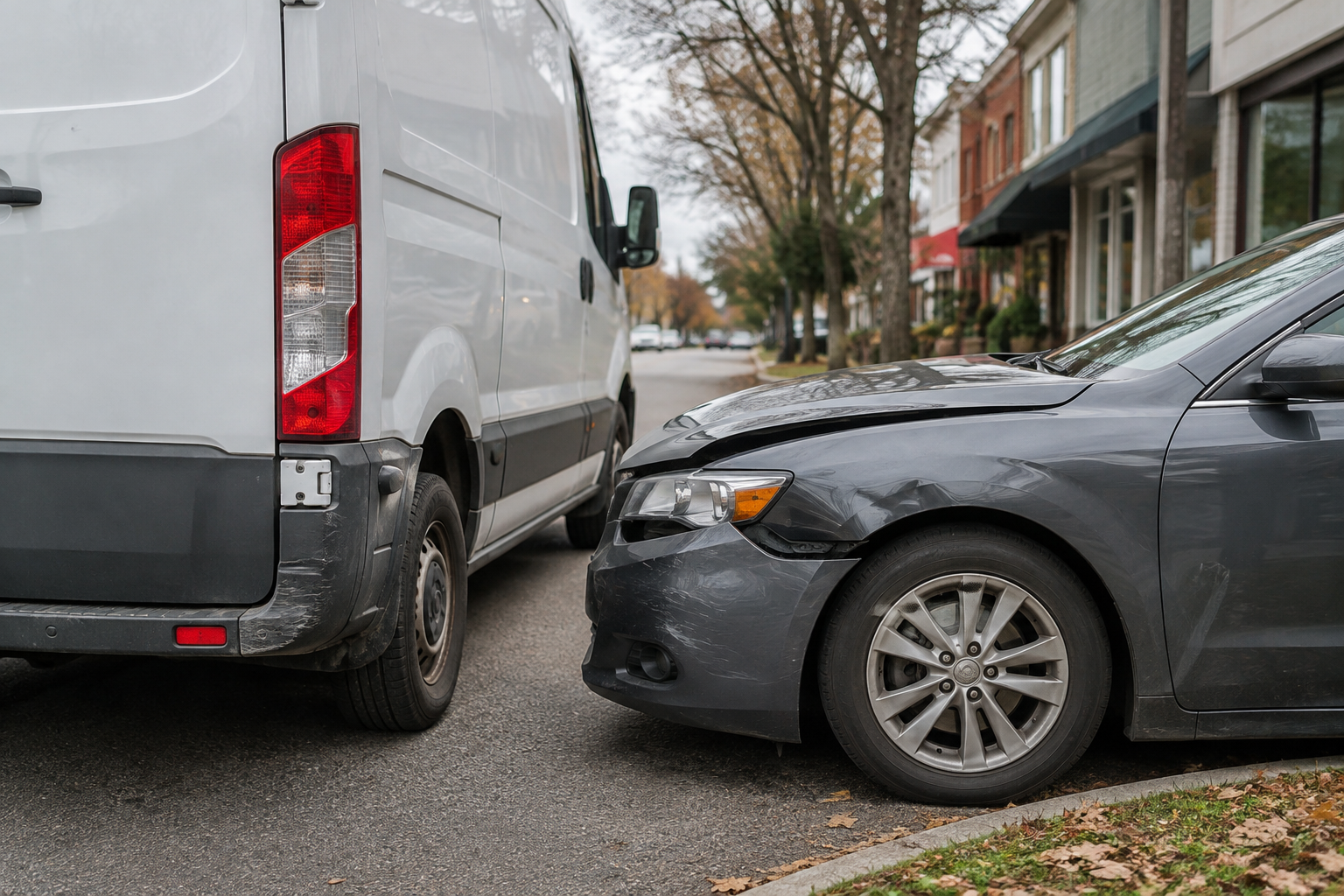
A commercial vehicle accident evidence checklist should cover the scene, the people and businesses connected to the vehicle, records that may disappear, and proof of your injuries and expenses. Save what you can safely access, identify who holds the rest, and ask a licensed attorney about targeted preservation requests. A company logo is a lead—not proof that the company is legally responsible.
This guide focuses on delivery vans, company cars, contractor pickups, and service vehicles. Those crashes can involve business records without being federally regulated large-truck cases. For broader background, see our guides to truck accident claims versus ordinary car claims and dealing with an insurance adjuster.
You do not need to investigate everything while hurt or shaken. Medical care and safety come first. This is general educational information, not legal advice; laws vary by state, and a licensed attorney can explain which evidence and deadlines matter in your situation.
Business involvement is not a reason to assume a larger payout. Use your records to organize medical expenses, missed income, and other costs; the car accident settlement calculator illustrates how those inputs affect a range. It does not establish employer liability, verify commercial coverage, or value the evidence in your case.
What Evidence Should I Collect After a Delivery Van Accident?
Start with evidence that could become harder to reconstruct once vehicles move and witnesses leave. If you cannot gather it safely, ask a trusted person to help from a lawful location or leave the documentation to responding authorities.
Your safe scene checklist
- Vehicle identification: Photograph the plate, vehicle type and color, visible unit numbers, company markings, and any displayed carrier number.
- Crash layout: Capture vehicle positions, lanes, signals, signs, driveways, loading areas, and the direction each vehicle was traveling.
- Damage: Take wider photographs showing the vehicle and closer photographs of damaged areas, without entering traffic.
- Conditions: Record the approximate time, weather, lighting, visibility, and anything obstructing a view.
- People: Keep the driver's exchanged information, witness contact details, and the responding agency's report or incident number.
- Camera leads: Note nearby storefront, residential, parking-lot, or vehicle cameras and where they point.
Suppose a plumbing van backs out of a driveway into your car. A close-up of the dent helps document damage, but a wider photograph may also show a hedge blocking the driver's view. Both are useful; neither alone explains the entire crash.
Write a brief account once you are safe. Separate what you personally observed from what someone told you. “The driver said they were going to a service call” is different from “I know the driver was working.” Record uncertainty rather than filling gaps with guesses.
Do not follow a departing vehicle, confront employees, or step into a loading area to get a better photograph. If the driver leaves, give your observations to police. If injuries prevent you from collecting anything, you can still request a free case evaluation with the information you have.
Does a Company Logo Prove Who Is Liable for a Crash?
No. Branding can help identify a business to investigate, but the driver, registered owner, employer, contractor, and insurer may be different entities. A rented van may carry temporary graphics; a delivery driver may work for a local contractor rather than the brand on the package.
Build a simple identification sheet with a separate entry for each role:
- Driver: Name and information obtained through the normal exchange or crash report.
- Vehicle owner or lessor: The person or business identified in available registration, rental, or ownership records.
- Employer: The business that hired the driver, if known.
- Contractor or platform: Any other business involved in assigning or performing the work.
- Insurer: Each insurance company identified, along with its claim number and the person or entity it says it insures.
Leave unknown entries blank. Do not replace a missing legal business name with a familiar brand. Save photographs showing the exact wording of markings, including smaller operator names that may appear near a door.
As this discussion of delivery-crash responsibility and staffing or contractor relationships explains, an investigation may examine who hired the driver, controlled the route, supplied training, owned the vehicle, and carried insurance.
These facts can help an attorney assess employer responsibility for an employee acting within the scope of work, or separate allegations involving hiring, training, or maintenance. Contractor status and ownership raise additional state-specific questions; neither automatically establishes or defeats liability.
For a company sedan, the distinction between a personal errand and a work assignment may matter. Preserve statements and documents about the trip's purpose without arguing with the driver about employment law. An attorney can investigate the relationship through appropriate requests.
Do Delivery Vans Have Electronic Logging Devices?
Not necessarily. Everyday use of “commercial vehicle” often means a vehicle used for business. That is not the same as establishing that a particular vehicle and operation fall under federal motor-carrier rules—or that a specific electronic logging requirement applies.
A service technician's sedan should not be treated as if it necessarily has the same records as a federally regulated tractor-trailer. Even when motor-carrier regulations apply, requirements and exceptions must be evaluated rather than assumed. Vehicle characteristics, operations, and applicable state rules need review.
Avoid a checklist that demands “the ELD” in every business-vehicle crash. Instead, ask counsel to determine which systems actually existed and who controlled them. Potential sources include:
- A forward-facing or interior-facing dashcam, if installed.
- Fleet GPS or telematics equipment, if used.
- A delivery or service-dispatch app.
- Electronic work orders, appointment schedules, or stop assignments.
- Vehicle event data, where available and relevant.
- Maintenance records held by an owner, fleet manager, or repair provider.
These sources answer different questions. A dispatch assignment may help show why the driver was in the area. Location data may help reconstruct a route. Neither automatically proves distraction, speeding, or fault.
Likewise, an app event near the collision time does not necessarily mean the driver manually operated the phone then. System-generated events, timestamp differences, and missing context need examination. Preserve the underlying records where possible, not just a screenshot offered as a complete explanation.
Commercial Vehicle Evidence: Who Holds It and How to Request It
Some evidence is yours to save immediately. Other material belongs to private businesses, witnesses, or public agencies. Knowing the likely holder helps you give an attorney useful leads without trying to obtain restricted information yourself.
The table below identifies possible custodians, not guaranteed sources. Records may not exist, may contain protected information, or may require formal legal procedures.
| Evidence | Likely owner or custodian | What it may help establish | Appropriate request route |
|---|---|---|---|
| Crash report and scene documentation | Responding law-enforcement agency | Identified parties, reported accounts, scene observations | Agency's authorized report-request process; counsel can help with access issues |
| Storefront or residential camera footage | Business, resident, property manager, or camera provider | Vehicle movements, signal timing, positions before impact | Note the location; ask counsel about prompt preservation and lawful access |
| Driver-facing or road-facing fleet video | Vehicle operator, employer, contractor, or vendor | Available views of the trip and collision | Targeted preservation request through counsel; voluntary production or legal process |
| Dispatch messages and work assignments | Employer, contractor, platform, or dispatch vendor | Trip purpose, scheduling, instructions, assigned stops | Counsel identifies custodians and requests relevant records |
| Ownership, lease, and contractor documents | Owner, rental company, employer, or contractor | Which entities owned, supplied, or operated the vehicle | Available official records plus counsel-directed document requests |
| GPS, telematics, or vehicle event data | Fleet operator, vendor, vehicle owner, or vehicle itself | Recorded location or vehicle operation, depending on system | Counsel coordinates preservation and qualified inspection when appropriate |
| Maintenance and repair records | Owner, fleet manager, repair shop, or leasing company | Reported defects, inspections, repairs, and responsible service providers | Counsel requests relevant records and considers vehicle inspection |
| Insurance correspondence and policy information | You, insurers, and insured businesses | Claim identities, coverage positions, potentially applicable policies | Save your communications; counsel seeks additional information through available procedures |
A California delivery-crash evidence overview describes how owners, contractors, maintenance providers, and other businesses may hold different records. That is a useful investigative principle even though legal responsibility must be evaluated under the law that applies to your crash.
When forwarding a lead, include its source. “Camera above the north entrance, photographed from the sidewalk” is more useful than “the store has video.” Also distinguish an actual recording you possess from a camera you merely noticed.
How Can I Preserve Delivery Driver Camera and Dispatch Data?
Tell an attorney promptly about evidence that could be overwritten, deleted, repaired, or moved. Camera systems, dispatch platforms, and vehicles do not all retain information on the same schedule. There is no universal number of days you can safely wait.
Give counsel a specific preservation brief
Provide the crash date, approximate time and time zone, location, direction of travel, vehicle description, plate, and known business names. Explain any uncertainty in the time estimate. Include camera locations and the names of anyone who said a recording exists.
For each digital source, ask whether preservation should include a relevant period before and after impact, original files, associated timestamps, and information needed to interpret the records. A short clip might omit the approach to the intersection or what happened immediately afterward.
A preservation request generally asks the recipient to retain potentially relevant material. It is not the same as obtaining the evidence, and a letter alone does not guarantee compliance or access. Counsel can assess follow-up steps, inspections, discovery, or other available procedures.
Preservation questions to ask an attorney
- Which companies and outside vendors may hold relevant video or dispatch data?
- Should separate notices go to the owner, employer, contractor, and platform?
- What time window and identifying details should each notice include?
- Are there known deletion schedules or pending vehicle repairs to address?
- Should both vehicles be inspected before repair, sale, or disposal?
- How will receipt, responses, and any gaps be tracked?
- What steps are available if a recipient says the material no longer exists?
Do not assume a claim reported to an insurer automatically preserves every third-party system. If you have a possible camera lead but little else, ask about a free attorney case evaluation and flag that issue clearly.
Safe Evidence Gathering Without Trespassing or Confrontation
Your role is to identify useful information, not conduct a private search of someone else's property or systems. Public-facing evidence includes what you can lawfully observe from a sidewalk or other place you are permitted to be. It does not include entering a fenced fleet yard, opening a parked van, or looking through a driver's device.
Keep these boundaries clear:
- Do not visit a driver's home, follow their route, or approach them at another job.
- Do not enter private loading docks or restricted service areas to photograph records or cargo.
- Do not access accounts, tracking systems, or employee portals without authorization.
- Do not pose as a customer, employee, or insurer to obtain information.
- If a party is represented by counsel, leave communications about the claim to your attorney rather than contacting that party directly.
For an independent witness, a brief, polite request for contact details is enough. Ask what they saw without suggesting an answer. If they decline, do not press them. Give your attorney any information you already have.
A nearby business may voluntarily help identify its camera contact. You can note that contact without demanding footage or debating privacy restrictions. Counsel can handle preservation and access requests, particularly if the business may itself be involved in the claim.
Public business listings can also help distinguish similarly named contractors. Save the page address and date viewed, but treat it as a lead—not proof of employment, ownership, insurance, or control on the crash date. A website may describe current operations rather than the arrangement that existed when you were injured.
Evidence of Injuries, Expenses, and Insurance Coverage
Showing how a collision happened is only part of pursuing fair compensation. You also need records connecting the crash to your injuries and documented losses. See a qualified medical provider and describe your symptoms and the collision accurately; let the provider evaluate your care needs.
Create separate folders for:
- Medical care: Visit summaries, referrals, treatment instructions, bills, and insurance benefit statements.
- Work losses: Missed dates, pay records, employer verification, and documentation of reduced hours or modified duties.
- Vehicle losses: Photographs, estimates, invoices, towing records, and rental receipts.
- Other expenses: Receipts for reasonably related out-of-pocket costs, with a short explanation of each.
- Daily effects: Brief factual notes about activities you could not do or needed help completing.
A medical bill and an insurer's benefit statement are not interchangeable. Keep both, and avoid counting the same charge twice in your own expense summary. For missed work, preserve the underlying pay records rather than relying only on a rounded total.
Track coverage without assuming who will pay
Keep each insurer's communications in a separate thread or folder. A company vehicle might lead to questions about the driver's policy, an employer's commercial policy, or another business's coverage. Identifying an insurer does not establish that its policy covers this collision.
When an adjuster contacts you, record whom they represent, the claim number, what they request, and any stated deadline. Be accurate, avoid guessing about speed or employment relationships, and ask counsel about broad releases, recorded statements, or coverage questions you do not understand.
Save written explanations of any disputed bill, denial, or request for more documentation. For general questions beyond this evidence guide, visit the car accident FAQ.
Organize Your Crash Evidence Without Losing Context
A useful evidence folder lets someone understand what an item is, where it came from, and what remains unknown. You do not need expensive software. A secure digital folder and a simple index can work.
Keep original photographs and recordings unchanged. If you crop an image or brighten a copy for viewing, retain the original separately. Back up your own dashcam recording before normal use overwrites it, following the device instructions, and avoid deleting unfavorable or confusing material.
For each item, record:
- The date you received or created it.
- The person, agency, or device it came from.
- A short description and file name.
- Whether it is an original, copy, screenshot, or excerpt.
- Any uncertainty about time, location, completeness, or source.
Keep a separate missing-evidence list. For example: “Driver mentioned a dispatcher; employer unknown,” or “Apartment camera faces exit; recording not confirmed.” These are investigation tasks, not established facts.
If a crash report contains an error, ask the agency about its correction or supplement procedure. Keep the original and any later version. Do not alter the report yourself or assume an officer's account resolves every disputed issue.
Finally, distinguish evidence-retention concerns from claim-filing deadlines. They are different problems, and waiting for a complete file may put either at risk. Our guide to state-specific crash claim deadlines explains why timing needs individual review. You can also find car accident lawyer information by state when preparing questions for local counsel.
First Attorney Call: Evidence Packet Checklist
- Put the crash date, location, and your contact details on a one-page cover sheet.
- Select clear copies of the plate, vehicle markings, and overall scene photographs; keep originals separately.
- Attach the incident number or report and identify the responding agency.
- List every insurer and claim number, identifying which vehicle or business each concerns if known.
- Flag any scheduled repair, towing transfer, or disposal affecting either vehicle that you know about.
- Include camera leads even if you have not confirmed a recording exists.
- Mark unknown employer, contractor, or owner information as unknown rather than guessing.
- Ask for a secure method to send medical and other sensitive documents.
Questions for Evaluating a Digital Evidence Lead
- Who told you the recording or data exists, and when did they tell you?
- Is this an actual file you possess, or only a possible source to investigate?
- What exact vehicle, entrance, roadway, or time period might the source capture?
- Does the displayed timestamp match the crash time, or is that still uncertain?
- Have you saved the source's contact information without accessing restricted systems?
- Has anyone mentioned deletion, equipment replacement, or loss of account access?
- Have you told counsel whether the source may be a party to the claim?
- If you received a clip or screenshot, have you identified who supplied it and whether a fuller original may exist?
Loss Documentation Cross-Check
| Claimed loss | Keep together | Gap to flag for review |
|---|---|---|
| Medical expense | Provider bill, payment receipt, benefit statement | Missing bill or unclear adjustment |
| Missed wages | Absence dates, pay records, employer confirmation | Dates or hours that do not match |
| Vehicle repair | Damage photographs, estimate, final invoice | Work unrelated to the collision |
| Rental transportation | Rental agreement, dated receipts, repair timeline | Unexplained rental dates or charges |
| Out-of-pocket assistance | Receipt, service date, description of help | Unclear connection to crash-related limitations |
Request a Free Case Evaluation About Missing Commercial Vehicle Evidence
You can ask for help before you know the driver's employer or have obtained a crash report. Bring the basics you have: crash date and location, vehicle identifiers, known injuries, insurer communications, and any camera or dispatch leads. Clearly flag upcoming repairs or other reasons evidence may become unavailable.
Free Case Evals is not a law firm. It is a free service that connects people injured in motor vehicle accidents with participating attorneys for a free case evaluation. A licensed attorney can discuss the applicable state law, possible evidence sources, and whether further investigation may be appropriate.
Request your free case evaluation to discuss your crash and the records you already have. You do not need to solve the business relationships yourself before asking informed questions about your next steps.
Sources
- Which Proof Helps a Philadelphia Delivery Crash Lawyer?
- California Commercial Delivery Truck Accident Claims
Sources consulted 2026-10-17. This is not an attorney-review date.
Printable Checklists From This Article
Frequently Asked Questions
What if the delivery van had no company markings?
Save the license plate, vehicle description, driver information, and incident number if available. An unmarked vehicle can still be used for business, but its appearance alone does not establish the driver's work status.
Can a delivery confirmation help identify the vehicle that hit me?
A delivery confirmation you lawfully received may provide a useful time, address, or service-provider lead. Save the original message, but do not treat it as proof that a particular driver or vehicle caused the crash.
Should I post my crash video online to find witnesses?
Preserve the original privately and ask an attorney before posting claim-related material publicly. A public clip may omit context or expose personal information; counsel can discuss other ways to seek witnesses.
What if the company says its driver was an independent contractor?
Save that communication and identify who made the statement. The label alone does not resolve responsibility; an attorney may need to examine contracts, work arrangements, and applicable state law.
Can I still pursue a claim if there is no camera footage?
Missing video does not by itself determine whether you have a claim. Photographs, witnesses, vehicle damage, available business records, and medical documentation may provide other evidence for an attorney to evaluate.
Should I download data from the other vehicle myself?
No—do not access or connect equipment to someone else's vehicle without authorization. Tell counsel why the data may matter so any preservation or inspection can be arranged lawfully with appropriate technical help.
What if the service vehicle was repaired before I contacted a lawyer?
Tell the attorney when you learned about the repair and preserve any earlier photographs or communications. Repair estimates, invoices, inspection records, or other existing materials may still help document the vehicle's condition.
Does Free Case Evals send preservation letters?
Free Case Evals is not a law firm and does not provide legal representation or send legal preservation demands on your behalf. The service connects injured people with participating attorneys for a free case evaluation, where they can ask about preservation needs.
This article is for general informational purposes only and is not legal or medical advice. Laws vary by state. Speak with a licensed attorney about your specific situation.
Hurt in a car accident?
Answer a few quick questions to see if you may qualify for a free case evaluation. No cost, no obligation.
Start My Free Case Evaluation