
Car Accident With a Company Vehicle: When May the Employer Be Liable?
Free Case Evals · October 30, 2026
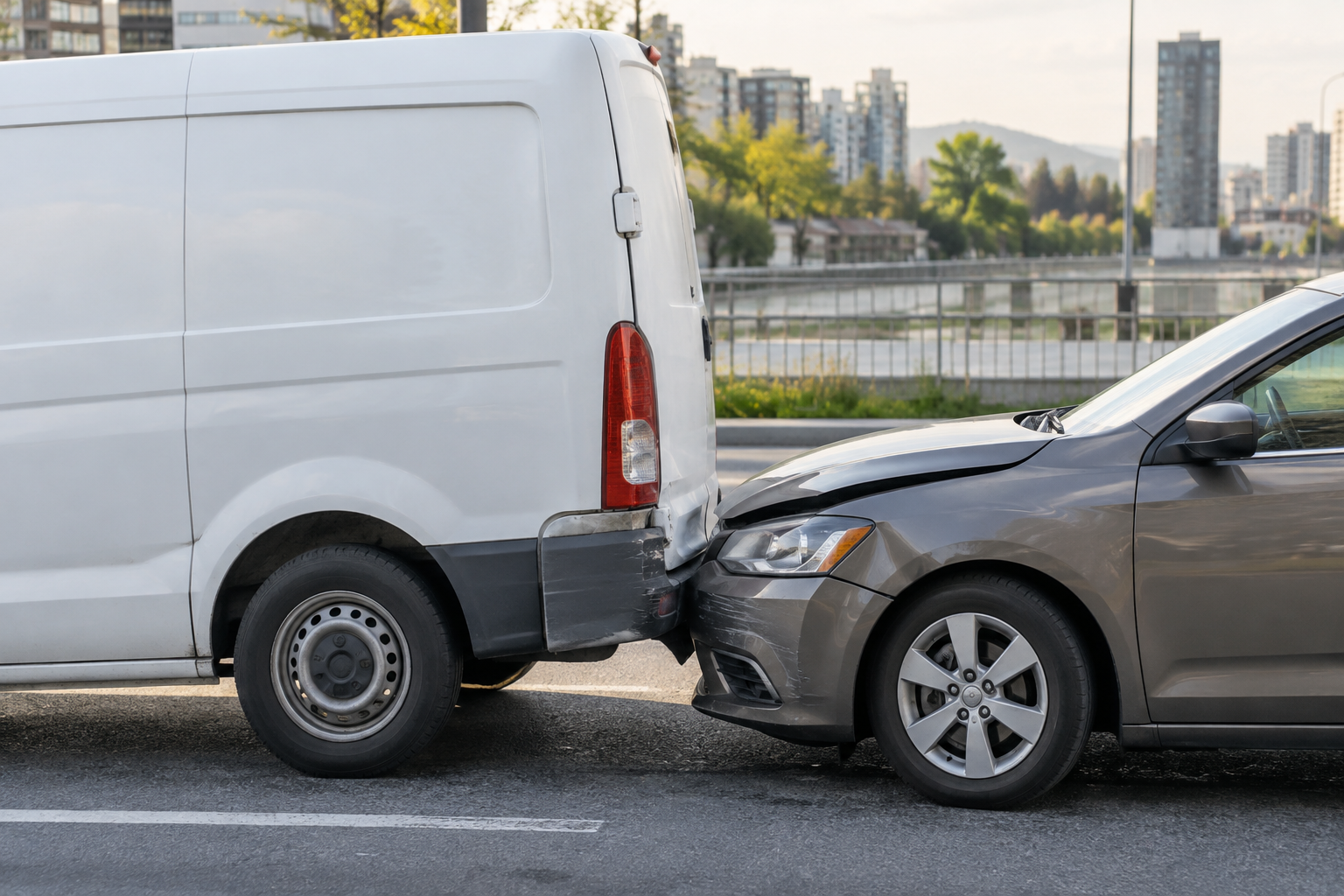
A car accident involving a company vehicle can leave you dealing with more than another driver. There may be a business owner, a fleet manager, and an unfamiliar insurance company—all while you are trying to get medical care and figure out how to get to work. If the driver caused the crash while performing job duties, their employer may also be legally responsible. Company ownership alone, however, does not settle liability or guarantee insurance coverage.
Your claim usually turns on three separate questions: what caused the collision, whether the driver was acting for the business, and which insurance policies cover the loss. A work van’s logo is a useful lead, not a complete answer. This article focuses on those company-specific issues; for broader help, see our guides to deciding whether to get a car accident lawyer and understanding the car accident settlement process.
The information below is general education, not legal advice. State laws and policy language differ, so a licensed attorney should assess your circumstances—especially if the company denies responsibility or several insurers are sending you elsewhere.
Business involvement is not a reason to assume a larger payout. Use your records to organize medical expenses, missed income, and other costs; the car accident settlement calculator illustrates how those inputs affect a range. It does not establish employer liability, verify commercial coverage, or value the evidence in your case.
Who Is Liable When a Company Vehicle Hits Your Car?
The driver may be liable for negligent driving, and the employer may share liability when the driving occurred within the scope of employment. That legal principle is commonly called respondeat superior, a form of vicarious liability. It can make the employer responsible for an employee’s work-related negligence even if a supervisor was nowhere near the crash.
As FindLaw explains in its company-vehicle accident overview, the employee’s work duties and the purpose of the trip matter to employer responsibility. The driver still has a duty to drive safely; using a work vehicle does not erase that duty.
Think of a repair technician who rear-ends you while traveling between service appointments. The collision evidence addresses whether the technician drove carelessly. Appointment and dispatch records address whether the trip was part of the job. Both sets of facts matter, but they prove different things.
Separate the driver, employer, owner, and insurer
These may be different entities. A van might be leased, operated by a local contractor, and display branding associated with a larger business. Avoid assuming that the most recognizable name is necessarily the responsible employer.
Try to identify:
- The driver’s full name and contact information.
- The business the driver says they work for.
- The registered vehicle owner, if available through exchanged documents or the crash report.
- The insurer and policy information provided at the scene.
- Any separate fleet operator or contracting business mentioned afterward.
Keep the exact names rather than shortening them to a brand. A small difference in a business name can matter when identifying the correct party or opening the right claim.
Was the At-Fault Driver Working at the Time of the Accident?
The strongest company-vehicle claim usually needs more than proof that the driver had a job. You need facts connecting the trip to that job. Delivering supplies, visiting a customer, moving between worksites, and completing an employer-directed errand can all support that connection.
Write down what the driver said about their destination while it is fresh. For example, “I’m late for my next installation” may point toward appointment records worth investigating. Record the words as accurately as you can without turning your recollection into a quotation you are unsure about.
What if the driver was commuting or running a personal errand?
A normal commute or an entirely personal trip can raise scope-of-employment defenses. But those labels do not answer every case. Employer requirements, the trip’s purpose, and any work being performed along the way may change the analysis under state law.
A brief stop during a work route can also present a different question from taking the vehicle on a substantial personal outing. If an insurer says “the driver was off duty,” ask what facts support that conclusion. A schedule entry alone may not explain why the driver was on that road.
Useful questions include:
- Where was the driver coming from and going next?
- Who assigned or approved the trip?
- Was the driver carrying tools, supplies, or customer orders?
- Had the driver received dispatch instructions?
- Was the company benefiting from the travel?
You may not be able to obtain internal records yourself. The practical goal is to identify what needs investigation, not to confront the driver’s employer or prove the entire claim before requesting help.
Which Insurance Pays After a Car Accident With a Company Vehicle?
A commercial auto policy may cover a qualifying claim arising from the driver’s use of a work vehicle. But legal responsibility and insurance coverage are separate questions. An employer may dispute liability, an insurer may dispute coverage, or both may happen at once.
Super Lawyers’ discussion of company-car crashes describes how driver and employer responsibility can overlap and how an insurance adjuster investigates a claim. For you, that means identifying the insurer is only the beginning; you also need to understand what it is investigating and whether it has accepted coverage.
Keep separate claim tracks organized
Depending on the circumstances and your policies, there may be questions about the driver’s insurance, the business’s insurance, and coverage available through your own insurer. Do not assume a personal auto policy covers every business use, or that a company policy covers every person driving the vehicle.
Create a simple contact log with the insurer’s name, claim number, adjuster, and the issue that adjuster handles. Property damage and bodily injury may be assigned separately. Ask each representative to clarify their role rather than treating every call as part of one unified process.
If you have personal injury protection or other applicable first-party benefits, ask your insurer about eligibility, required documents, and reporting obligations. No-fault rules concern certain injury benefits; they do not mean that every crash-related loss is automatically paid by your own carrier.
If insurers are redirecting you without explaining why, you can request a free case evaluation. Free Case Evals connects people injured in motor vehicle accidents with participating attorneys; it is not a law firm and does not decide coverage.
Proving Fault in a Company-Vehicle Crash
A work-related trip does not prove the employee caused your collision. You still need evidence of the driving conduct that led to it. Keep the fault investigation separate from the question of who employed the driver.
Photographs of vehicle positions, damage, lane markings, traffic controls, and sightlines can help explain what happened. Preserve original dashcam files and witness contact details. Obtain the crash report when available, then review identifying information and the reported sequence of events for errors.
Suppose a company pickup turns left across your lane. The relevant questions include the signal, right of way, speed, visibility, and each vehicle’s movement—not merely who owned the pickup. Our explanation of left-turn accident fault and right-of-way evidence covers that collision pattern in more detail.
For a service van backing out at a shopping center, the layout and each driver’s movement may be central. See how parking lot accident fault depends on yielding and the surrounding facts.
Be precise when describing the crash. “The van entered my lane” is more useful than “the company is responsible for everything.” Separate what you observed from what you inferred. If you did not see the driver using a phone, do not present distraction as an established fact.
If the insurer alleges you also contributed, ask which conduct and evidence it relies on. State fault rules can affect recovery. A disputed allegation should be evaluated against the evidence rather than accepted simply because an adjuster states it confidently.
Company Records That Can Connect the Trip to the Employer
Some of the most useful information may be in the business’s systems rather than in your glove compartment. Dispatch logs, route histories, work orders, time records, and vehicle assignments can help explain why the driver was traveling.
An article addressing company-owned vehicle liability in Florida identifies time sheets, vehicle records, and job descriptions as potentially useful when work duties are disputed. The legal rules vary by state, but the practical lesson travels well: investigate the assignment behind the trip.
Match the record to the disputed issue
A work order may establish the destination but say nothing about the collision. A vehicle-location record may show the route without explaining whether an errand was authorized. A job description may establish driving duties without proving what the employee was doing that afternoon.
Ask what combination of records could answer the specific dispute. For example:
- “The driver had finished work.” Look for the last assignment, delivery confirmation, and communications about subsequent tasks.
- “That vehicle does not belong to us.” Identify the owner, lease arrangement, and entity operating it.
- “The driver was not our employee.” Investigate the working relationship and who directed the trip.
- “The collision happened differently.” Identify available video, vehicle data, and independent witnesses.
Raise preservation concerns early
Video and electronic records may not remain available indefinitely. Tell an attorney promptly about visible cameras, dashcams, fleet tracking, or dispatch systems that may hold relevant information. Ask whether preservation requests are appropriate and who should receive them.
Do not access private systems, impersonate someone, or pressure employees for confidential files. Save what you lawfully possess and identify the rest for investigation. A screenshot of a company name or fleet number can be a useful starting point even when you have no access to the underlying records.
What If the Company Says the Driver Was an Independent Contractor?
The contractor label can change the liability analysis, but it should prompt investigation rather than end your inquiry. The actual working arrangement and applicable state law matter. Who directed the trip, controlled the work, and supplied the vehicle may be relevant to an attorney’s review.
Munley Law’s company-vehicle discussion notes that contractor situations require close attention to the facts. You should not assume that a branded vehicle establishes employment—or that a company’s denial conclusively disproves it.
Ask the adjuster to identify the business that employed or contracted with the driver and the insurer handling that entity’s claim. Save any written explanation of the denial. If a delivery vehicle carries a large retailer’s name but is operated by a separate delivery company, both identities are useful leads, not proof that both are liable.
Other variations deserve careful review too:
- An employee’s personal car used for work: Employer responsibility may still be possible; title ownership is not the only issue.
- A borrowed or leased work vehicle: Identify the operator and applicable coverage instead of assuming the owner handles everything.
- A government vehicle: Special legal procedures can apply. Flag the government connection immediately rather than treating it as an ordinary private-company claim.
These are good reasons to see whether your crash may warrant a case review. Bring the denial and the names of every entity involved. You do not need to resolve the employment relationship before asking a licensed attorney to assess it.
Documenting Your Losses Without Assuming a Bigger Payout
A commercial vehicle does not automatically mean a larger settlement. Your claim still needs support for the harm the collision caused, and available coverage must be investigated rather than guessed. A recognizable business name says little about what your particular claim is worth.
Start with medical care from a qualified provider. Keep visit summaries, bills, payment records, and treatment recommendations. Be accurate about your symptoms, prior relevant issues, and how the crash has affected everyday activities. Medical decisions should follow your provider’s guidance, not a strategy for increasing a claim.
For income loss, collect documents that distinguish missed work from an estimate. Useful materials may include payroll records, attendance records, and an employer’s confirmation of missed shifts. If you work for yourself, preserve canceled appointments, invoices, and business records that explain the claimed loss without treating gross revenue as automatically equivalent to lost income.
For vehicle and transportation expenses, keep repair estimates, photographs, invoices, towing records, and receipts for necessary alternative transportation. Ask the insurer about authorization and documentation before assuming every expense will be reimbursed.
A short, factual recovery journal can help you remember limitations that bills do not capture: needing help with errands, missing ordinary activities, or struggling with work tasks. Describe actual changes without exaggeration.
Finally, keep track of who has already paid each bill. An attorney may need to examine reimbursement issues before assessing what a settlement would leave you. Do not confuse the total amount demanded, the settlement amount, and the money ultimately available after obligations are addressed.
Handling Employer Denials, Adjuster Requests, and Deadlines
Company-vehicle claims can involve two investigations: the insurer’s claim review and the employer’s internal review. You may hear from several people asking similar questions. Before responding, identify who is contacting you, whom they represent, and what information they want.
Give accurate information and avoid guessing about the driver’s job status, company policies, or your future recovery. If you do not know an answer, say so. Keep copies of correspondence and summarize phone calls with dates and names.
Ask whether the dispute is about fault, employment, or coverage
A statement such as “we are not responsible” is too vague to help you decide what to do next. Ask for the position in writing and whether it concerns:
- The driver’s role in causing the crash.
- Whether the trip was work-related.
- The identity of the employer or vehicle operator.
- Whether a policy applies to this driver or use.
- The relationship between the collision and your claimed losses.
Each issue calls for different evidence. Sending more medical bills will not resolve a dispute about who employed the driver.
Review requests for recorded statements, broad authorizations, or releases carefully with an attorney, particularly if you do not understand their scope. Also ask your own insurer about contractual cooperation requirements rather than assuming every insurer request can be handled the same way.
Claim discussions do not necessarily protect a lawsuit deadline. State filing rules vary, and government-related claims may involve special procedures. Get deadline guidance promptly rather than waiting for an adjuster to finish investigating. For general questions, visit the car accident FAQ; for location-specific help, find a car accident lawyer by state.
Company-Vehicle Claim File Setup Checklist
- Create separate folders for collision evidence, business identity, insurance correspondence, medical records, and expenses.
- Save original photographs and videos; keep an additional backup without editing the original files.
- Put each insurer's claim number and adjuster contact details on a single reference sheet.
- Label business names by their reported role: employer, vehicle owner, fleet operator, or contracting company.
- Scan letters and save envelopes when the mailing date may matter.
- Keep a running list of unanswered questions and who said they would follow up.
- Set reminders for requested documents and ask an attorney to confirm applicable legal deadlines.
Records to Discuss With an Attorney
| Record | Question it may help answer | Possible source |
|---|---|---|
| Dispatch assignment | Was the trip directed by the business? | Employer or dispatch provider, through appropriate requests |
| Customer appointment or work order | Was there a work destination near the crash location? | Business or customer records |
| Vehicle assignment or lease | Which entity operated or supplied the vehicle? | Fleet manager, owner, or leasing business |
| Route or location history | Did the vehicle follow a work route or deviate from it? | Business or fleet technology provider |
| Coverage-position letter | Is the insurer disputing coverage, liability, or both? | Claim adjuster |
| Payroll and attendance documentation | What work and income did the injured person miss? | Your employer or your own business records |
Questions for a Company-Vehicle Case Evaluation
- Ask which facts would help determine whether the driver was acting within the scope of employment.
- Ask whether the business name on the vehicle matches the likely employer or operator.
- Ask which records may need prompt preservation and who should receive a request.
- Ask what the insurer's written denial actually disputes and what evidence could address it.
- Ask whether your own insurance offers benefits while the liability claim is pending.
- Ask which state deadlines and any special government-claim procedures may apply.
- Ask how any proposed release could affect unresolved claims against other parties.
- Ask about representation terms and fees separately from the free evaluation.
Request a Free Evaluation of Your Company-Vehicle Accident Claim
If the driver who injured you was making deliveries, traveling between jobs, or handling a company errand, a case evaluation can help identify questions about employer responsibility and insurance. It can also help when the business denies the work connection or different companies point at one another.
Bring whatever you have: the crash report, photographs, insurer correspondence, medical documentation, and any company or fleet information. Tell the attorney what remains uncertain, especially disputed work status, missing records, and any deadline or release mentioned by an insurer. Missing paperwork is not a reason to postpone asking questions.
You can request a free case evaluation through Free Case Evals. Free Case Evals is a free service connecting people injured in motor vehicle accidents with participating attorneys. It is not a law firm, does not provide legal advice, and cannot promise representation or a particular result.
Sources
- What Happens if You Get in a Car Accident in a Company Vehicle? - FindLaw
- What To Do if You're in a Car Accident with a Company Car
- Accident In Company Vehicle: Who Pays?
- Company-Owned Vehicle Involved in an Accident in Florida?
Sources consulted 2026-10-30. This is not an attorney-review date.
Printable Checklists From This Article
Frequently Asked Questions
Can I make a claim if I was a passenger hit by a company vehicle?
Potentially, yes. Your status as a passenger does not by itself prevent a claim against a negligent work driver or a legally responsible employer. An attorney can evaluate the collision evidence and applicable insurance.
Does the company logo on a van prove the company owns it?
No. Branding can identify a business connection, but the vehicle may be leased or operated by another entity. Ownership, operation, and employment records can help establish the relevant relationships.
What if the company driver gave me only a personal insurance card?
Keep that information and tell the insurer that the vehicle may have been used for work. Ask whether a business insurer or fleet claims contact is involved. A personal insurance card alone does not resolve which coverage applies.
Can I still pursue a claim if the company fires the driver after the accident?
A later employment decision does not itself establish or eliminate responsibility for the crash. The driver's relationship with the company and activities at the time of the collision remain relevant. Preserve any communications discussing those facts.
Does a traffic ticket against the work driver guarantee payment?
No. A citation may be relevant, but it does not automatically resolve civil liability, employer responsibility, insurance coverage, or the amount of your losses. Other collision and claim evidence still matters.
What if the company offers to pay my repair shop directly?
Ask for the offer and its terms in writing, including whether any release is required. Do not assume a repair arrangement resolves—or leaves untouched—your injury claim. Have a licensed attorney review unclear release language before signing.
Do all company vehicles have high insurance limits?
No particular limit can be assumed from a vehicle's appearance or the size of the business. Applicable coverage and limits require investigation. Even substantial coverage does not establish the value or validity of an individual claim.
Is Free Case Evals the law firm that handles my company-car accident?
No. Free Case Evals is a free service that connects people injured in motor vehicle accidents with participating attorneys for a free case evaluation. Any representation arrangement would be discussed with the attorney, not assumed from requesting an evaluation.
This article is for general informational purposes only and is not legal or medical advice. Laws vary by state. Speak with a licensed attorney about your specific situation.
Hurt in a car accident?
Answer a few quick questions to see if you may qualify for a free case evaluation. No cost, no obligation.
Start My Free Case Evaluation