
Who Is at Fault in a Left-Turn Accident? Signals, Speed, and Evidence
Free Case Evals · October 25, 2026
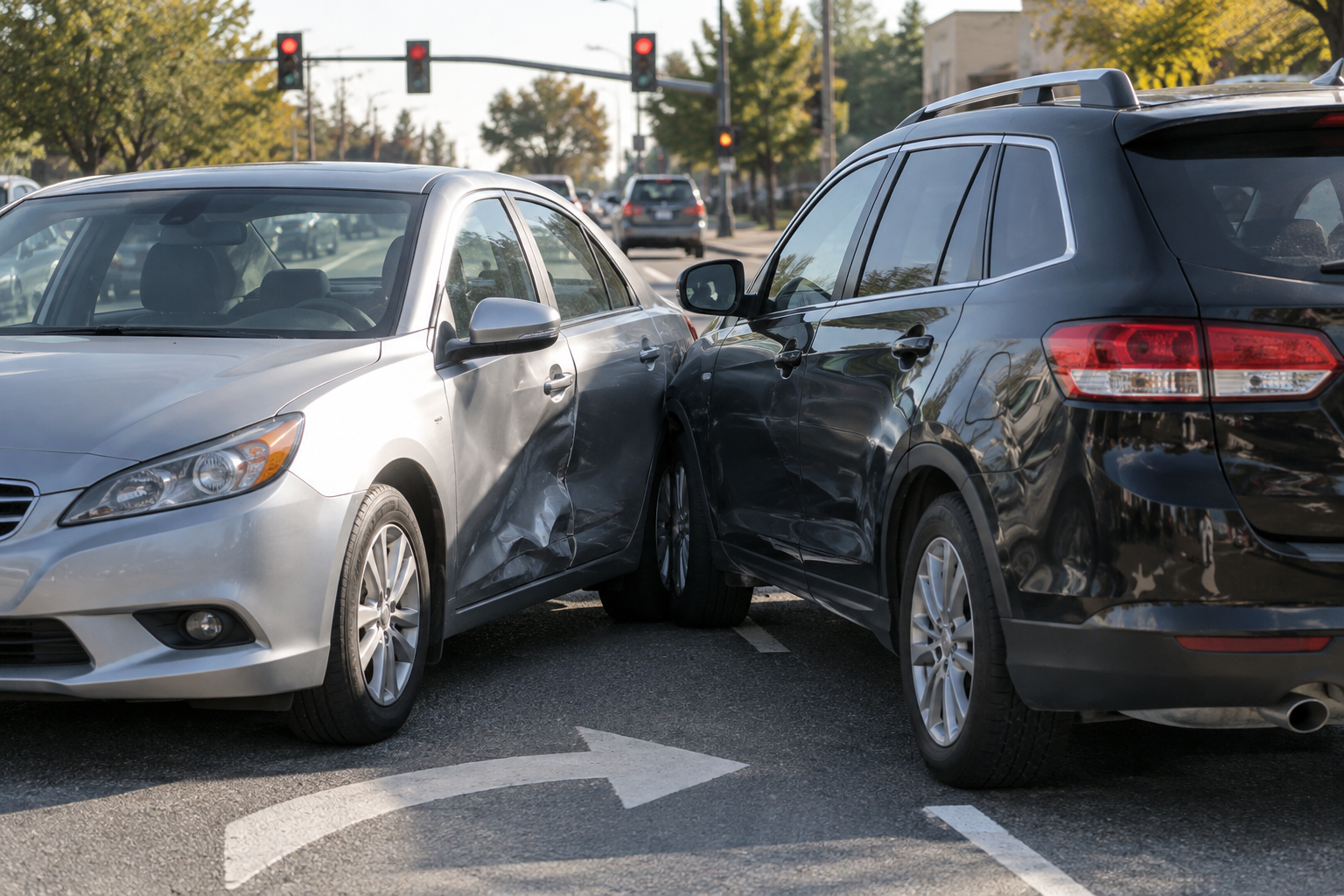
Who is at fault in a left-turn accident? The short answer is that the turning driver often bears responsibility because drivers generally must yield to oncoming traffic that presents a hazard. But fault is not automatic: a red-light violation, unsafe speed, or other contributing conduct by the oncoming driver can change the result. The answer depends on the applicable state law and evidence of how both drivers approached the collision.
That distinction matters when you’re injured and an adjuster treats “you turned left” as the end of the investigation. It also matters if you were traveling straight and the other driver claims you appeared too quickly. Neither account should substitute for examining the signal, available gap, sight lines, and timing.
This article focuses on proving what happened in a left-turn crash. For the broader financial consequences, see our guide to how partial fault affects compensation. If you’re deciding whether you need help investigating, our guide on when to get a lawyer after a car accident explains that separate decision. This is general educational information, not legal advice; laws vary by state.
Keep the evidence about responsibility separate from the records of your losses. You can use the car accident settlement calculator to illustrate medical costs, missed income, and pain-and-suffering assumptions, but it does not decide fault, apply your state’s negligence rules, or check whether insurance is available.
Is the Left-Turning Driver Always at Fault?
No. The usual starting point is the turning driver’s duty to yield, not a nationwide rule automatically assigning blame. As Farah & Farah’s explanation of left-turn fault describes, failing to yield commonly makes the turning driver responsible, while the other driver’s conduct can support shared fault.
Picture yourself waiting to turn into a grocery store. An approaching vehicle is close enough that turning would put you directly in its path. Beginning the turn anyway can support a failure-to-yield finding. Using your turn signal communicates your intention; it does not give you priority over approaching traffic.
The investigation should separate three questions:
- What duty applied? Was the turn controlled by an arrow, ordinary signal, stop sign, or driveway entrance?
- What did each driver do? Consider turning, accelerating, braking, lane changes, and signal compliance.
- Which conduct contributed to the collision? A violation matters to fault when it helps explain why the crash occurred.
Avoid describing every left-turn collision as carrying a formal “presumption” of fault. The legal effect of the circumstances depends on state law, and an insurer’s usual approach is not itself a legal standard.
If someone has already blamed you, ask what evidence supports that conclusion beyond the fact that you turned. You can request a free case evaluation to discuss the disputed facts with a participating attorney through Free Case Evals, a connection service—not a law firm.
Who Is at Fault in a Left-Turn Accident at a Green Light?
The type of green signal matters. A circular green light and a protected green arrow should not be treated as interchangeable. Reconstructing which signal each driver faced is often more useful than simply asking whether “the light was green.”
Ordinary green lights and protected turn arrows
With an ordinary green light, a left-turning driver generally still must yield to conflicting oncoming traffic. A driver may honestly remember having green without having the right to cross an approaching vehicle’s path at that moment.
A protected left-turn arrow presents a different factual question. Investigators need to establish whether the arrow was active when the turn began and what signal controlled the opposing lane. Evidence that the oncoming driver entered against a red signal can shift responsibility, although the entire sequence still matters.
Be specific when describing the signal:
- Which lane were you in?
- Was the illuminated symbol an arrow or a circle?
- Where was your vehicle when you last observed it?
- Did you personally see the opposing signal, or are you assuming its color?
Yellow lights and changing signals
Yellow-light crashes are especially disputed because the drivers may be describing different moments. One may remember entering the intersection; another remembers the instant of impact.
Shulman & Hill’s discussion of left-turn collision evidence identifies signal timing, witnesses, and camera footage as useful in these disagreements. Local yellow-light rules and the vehicles’ positions affect the analysis. Do not assume that a light turning yellow either authorizes a turn or proves the oncoming driver broke the law.
Write down what you actually observed as soon as practical. “I saw a circular green before moving forward” is more useful than an unsupported statement that the other driver “must have had red.”
What If the Oncoming Driver Was Speeding in a Left-Turn Crash?
Speeding can support fault against the oncoming driver, but it does not automatically excuse an unsafe turn. The question is how the speed affected the available gap, the time to react, or the ability to avoid impact.
Suppose an approaching car appears far enough away for a safe turn, but reaches the intersection much sooner than expected. That raises a speed question. It does not establish the answer. Investigators still need to consider distance, visibility, the turning vehicle’s movement, and whether the approaching car was already an obvious hazard.
A Justia discussion of a left turn across a multilane road illustrates this distinction: alleged speeding and a turning driver’s failure to yield can both require investigation. The discussion concerns California facts and should not be treated as a rule for every state.
Useful support for a speed allegation may include video covering the approach, reliable witness observations, and physical evidence assessed by someone qualified to interpret it. Saying “the damage was severe, so they must have been speeding” is not a reliable substitute.
Distraction raises a similar issue. A driver traveling straight still has responsibilities, but an allegation that they were looking at a phone needs support. Record specific observations rather than conclusions: for example, a witness saw the driver looking down before entering the intersection.
When speaking with an adjuster, distinguish what you know from what you suspect. Ask whether the investigation considered the oncoming driver’s approach rather than only your turning movement.
How Fault Changes at Driveways, Stop Signs, and Blocked Intersections
Not every left-turn crash occurs under traffic lights. The layout can explain why drivers disagree and identify evidence that an intersection-only investigation might miss.
Turning left out of a parking lot
If you were leaving a shopping center, document each lane you needed to cross and where your vehicle was when the collision occurred. A car stopped in the nearest lane does not establish that the farther lanes were clear.
A driver’s wave can be misunderstood. It may mean only that the waving driver will wait—not that they checked every lane or transferred the right of way. Record the wave if it happened, but also explain what you could see independently.
A center turn lane adds another factual question. Were you entering it, crossing it, or waiting within it? A sketch showing lane boundaries and your vehicle’s position can prevent an adjuster from picturing a different maneuver.
Stop signs and obstructed views
At a stop-controlled or uncontrolled intersection, investigators need to identify the controls for each approach, arrival sequence, and applicable right-of-way rules. “I stopped first” alone does not explain whether proceeding with the turn was safe.
A delivery van, roadside vegetation, or stopped traffic may have blocked your view. Photograph the obstruction from a safe location, including how it relates to the driving lanes. An obstructed view explains the conditions; it does not automatically excuse proceeding without a clear path.
Preserve details that can disappear. A parked truck may leave, a work zone may change, and backed-up traffic will clear. Wide photographs showing the entire approach can be more informative than close-ups of a bumper.
What Evidence Proves Fault in a Left-Turn Accident?
The strongest investigation connects independent records to specific disputed facts. Collecting a large folder is less useful than identifying which item helps establish the signal, vehicle path, available view, or opportunity to react.
Video and witness accounts
Dashcam or nearby business footage may show the approach and impact. Ask promptly whether relevant footage exists and can be preserved; do not assume every intersection camera records or that a business will retain footage indefinitely. An attorney can help evaluate appropriate preservation and access steps.
Keep original files when possible, rather than only a short edited clip. The seconds before the turn may explain more than the impact itself. Note whether a camera’s displayed time appears inconsistent with the actual crash time.
For witnesses, obtain contact information and note where they were positioned. Someone behind your vehicle may have seen your signal but not the opposing traffic light. Someone on the sidewalk may have a better view of the approaching car. Their vantage point affects what their account can establish.
Vehicle damage and roadway evidence
Damage location can help reconstruct vehicle orientation and contact. A side impact may be consistent with a vehicle crossing another’s path, but it does not independently establish which driver had the right of way.
Photograph, when safe:
- Each vehicle from several angles, not just the damaged area.
- Lane markings, turn pockets, stop lines, and signs.
- Debris, visible tire marks, and final vehicle positions.
- Sight-line obstructions and lighting or weather conditions.
Record whether vehicles were moved before photographs were taken. Final resting positions are not necessarily impact positions, and repair photographs may not show the original scene.
Police reports and competing statements
A police report may identify witnesses, diagram the crash, record statements, and note citations. Request a copy and review objective details such as direction of travel and lane identification. If something is inaccurate, ask the issuing agency about its correction or supplemental-information process.
A report or ticket can matter, but neither automatically settles civil liability. An officer who arrived afterward may be documenting accounts rather than personally observing the collision. Keep the distinction between observations, driver statements, and conclusions clear when presenting the report to an insurer.
How Shared Fault Affects a Left-Turn Injury Claim
A collision can involve both an unsafe turn and negligent conduct by the approaching driver. When both contributed, state law determines how shared responsibility affects the injured person’s ability to recover compensation.
In comparative-negligence systems, a person’s share of fault generally reduces recoverable damages. Some states also restrict recovery when fault reaches a specified threshold. Contributory-negligence rules can be much more restrictive. Do not assume that a friend’s experience in another state predicts your result.
For a left-turn claim, challenge unsupported assumptions rather than bargaining over an arbitrary fault split. If an adjuster assigns shared responsibility, request the factual basis:
- Which driving action do they say contributed to the crash?
- What evidence supports that action?
- Did they consider both drivers’ signals and movements?
- Are they relying on a witness, video, or only conflicting statements?
- What additional information would they review?
Keep the response and your supporting documents together. A short written explanation with labeled photographs is easier to evaluate than a long account that mixes observations with speculation.
If the dispute could affect payment for your injuries, see whether your crash may warrant a case evaluation. Free Case Evals connects injured people with participating attorneys for a free evaluation; it does not decide fault or provide legal representation.
You can also find a car accident lawyer by state to explore help familiar with the applicable rules. Ask a licensed attorney how the evidence and local fault law fit together, rather than requesting a prediction based only on the phrase “left-turn accident.”
Protecting Your Injury Claim While Fault Is Disputed
A liability investigation and documentation of your losses are separate tasks. You may need to work on both while insurers exchange accounts of the crash. Do not wait for agreement about fault before seeking appropriate care from a qualified medical provider.
After addressing immediate safety and reporting needs, keep a simple claim file. Include medical records and bills, repair estimates, photographs, insurer correspondence, and documentation of time missed from work. For each expense, keep the date, provider or vendor, amount charged, and receipt if paid. These records help distinguish an actual loss from a rough estimate.
Ask about payment without assuming coverage
Ask the relevant insurers what coverage may apply, what documentation they need, and whether payment is being delayed because liability remains disputed. Available coverage and payment responsibilities depend on the policies and state law. A fault allegation alone does not explain every coverage decision.
If you need transportation while your vehicle is unavailable, keep rental agreements and receipts. Our article on who may pay for a rental car after an accident addresses that expense separately. Do not assume an insurer has authorized every rental charge simply because you opened a claim.
Report facts carefully and track deadlines
Report the collision to your insurer and follow applicable reporting requirements. Before giving an account, review your notes so you can distinguish remembered facts from estimates. If you do not know the other vehicle’s speed or the opposing signal’s color, say so.
Save communications showing when the claim was reported, which documents were requested, and what you submitted. Ask about relevant reporting, claim, and legal filing deadlines; they vary, and an ongoing fault discussion is not a reason to assume you have unlimited time.
For broader claim questions, consult our car accident FAQ. Keep your left-turn investigation focused on the disputed mechanics rather than letting unrelated paperwork obscure the evidence of responsibility.
Building a Clear Account When Drivers Disagree
A useful crash account does not need dramatic language. It needs a sequence that another person can understand and check against independent evidence.
Start before the turn. Describe your lane, intended destination, traffic control, and what you could see. Then identify when you began moving, where you first noticed the other vehicle, and what happened before contact. End with the point of impact and whether the vehicles were moved afterward.
Separate your account into three categories:
- Observed: “I was in the marked left-turn lane.”
- Estimated: “The approaching vehicle appeared several car lengths away.”
- Unknown: “I could not see the traffic light facing that driver.”
This approach preserves credibility without forcing you to fill memory gaps. Avoid adopting someone else’s estimate as your own observation. If a passenger or witness provides additional information, identify it as their account.
When submitting evidence, connect each item to a disputed issue. For example, a wide-angle photograph may show a blocked sight line, while a video may establish when the turn began. Neither should be described as proving more than it shows.
If the insurer denies responsibility or maintains a disputed allocation, ask for the explanation in writing. A licensed attorney can assess whether further investigation or a legal claim is appropriate. Our guide to how long a car accident lawsuit can take explains that broader process without predicting the timeline for your crash.
Left-Turn Evidence Preservation Checklist
- Save original dashcam files in a separate backup without trimming or overwriting them.
- List nearby businesses that may have cameras, including their location relative to the intersection.
- Note the crash date, approximate time, travel directions, and lane names for any footage inquiry.
- Photograph the exact turn approach from a safe public location; never stand in traffic.
- Keep a record of who has each photograph, video, or witness statement.
- Before repairs or disposal, ask your insurer or attorney whether additional vehicle documentation is needed.
- Store written preservation requests and any replies with your claim records.
Match the Dispute to the Evidence
| Disputed issue | Potential evidence | Where to look | Limitation to remember |
|---|---|---|---|
| Which signal controlled the turn | Approach footage and witness observations | Dashcam owner, nearby business, identified witnesses | A video may not show the relevant signal face |
| Whether the view was blocked | Wide scene photographs | Your records or safely obtained follow-up photos | Conditions may have changed after the crash |
| Where vehicles first contacted | Original damage photos and roadway documentation | Drivers, insurer, responding agency | Final resting position may differ from impact position |
| Whether the approaching vehicle's speed contributed | Video of the approach and physical evidence | Available camera sources and qualified investigation | Damage alone does not establish speed |
| Which lane each driver occupied | Lane-marking photos, diagrams, and footage | Scene records and police report | A diagram may reflect disputed driver accounts |
Questions to Bring to a Left-Turn Case Evaluation
- Ask which state's fault rules apply to your collision and why.
- Ask which disputed fact would most change the liability analysis.
- Ask whether any available video or vehicle evidence needs prompt preservation.
- Ask how an alleged traffic violation relates to causing this particular collision.
- Ask what information is missing from the insurer's fault explanation.
- Ask which coverage questions should be addressed while fault remains unresolved.
- Ask which reporting or filing deadlines need immediate attention.
- Ask what additional records would help document your injuries, expenses, and missed work.
Request a Free Evaluation of Your Left-Turn Accident
You do not need a complete investigation before asking for help. Bring what you have: the report number, scene photographs, witness contacts, insurance correspondence, and a brief list of disputed facts. Flag any possible video source so a participating attorney can assess whether prompt preservation efforts may be appropriate.
Request a free case evaluation through Free Case Evals to discuss your left-turn crash with a participating attorney. Free Case Evals is a free service that connects people injured in motor vehicle accidents with participating attorneys; it is not a law firm. The evaluation is an opportunity to ask how state law applies, what evidence may still be needed, and what next steps may be available—not a promise of compensation.
Sources
- Who Is at Fault in a Left-Hand Turn Car Accident?
- How Is Fault Decided in a Left-Turn Car Accident?
- Car accident - California Car Accidents Questions & Answers - Justia Ask A Lawyer
Sources consulted 2026-10-25. This is not an attorney-review date.
Printable Checklists From This Article
Frequently Asked Questions
Can I dispute fault if I already told insurance I was turning left?
Yes. Acknowledging your direction of travel is not the same as establishing full legal responsibility. Keep your account accurate and provide evidence about the signal, approaching traffic, and other circumstances rather than changing facts.
Does hitting the rear quarter of a turning car prove the turn was safe?
No. The contact location may help explain how far the vehicle had progressed, but it does not independently establish right of way or whether the initial gap was safe. It should be considered alongside timing, vehicle paths, and other evidence.
Can a passenger be a witness in a left-turn accident?
A passenger may provide relevant observations about the signal, vehicle movement, or events before impact. Their relationship to a driver and their ability to see the disputed event may affect how the account is evaluated.
What if there were no witnesses to my left-turn crash?
A claim can still be investigated using photographs, video if available, vehicle damage, roadway evidence, and the drivers' accounts. The absence of a witness does not automatically establish fault against either driver.
Does getting no traffic ticket mean I was not at fault?
No. The absence of a citation does not resolve civil liability, just as a citation alone does not necessarily settle every fault question. Insurers and, if necessary, courts consider the relevant evidence and applicable law.
Can I seek compensation if I was a passenger in the left-turning car?
Potential claims depend on which drivers contributed to the crash, applicable coverage, and state law. Keep information for both vehicles and discuss possible sources of payment with a licensed attorney rather than assuming only the other vehicle's driver may be responsible.
What if both drivers say they had a green arrow?
The investigation should identify the exact signal each driver faced and the time each entered the intersection. Footage, witness vantage points, and available signal information may help resolve conflicting memories; neither account should be accepted solely because it sounds confident.
Should I repair my car before the left-turn fault investigation is finished?
Ask your insurer or attorney whether any inspection or additional documentation is needed before repairs begin. Preserve original photographs and estimates, and ask how repair timing affects transportation expenses or other claim requirements.
This article is for general informational purposes only and is not legal or medical advice. Laws vary by state. Speak with a licensed attorney about your specific situation.
Hurt in a car accident?
Answer a few quick questions to see if you may qualify for a free case evaluation. No cost, no obligation.
Start My Free Case Evaluation