
Who Is at Fault in a Parking Lot Accident? Evidence to Save
Free Case Evals · October 27, 2026
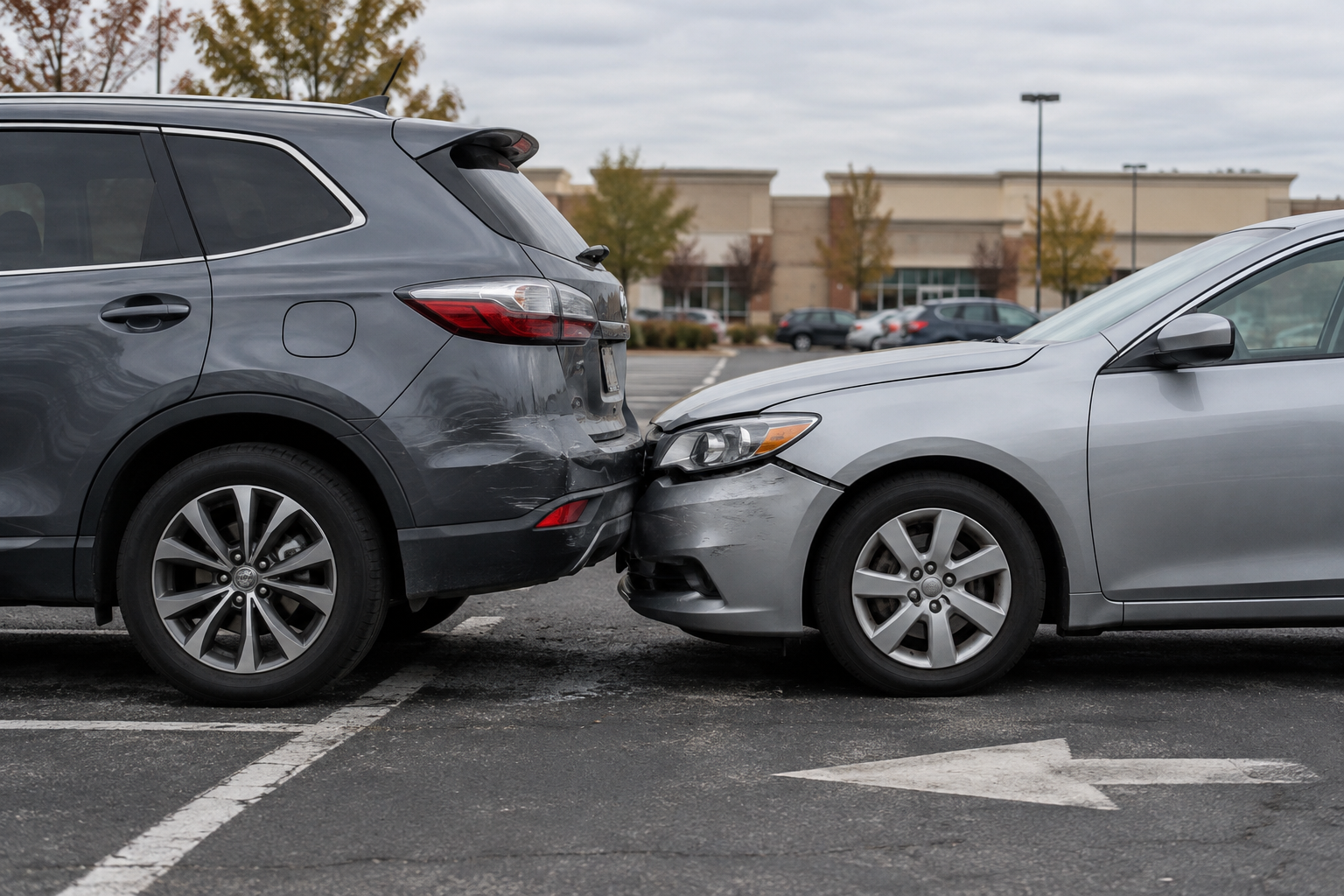
Who is at fault in a parking lot accident? The short answer is: usually the driver who failed to yield or otherwise drove carelessly. A driver leaving a parking space generally must yield to vehicles already traveling in the aisle, but speed, visibility, signs, and each driver’s actions can change the result. Parking lot collisions are not automatically split equally between drivers.
That matters when the other driver says, “It happened on private property, so nobody is responsible,” or an insurer treats a disputed backing accident as an obvious shared-fault claim. You can challenge assumptions with evidence. The goal is to establish the sequence of movements, identify available insurance, and document how the collision affected you.
Below, you’ll find guidance specific to parking lot crashes. For the broader rules, see our guide to how partial fault affects compensation and, if injuries or disputed responsibility are involved, when to consider a car accident lawyer. This is general educational information, not legal advice; laws vary by state, and a licensed attorney can assess your situation.
Keep the evidence about responsibility separate from the records of your losses. You can use the car accident settlement calculator to illustrate medical costs, missed income, and pain-and-suffering assumptions, but it does not decide fault, apply your state’s negligence rules, or check whether insurance is available.
How Is Fault Determined in a Parking Lot Accident?
Fault generally turns on negligence: whether someone failed to use reasonable care and caused the collision and resulting losses. Investigators look beyond who struck whom. They examine who had priority, who needed to yield, whether either driver was distracted, and whether someone had a reasonable opportunity to avoid impact.
As Nolo explains in its parking lot accident overview, insurers investigate driver accounts, witnesses, vehicle damage, photographs, and other evidence. Their conclusions are claim positions, not necessarily the final word if the dispute proceeds to court.
Private property does not erase responsibility
Many parking lots are privately owned. That can affect which traffic laws apply and how police respond, but it does not give drivers permission to ignore safety. Signs, directional arrows, lane design, and ordinary duties to look and yield can all help establish reasonable conduct.
Start by drawing a simple diagram while your memory is fresh. Mark the parking spaces, travel aisles, entrances, arrows, and both vehicles’ paths. Separate what you actually saw from what you inferred. “I saw reverse lights” is different from “the driver must have been looking at a phone.”
Also distinguish responsibility for the collision from the extent of your losses. Proof that the other driver caused the crash does not, by itself, establish every repair expense or injury-related loss. Those require supporting records too.
Who Is at Fault When Backing Out of a Parking Space?
A driver backing from a space generally must check for traffic and yield before entering the aisle. If you were traveling through the aisle and another vehicle reversed into your path, that failure to yield is usually the starting point for the fault analysis.
Justia’s discussion of parking lot claims identifies backing drivers’ responsibility to watch their surroundings and explains why they are often assigned at least some fault. That is a general principle, not a substitute for examining the evidence.
An aisle driver can still contribute to the collision
Having priority does not excuse unsafe driving. Consider a driver who backs out slowly while another vehicle cuts across empty spaces and enters the aisle unexpectedly. Or a driver who approaches too fast to respond to a visible reversing vehicle. Those facts may support shared responsibility.
Useful details include:
- Whether the backing vehicle was still within the space or already occupying the aisle.
- Whether the aisle vehicle followed the marked travel direction.
- Whether either driver stopped before contact.
- Whether parked vans, landscaping, or other obstacles blocked visibility.
- What witnesses actually observed about speed and timing.
Do not rely on a damage photograph alone to prove the entire sequence. A dent on a rear corner can be consistent with more than one account. Pair damage images with vehicle positions, footage, or an independent witness statement.
If you pulled forward out of a space rather than reversing, the basic issue is similar: you generally still need to yield before entering the travel aisle.
Are Parking Lot Accidents Always 50/50 Fault?
No. Equal fault is not a universal parking lot rule. One driver may bear responsibility, both may share it unequally, or the evidence may leave a genuine dispute. An insurer should identify the conduct and evidence supporting its assessment rather than rely only on the location of the accident.
When two cars back out at the same time
Both drivers have duties to look and proceed carefully. But “both were backing” does not establish that both contributed equally. The timing matters: did one driver stop while the other continued, or did one vehicle enter the aisle substantially earlier?
Say you reverse partway out, notice a vehicle behind you, and stop. The other driver continues reversing into you. Evidence of your stop could materially change the assessment. Your account is stronger if footage or a witness establishes when you stopped and what happened afterward.
Shared responsibility also affects recovery differently depending on state law:
- Pure comparative negligence: Recovery generally decreases according to your share of fault.
- Modified comparative negligence: Recovery may be barred once your responsibility reaches the state’s threshold.
- Contributory negligence: In some jurisdictions, contributing fault can generally bar recovery, subject to applicable exceptions.
If an adjuster assigns you a share of blame, request the explanation in writing. Ask what evidence supports it and whether additional footage or witness information would change the decision. If you were injured, you can request a free case evaluation to discuss the disputed assessment with a participating attorney.
Right of Way in Parking Aisles, Turns, and Other Common Crashes
Parking lots often combine narrow parking aisles with larger lanes connecting entrances and exits. A vehicle entering a main travel lane from a smaller aisle generally needs to yield, but signs and the actual layout matter. Do not assume every wider strip of pavement has legal priority.
Turning into the same parking space
Two drivers competing for one space can produce conflicting accounts. A driver turning left across an approaching vehicle’s path generally must yield. Still, the analysis should consider each vehicle’s position, direction, and movements—not simply who signaled or spotted the space first.
Photograph the approach from both directions and note whether one vehicle had already entered the space. Our article on left-turn fault and right-of-way evidence explains the broader turning principles.
Rear-end collisions in a travel aisle
A following driver generally must leave enough room to stop when the vehicle ahead pauses for pedestrians, traffic, or a parking space. But a claim that the front vehicle reversed creates a different factual question. Rear-end damage alone may not settle that dispute; footage showing movement immediately before impact can be especially valuable.
A moving vehicle hits a parked car
The moving driver is ordinarily the focus when a properly parked, stationary car is struck. If the other driver claims your parking position contributed, ask them or their insurer to explain how it caused the collision.
A crooked parking position or parking-rule violation does not automatically establish responsibility for the impact. Photographs showing the space boundaries, aisle clearance, and vehicle position help distinguish an actual obstruction from an unsupported accusation.
What Evidence Proves Fault in a Parking Lot Accident?
Parking lot evidence can disappear quickly. Vehicles move, shoppers leave, and surveillance systems may overwrite recordings. Once everyone is safe, concentrate on documenting the scene and finding evidence you cannot recreate later.
Take wide photographs before close-ups, when safe. Capture both vehicles in relation to the parking spaces and aisle. Then photograph damage, debris, signs, arrows, sight obstructions, and the approach each driver used. Never stand in moving traffic to get a better angle.
Request surveillance preservation promptly
Look for cameras on stores, garages, entry gates, and nearby buildings. Ask management whether footage may cover the collision and request that the relevant time period be preserved. Give the date, approximate time, exact location, and vehicle descriptions; allow for possible differences between camera time and actual time.
A business may not release footage directly to you. Keep the manager’s contact information and a copy of your preservation request so an attorney or insurer can follow up. Do not assume your request guarantees that footage will be retained or produced.
For witnesses, collect contact details and ask what they saw before impact—not merely what they heard afterward. Someone who watched one car stop may offer more useful information than someone who only saw the final positions.
Preserve original files, including dashcam recordings, rather than keeping only edited clips or screenshots. Write down your own account promptly, noting uncertainty where appropriate. Honest limits make your statement more useful than a detailed reconstruction presented as direct observation.
What to Do After a Parking Lot Collision When You Are Hurt
Check for immediate danger and call emergency services if someone needs urgent help. Follow instructions about moving vehicles and obtaining assistance. If you have health concerns after the crash, see a qualified medical provider rather than judging your condition from how little damage you can see.
Exchange identifying, vehicle, and insurance information. Also record the parking lot’s address and the nearest store, entrance, or parking row. A large shopping center’s street address alone may not tell an investigator where the impact occurred.
Reporting the crash on private property
Contact the appropriate police line and ask about reporting requirements. Officers may not respond to every minor private-property collision, and reporting rules differ by jurisdiction. If officers do not attend, ask whether you should submit a separate report and keep any incident or reference number.
A store security report can provide additional documentation, but it is not necessarily a substitute for a required official report. Request instructions for obtaining a copy, and keep the employee’s name or department.
Notify your insurer promptly under your policy’s requirements. Give a factual account without guessing about speed, distances, or injuries you cannot assess. If you later remember something significant, explain the correction rather than silently changing your account.
Begin a separate folder for medical records, bills, work absences, repair estimates, and communications. Record the date and purpose of each expense. This helps you explain your losses without trying to reconstruct weeks of appointments and missed work from memory. For general post-crash questions, see the car accident FAQ.
Insurance Claims and Compensation After a Parking Lot Crash
The fact that a crash happened in a parking lot does not ordinarily remove your insurance options. As Nolo’s parking lot claims guidance explains, claims may involve your own coverage or the responsible driver’s insurance. The available payment route depends on coverage, state law, and the facts.
The other driver’s liability coverage may pay covered losses if responsibility is established. Your own collision coverage, if purchased, may provide a route for vehicle repairs while fault remains disputed, subject to policy terms and a deductible. Your insurer may pursue reimbursement afterward, but deductible recovery is not guaranteed.
For injury expenses, ask your insurer whether medical payments coverage or personal injury protection applies. If the other driver has no insurance or leaves unidentified, ask about uninsured motorist coverage. Injury and property-damage protections can differ; do not assume a hit-and-run is covered under every policy.
Match each requested payment to documentation
Organize losses by category:
- Medical expenses: Keep bills, payment statements, and relevant treatment records.
- Lost income: Preserve employer confirmation, missed-work dates, and earnings documentation.
- Vehicle damage: Keep estimates, inspection photographs, repair invoices, and towing receipts.
- Transportation expenses: Save rental receipts and correspondence about authorization and limits.
- Daily limitations: Make factual notes about activities affected by the injury, without exaggeration.
If your car cannot be used, ask about payment before committing to an extended rental. Our guide to who pays for a rental after an accident explains that separate issue.
Low visible damage does not resolve every question about an injury claim. Medical documentation and the circumstances still matter. Before accepting a settlement, understand whether the release addresses property damage only or also injury claims. If you are unsure what you would be giving up, have a licensed attorney review it.
Disputed Fault, Unsafe Lot Conditions, and Claim Deadlines
When an insurer disputes your account, identify the precise disagreement. Is it claiming you were moving, ignoring an arrow, or entering from a parking space? Send evidence addressing that point, along with a short explanation of what the evidence shows. A focused response is more useful than repeatedly insisting the other driver was wrong.
Keep a communication log with dates, claim numbers, requested documents, and promised follow-up. If payment is denied, request a written explanation identifying the basis for the denial. Distinguish a liability dispute from a coverage issue: the next steps may differ.
When the parking lot owner may be involved
Dangerous property conditions can sometimes contribute to a collision. Examples worth investigating include obstructed sightlines, inadequate lighting, or confusing traffic controls. TORKLAW’s parking lot overview discusses potential claims against a property owner when unsafe conditions contributed to the accident.
A difficult layout alone does not prove owner liability. Document the specific condition, its role in the collision, and who owned or maintained the area. An attorney can assess applicable duties and whether evidence of notice or maintenance history is needed.
Do not wait for negotiations to address timing
Insurance notice requirements, evidence preservation, and lawsuit filing deadlines are separate concerns. Do not assume an open claim or continuing discussions extend the statute of limitations. Ask a licensed attorney which deadlines apply, especially if more than one potentially responsible party is involved.
You can find a car accident lawyer by state for state-specific assistance. Bring the written fault assessment, policy correspondence, scene evidence, and injury records so the conversation can focus on the actual dispute.
Parking Lot Surveillance Preservation Checklist
- Identify the store, garage operator, or property manager responsible for each visible camera.
- Record the collision date, approximate time, parking row, and nearest entrance.
- Provide vehicle colors and descriptions without speculating about fault.
- Ask that footage from before and after the collision be preserved, allowing for camera-clock differences.
- Send a written follow-up and retain a copy with the recipient’s contact details.
- Ask how your insurer or attorney can request access to retained footage.
- Preserve your own original dashcam files separately from any clips you share.
Evidence for Disputed Parking Lot Movements
| Disputed point | Useful evidence | Where to look | Limitation to remember |
|---|---|---|---|
| One car stopped before impact | Continuous video or an eyewitness account | Dashcams, businesses, nearby drivers | A still photo rarely establishes when the stop occurred |
| A driver traveled against an arrow | Scene photographs and approach footage | Pavement markings, entrance cameras | Show whether the marking was visible from the driver’s approach |
| A parked vehicle blocked visibility | Driver-height scene photographs | Both vehicles’ approach paths | Conditions may change when other vehicles leave |
| A vehicle cut across spaces | Wide-angle surveillance or an independent witness | Storefront cameras, shoppers | Damage alone may not establish the earlier travel path |
| Poor lighting contributed | Photographs under comparable conditions and maintenance information | Property manager, scene documentation | A dark photograph alone does not establish legal responsibility |
Questions for a Parking Lot Injury Claim Evaluation
- Which specific facts could change the insurer’s fault assessment?
- Does the evidence distinguish a stopped vehicle from one still reversing?
- What state fault rule applies, and how might it affect recovery?
- Who should receive a request to preserve surveillance or maintenance records?
- Which of my insurance coverages might apply while responsibility is disputed?
- Is there evidence supporting investigation of the property owner’s role?
- Which reporting, policy-notice, and lawsuit deadlines need attention?
- Would a proposed release settle only vehicle damage or also my injury claim?
- If representation is offered, what fees and costs would apply?
Request a Free Case Evaluation for Your Parking Lot Injury Claim
If you were injured and fault is disputed, you do not need to resolve every unanswered question before seeking an evaluation. Start with what you have: the collision date and location, insurance information, photographs, and a brief description of your treatment and the insurer’s response.
Free Case Evals is not a law firm. It is a free service that connects people injured in motor vehicle accidents with participating attorneys for a free case evaluation. An evaluation does not guarantee representation, compensation, or a particular result.
You can connect with a participating attorney for a free evaluation to discuss the backing sequence, missing camera footage, shared-fault allegations, or other issues affecting your claim. Ask about applicable deadlines and what additional evidence would be most useful. If you later consider hiring an attorney, discuss representation terms and any fees or costs directly with that attorney.
Sources
- Parking Lot Accidents - Determining Fault & Getting Legal Help | TORKLAW
- Who Is at Fault for a Parking Lot Accident?
- Parking Lot Car Accidents & Potential Legal Claims | Car Accidents Legal Center | Justia
Sources consulted 2026-10-27. This is not an attorney-review date.
Printable Checklists From This Article
Frequently Asked Questions
Can I make a parking lot accident claim without a police report?
A missing police report does not automatically prevent a claim. Insurers can consider photographs, witness accounts, video, and other records, but you should still check and follow applicable reporting requirements.
Does using a backup camera mean I am not at fault?
Using a backup camera does not by itself establish that you exercised reasonable care. Investigators still consider whether you checked your surroundings, yielded when necessary, and responded to visible hazards.
Is an insurance company's parking lot fault decision final?
An insurer’s assessment is not necessarily the final legal determination. Additional evidence may support reconsideration, and an unresolved dispute may require legal proceedings.
Can a passenger claim compensation after a parking lot collision?
An injured passenger may have a claim involving one or more responsible drivers, depending on the facts and applicable insurance. Preserve information for both vehicles and discuss available payment routes with a licensed attorney.
Does no-fault insurance mean no one is responsible for a parking lot crash?
No-fault insurance generally concerns how certain injury benefits are paid, not whether a driver caused a collision. Property-damage claims and the ability to pursue additional injury compensation depend on state law and policy terms.
What if the other driver changes their story after a parking lot accident?
Preserve earlier messages, statements, photographs, and any witness contact details. Give the insurer a factual explanation of the inconsistency and the evidence supporting your account, rather than speculating about the driver’s motives.
Does a parking lot accident ticket prove who is liable?
A citation can be relevant evidence, but it does not necessarily resolve civil liability by itself. The underlying conduct, applicable law, and other evidence still need to be evaluated.
Should I accept cash at the scene for a parking lot accident?
An immediate cash offer may not account for damage or injury-related losses that have not yet been evaluated. Document the incident, comply with reporting obligations, and understand any release before agreeing to settle.
This article is for general informational purposes only and is not legal or medical advice. Laws vary by state. Speak with a licensed attorney about your specific situation.
Hurt in a car accident?
Answer a few quick questions to see if you may qualify for a free case evaluation. No cost, no obligation.
Start My Free Case Evaluation